
Halal certification is mandatory for food products sold in Indonesia, but the deadline depends on the size of the business. For food businesses, the latest rules decide when a product must be certified by the Halal Product Assurance Organizing Agency (BPJPH) and what to prepare.
This article covers the definition, legal basis, which products and businesses must be certified and by when, the parties involved, application routes, benefits, and post-certification duties.
What Is Halal Certification?
Halal certification is the process of inspecting a product and formally determining that its ingredients and production process meet halal requirements under Islamic law. A product that meets those requirements receives a halal certificate from BPJPH.
The inspection covers both ingredients and the Halal Product Process (PPH). PPH is the series of activities that ensure a product stays halal, including material supply, processing, storage, packaging, distribution, sale, and serving.
At a bakery, for example, the inspection checks ingredients such as flour, eggs, butter, and flavorings along with the mixing and baking of the dough.
Legal Basis for Halal Certification in Indonesia
The legal basis for halal certification in Indonesia is Law No. 33 of 2014 on Halal Product Assurance (UU 33/2014). Its implementing rules are now set out in Government Regulation No. 42 of 2024 (PP 42/2024), which replaces Government Regulation No. 39 of 2021.
The core rule requires products that circulate or go on sale in Indonesia, including imports, to hold a halal certificate. Products made from prohibited (haram) materials fall outside this duty, but the business must label them as non-halal.
Products and Businesses That Must Be Halal Certified
Products that must be halal certified include food, beverages, medicines, cosmetics, chemical products, biological products, genetically engineered products, and consumer goods. The obligation applies to micro, small, medium, and large businesses as well as imported products, with a different deadline for each group.
The schedule for food is set in Article 160 of PP 42/2024. Ahead of the October 18, 2026 deadline, the government announced an extension through an amendment to that regulation, covering micro and small businesses and other groups in the table below.
| Product and business group | Obligation takes effect |
|---|---|
| Food, beverages, slaughtered products, and slaughtering services from medium and large businesses | October 18, 2024 |
| Food, beverages, slaughtered products, and slaughtering services from micro and small businesses | October 18, 2028 (previously October 18, 2026) |
| Imported food, beverages, slaughtered products, and slaughtering services | October 18, 2028 |
| Services related to food, beverages, and slaughtered products, other than slaughtering services | October 18, 2028 |
Medium and large businesses have had to hold halal certificates since October 18, 2024, and the extension announcement mentions no change for them. For imported products, the 2028 deadline is in line with the completion of mutual recognition agreements for halal certificates between countries.
Natural medicines, health supplements, cosmetics, chemical products, genetically engineered products, and some consumer goods were also extended to October 17, 2028. The schedule above follows the announcement as of October 21, 2026, so check the official text of the amending regulation once it is published.
Parties Involved in Halal Certification
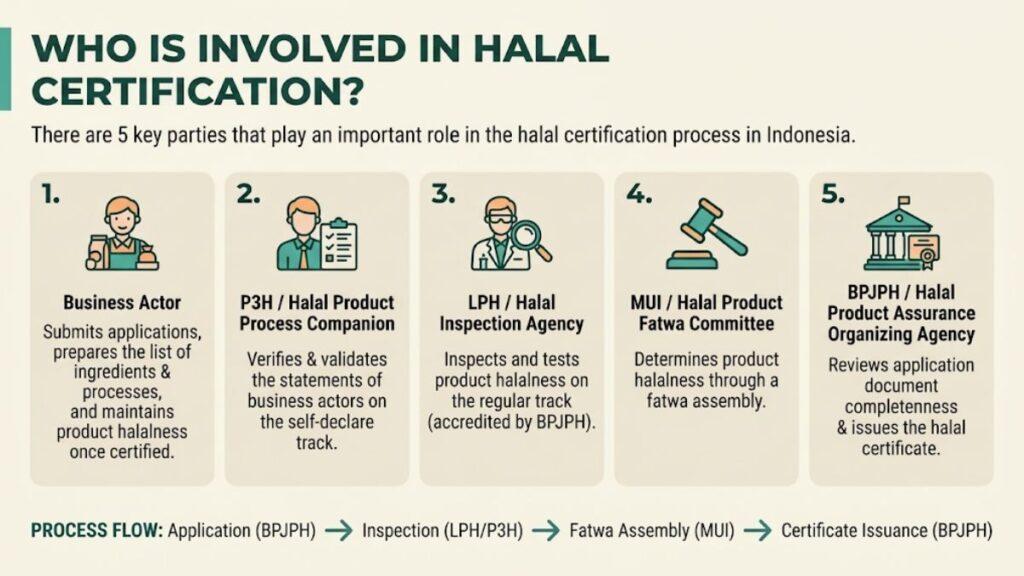
Halal certification involves five parties, namely BPJPH, Halal Inspection Agencies (LPH), the fatwa-issuing body, Halal Product Process Assistants (P3H), and business operators.
| Party | Role in the process |
|---|---|
| BPJPH | Checks that application documents are complete and issues the halal certificate |
| Halal Inspection Agency (LPH) | Inspects and tests the halal status of products on the regular route, and is accredited by BPJPH |
| Indonesian Ulema Council (MUI) or the Halal Product Fatwa Committee | Determines the halal status of a product through a fatwa session |
| Halal Product Process Assistant (P3H) | Verifies and validates the business operator’s statement on the self-declare route |
| Business operator | Submits the application with the ingredient list and processing steps, then keeps the product halal after the certificate is issued |
The process starts with an application to BPJPH, moves through LPH inspection or P3H assistance and a fatwa session, and ends when BPJPH issues the certificate.
During inspection or assistance, the LPH or P3H assesses your ingredient list and production process. For that reason, gather ingredient documents from your suppliers before you apply.
Regular and Self-Declare Routes in Halal Certification
Businesses can take the regular route, which involves LPH inspection, or the self-declare route, a halal statement made by the business itself with P3H assistance. Medium and large businesses use the regular route.
The self-declare route is open only to micro and small businesses, under Article 98 of PP 42/2024. The requirements are that the product poses no halal risk or uses ingredients already confirmed halal, and that the production process is halal and simple.
Benefits of Halal Certification for Food Businesses
Halal certification gives food businesses two direct benefits, namely legal certainty to sell their products and proof of halal status that they can show to buyers.
Legal Certainty for Products on the Market
Under the law, a certified product meets the requirement to circulate, so the business can sell it without breaching the certification obligation.
Proof of Halal Status for Buyers and Export Markets
Muslim consumers can recognize a certified product by the Indonesian Halal Label on the packaging, without asking the seller about ingredients. Hotels and caterers sell food that must also be halal certified, so they need assurance that the ingredients they buy are halal.
For export markets, each destination country decides which halal proof it accepts, so a BPJPH certificate may not be enough in every market.
Also read: Halal Certification for Export: Why It Matters for Food Products
Business Duties After the Halal Certificate Is Issued
After BPJPH issues the certificate, business operators must consistently keep their products halal through the Halal Product Assurance System (SJPH). SJPH is an integrated system that governs ingredients, production processes, resources, and work procedures to keep products halal continuously.
Article 51 of PP 42/2024 sets five duties for certified business operators.
- Display the Indonesian Halal Label on certified products
- Keep certified products halal
- Separate the locations, premises, and equipment for halal and non-halal products, from slaughter to serving
- Update the certificate if the ingredient composition and/or the Halal Product Process (PPH) changes
- Report changes in ingredient composition and/or PPH to BPJPH
For that reason, record every ingredient substitution or recipe change, then file the report and certificate update with BPJPH.
Conclusion
Halal certification is an official requirement for products sold in Indonesia, with deadlines that differ by business size and product type. Medium and large businesses have been required to certify since October 2024, while micro and small businesses have until October 2028.
Start by choosing the application route that fits your business and collecting halal documents from every ingredient supplier. Once you hold a certificate, record every change in ingredients and recipes, because you must report any change in composition.

FAQ
Do You Have to Pay for Halal Certification?
Yes, the business bears the certification fee (Article 102 of PP 42/2024), but micro and small businesses can apply at no cost through BPJPH’s Free Halal Certification program (SEHATI). The program quota can change under implementing rules, so check availability when you register.
Do Ingredients from Suppliers Also Have to Be Halal?
Yes, the ingredients you use must be guaranteed halal, and the ingredient list is part of the application documents. For that reason, collect halal documents from every supplier and confirm that their halal certificates are valid before you apply.
What Is a Halal Supervisor?
A halal supervisor (penyelia halal) is the person responsible for the Halal Product Process (PPH), according to Article 1 point 19 of PP 42/2024.
What Is the Difference Between a Halal Certificate and the Halal Label?
A halal certificate is the recognition of a product’s halal status issued by BPJPH, while the Halal Label is the mark placed on a certified product. Displaying the Halal Label is one of the duties of a business after the certificate is issued.
Should Micro and Small Businesses Get Halal Certified Now?
Yes, it is better to start now. The deadline for micro and small businesses has only moved to October 2028, and an issued certificate can serve as proof of halal status for buyers right away.