
Picture a small bakery that just switched from fresh eggs to egg powder for its cake batter. The moment the powder hits the water, some of it just sits at the bottom of the bowl and refuses to dissolve.
That kind of problem isn’t random. Egg powder solubility depends heavily on how the liquid egg was dried in the first place.
A 2022 study in Frontiers in Nutrition on salted duck egg white protein powder found that solubility, foaming, and emulsification all dropped after drying, with spray-dried samples losing the most solubility because of the higher heat involved. Protein structure is what drives this drop, and it’s exactly why egg powder solubility can swing so much between products made with different methods.
This article looks at how drying methods affect egg powder solubility, covering the mechanism behind it and how manufacturers can pick the right method for their needs.
What Does Egg Powder Solubility Actually Mean?
Egg powder solubility is the ability of its protein to dissolve back into water after drying. The higher the solubility, the more evenly the powder mixes without clumping or settling at the bottom.
This matters because egg powder gets reconstituted into liquid form across a lot of food products. Cakes, noodles, and bread all need fully dissolved egg powder to keep their texture consistent.
Solubility is usually measured as the percentage of protein that re-dissolves compared to the total protein in the sample. That number drops fast once the protein has coagulated during drying.
How Is Egg Powder Solubility Measured?
The standard approach dissolves a sample of egg powder in water, then spins it in a centrifuge. The dissolved portion is separated from the sediment, and nitrogen content in each part is measured with the Kjeldahl method, following the protocol used by the Frontiers in Nutrition study mentioned earlier.
Nitrogen in the dissolved fraction is then compared against nitrogen in the original solution before centrifuging. The resulting percentage is the solubility value, and a higher number means better performance in food applications.
This lab based test gives an objective way to compare drying methods side by side. It’s a lot more reliable than just eyeballing how well a powder dissolves in a glass of water.
Why Does the Drying Method Change Solubility?
The short answer is heat. Heat applied to egg protein during drying triggers denaturation, where the protein’s folded structure opens up and loses its original shape.
Once denaturation goes far enough, protein molecules start binding to each other and form clumps that no longer dissolve well in water. The same Frontiers in Nutrition study on egg protein powder traced this drop directly to heat exposure during drying, noting that hydrophobic groups normally hidden inside the protein get pushed to the surface and lose their ability to bond with water.
So the hotter and longer the drying process runs, the greater the risk of protein damage and dropped solubility. Here are the three drying methods most commonly used for egg powder and how each one affects the outcome.
1. Spray Drying
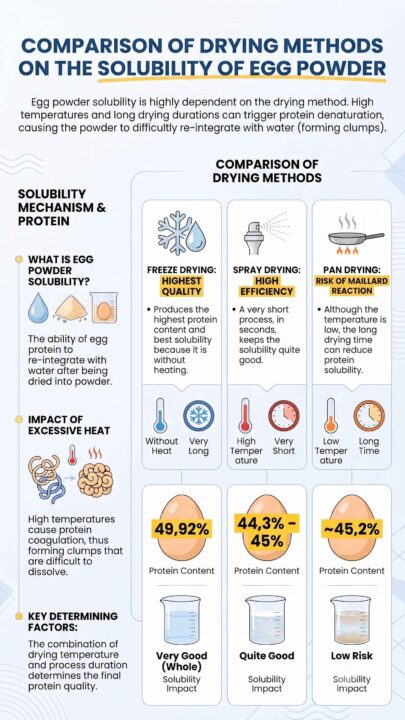
Spray drying atomizes liquid egg into fine droplets and sprays them into a chamber of hot air, drying them almost instantly. According to the Frontiers in Nutrition study on egg white protein powder, samples dried this way (at an inlet temperature around 180°C) showed the lowest solubility among the drying methods tested.
The very short contact time helps limit protein damage compared to slower high-heat methods. But the intense heat still unfolds protein molecules and exposes their hydrophobic groups, which weakens their interaction with water and drags solubility down.
2. Pan Drying (Oven Drying)
Pan drying spreads a thin layer of liquid egg on a flat surface and dries it at a lower temperature than spray drying. The lower heat sounds gentler, but the process takes much longer to finish.
That extended exposure time opens the door to the Maillard reaction between protein and reducing sugars, which changes the color, aroma, and ultimately the solubility of the egg protein. Time turns out to matter just as much as temperature here.
3. Freeze Drying
Freeze drying dries egg protein while it’s still frozen, removing water through sublimation instead of heat. Because there’s no real heat involved, the protein structure stays largely intact.
In the same Frontiers in Nutrition comparison, freeze-dried samples consistently kept the highest solubility, foaming, and emulsifying properties of the three methods studied. The tradeoff is a much longer processing time and a lot more energy use than spray drying or pan drying.
Comparing the Three Drying Methods
Each method has its own strengths and weaknesses depending on what a manufacturer prioritizes. The table below sums up how they stack up on heat exposure, processing time, and solubility outcome.
| Method | Heat Exposure | Processing Time | Effect on Solubility |
|---|---|---|---|
| Spray Drying | High temperature, very brief contact | Seconds | Lowest solubility among the three |
| Pan Drying | Lower temperature, long exposure | Hours | Solubility risk from Maillard reaction |
| Freeze Drying | No real heat, sublimation-based | Very long | Best preserved solubility |
This comparison shows that processing time matters just as much as peak temperature. Pan drying proves that even a lower temperature can hurt solubility if the process drags on too long.
Other Factors That Affect Solubility
Drying method isn’t the only variable at play here. A couple of other factors quietly shape the final solubility number too.
Leftover fat from the egg yolk can oxidize and alter protein structure, pulling solubility down even further. Storage conditions after drying matter too, since moisture reabsorption can trigger further chemical reactions in protein that’s already dried.
How to Choose the Right Drying Method
Picking a method should come down to what the final product needs, not just which process is easiest to run. Here are four things worth weighing before settling on a drying method.
- Production scale: Spray drying suits large volumes best because it’s fast and produces a consistent output.
- Energy budget: Freeze drying gives the best solubility, but its energy costs run far higher than the other two methods.
- End use of the product: Applications that need strong emulsifying or foaming properties, like baked goods, should avoid excessively high or prolonged heat exposure.
- Shelf life: Spray drying’s low final moisture content helps extend shelf life, even with some tradeoff in functional protein properties.
Conclusion
Drying method isn’t just a way to turn liquid egg into powder, it’s a key variable that determines how well the final product dissolves. Spray drying wins on speed, pan drying is easy to run with basic equipment, and freeze drying remains the best choice for keeping protein structure fully soluble.
All three come with a tradeoff between processing efficiency and functional protein quality. Understanding this tradeoff matters for anyone relying on egg powder as a raw material, from small food producers to large scale manufacturers.
For businesses that need egg powder with consistent solubility and reliable quality, sourcing from a supplier that follows the right processing standards is a good first step. Accelist Pangan Nusantara supplies egg powder for both home-scale and industrial food production.
If you’re looking for an egg powder supplier with consistent quality and solubility for your production line, feel free to contact us to discuss your egg powder needs.

FAQ
No. Solubility depends on the drying method and storage conditions, so two egg powder products can have very different solubility even if they came from the same eggs.
Freeze drying generally gives the best solubility because it involves the least heat exposure, though it comes with a much higher processing time and cost.
Clumping usually means the protein has coagulated due to excessive heat or an overly long drying process.