

Packaging’s role in cross-contamination often goes unnoticed, even though packaging is the last line of defense before a product reaches the consumer. A packaging failure can undo every quality control effort made earlier in production.
According to AIB International, a packaging failure can bypass every upstream quality control already applied during production, raising the risk of a product landing in the highest recall classification. Under FSMA in the United States, manufacturers are even required to evaluate packaging-related hazards, such as foreign material, chemical migration, and seal failure, as part of their hazard analysis.
This article covers packaging’s role in cross-contamination, from the mechanisms behind packaging failure to how to choose the right packaging. You will also find out why powdered products like egg powder are more vulnerable to this risk.
What Is Cross-Contamination in the Context of Food Packaging?
Cross-contamination in the context of packaging refers to the transfer of a hazard, whether microbial, allergenic, or chemical, from outside the packaging into the product due to a failure in the packaging’s function as a barrier. This differs from contamination that occurs during production itself, since the source here comes from outside the packaging after the product has already been packed.
How Can Packaging Prevent or Trigger Cross-Contamination?
Packaging works as a physical barrier that cuts off the path of contamination from the outside environment to the product inside. Here are four mechanisms that determine whether packaging succeeds in preventing cross-contamination or ends up causing it.
- Seal integrity that keeps microbes, dust, and moisture from entering through the packaging
- Moisture vapor transmission rate (MVTR) and oxygen transmission rate (OTR), which determine how effectively packaging keeps internal conditions stable
- Choosing a packaging material that isn’t porous and doesn’t react with the product inside
- Proper handling of packaging during storage and distribution to avoid physical damage
What Types of Packaging Failure Can Trigger Cross-Contamination?
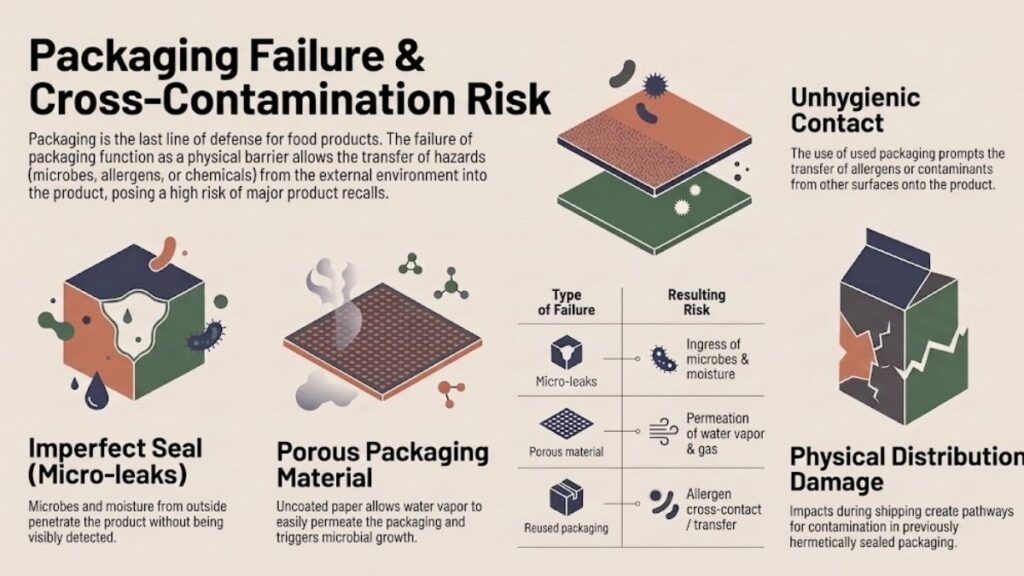
Packaging failure isn’t always visible to the naked eye, which makes it important to recognize the specific types. Here is a breakdown of the most commonly found failures.
| Type of Failure | Resulting Risk |
|---|---|
| Imperfect seals (micro-leaks) | Microbes and moisture from outside can enter undetected |
| Porous packaging material, such as paper without a protective coating | Moisture vapor and gas can pass through the packaging easily, triggering microbial growth |
| Packaging reused or exposed to an unhygienic surface | Allergens or contaminants from other products or surfaces can transfer over |
| Physical damage during distribution | Opens a contamination pathway that was previously sealed off |
These four failure types can occur separately or together, depending on material quality and how the packaging is handled across the supply chain. The more of these failures that occur, the greater the risk of cross-contamination in the final product.
Why Are Powdered Products Like Egg Powder More Vulnerable to Cross-Contamination Through Packaging?
Powdered products are hygroscopic, meaning they easily absorb moisture from the surrounding air the moment their protective packaging stops functioning. The damp condition that results from this failure creates an environment that supports microbial growth and clumping in powdered products.
Egg powder specifically also carries a risk of Salmonella contamination if the packaging fails to keep it dry and tightly sealed. This is why packaging for powdered products like egg powder ideally needs a stricter moisture and oxygen barrier than food products in general.
Read also: HACCP: How Food Suppliers Keep Safety Consistent
Tips for Choosing Packaging That Reduces Cross-Contamination Risk
Choosing the right packaging is a far more effective prevention step than dealing with contamination after it happens. Four tips below help you minimize this risk.
1. Choose Packaging With Low Moisture and Oxygen Transmission Rates
Use packaging with low MVTR and OTR, such as foil-laminated packaging or multi-layer film. Good barrier properties help keep the internal condition of the packaging stable even over long storage periods.
2. Test Seal Strength Before Distribution
Run seal strength tests, such as tensile testing or immersion testing, before packaging is distributed at scale. This testing helps catch a potential seal failure before the product reaches the consumer.
3. Avoid Reusing Packaging Across Different Products
Use new packaging for every product batch, especially if the packaging previously came into contact with a product containing a different allergen. This practice prevents allergens or contaminants from transferring between products.
4. Inspect Packaging Condition Regularly During Storage
Carry out routine visual checks on packaging kept in the warehouse to catch physical damage as early as possible. Damaged packaging should be set aside immediately so it doesn’t contaminate other products nearby.
Conclusion
Packaging’s role in cross-contamination comes down to its ability to maintain seal integrity and its barrier properties against moisture, oxygen, and microbes. A failure in any one of these aspects can open a contamination pathway that production had otherwise successfully prevented.
Powdered products like egg powder need extra attention because of their hygroscopic nature and their vulnerability to microbial growth once packaging stops functioning properly. Choosing the right packaging and testing its strength regularly is an important step in keeping a product safe all the way to the consumer.
For culinary businesses or food manufacturers that need raw material packaged to guard against cross-contamination, Egg Powder from Accelist Pangan Nusantara is packaged to a standard that keeps product integrity intact all the way to your hands. Contact Us for product information and to discuss your business’s egg raw material needs.

FAQ
Cross-contamination results from a hazard transferring in from another source, while regular contamination can originate from the production process itself.
A seal failure can be detected through tensile testing, immersion testing, or physical signs such as packaging that has swollen or is leaking.
No, since a more porous packaging material like uncoated paper tends to carry a higher risk than foil-laminated or multi-layer film packaging.
It’s best not to, since even minor damage can become an entry point for contamination that isn’t visible to the eye.
Because their hygroscopic nature makes powdered products absorb moisture and microbes more easily the moment their protective packaging stops functioning.