

International certification challenges are a hurdle food manufacturers run into often when trying to expand into overseas markets, especially when they need to meet HACCP, ISO, and halal certification standards all at once. Each of these three certification types comes with its own process, cost, and level of recognition that varies by destination country.
An academic study published on ResearchGate notes that more than 400 halal certification bodies operate globally, yet many of them still don’t recognize one another. That situation leads to duplicated audits, ballooning compliance costs, and delays in cross-border trade.
This article covers the international certification challenges tied to HACCP, ISO, and global halal that food manufacturers face, from how each standard differs to why one certificate doesn’t automatically work in every country. You will also find ways to handle these challenges so the certification process runs more smoothly.
Why Is International Certification Important Yet Challenging for Food Manufacturers?
International certification is a non-negotiable requirement for food manufacturers who want their products accepted in overseas markets, since many countries require proof of compliance with a specific food safety standard before a product is even allowed in. The challenge arises because every country or region tends to have its own certification body, regulation, and interpretation of the standard, so one certificate is not guaranteed to be accepted in another market.
Comparing HACCP, ISO, and Global Halal Certification Challenges
Each of these three certification types faces a different challenge, even though they all aim to reassure the international market. Here is a comparison of the main challenge behind each one.
| Certification Type | Main Challenge | Example Case |
|---|---|---|
| HACCP | Implementation is interpreted differently from country to country, even though the underlying principles reference the same Codex Alimentarius | An additional audit is still often required when entering a market with stricter regulation, such as the EU or the US |
| ISO 22000 | Proliferation of derivative certification schemes like FSSC 22000, BRC, and SQF, each with its own added requirements | Manufacturers sometimes need to hold more than one scheme to satisfy different buyers’ requirements |
| Global halal | Differing theological and technical standards between certification bodies mean one certificate isn’t automatically recognized in another country | A certificate from Malaysia’s JAKIM isn’t always accepted directly in a market that relies on Indonesia’s BPJPH standard, or vice versa |
All three of these challenges essentially stem from the same underlying issue: the lack of full uniformity and recognition between certification bodies across countries. A manufacturer who understands these differences early on can build a more efficient certification strategy instead of chasing every standard separately.
Why Doesn’t a Halal Certificate Automatically Work in Every Country?
Halal certification is market-by-market, meaning the authority in each destination country decides which certification body it recognizes. A halal certificate from one country is not guaranteed automatic acceptance in another, even between countries with a Muslim-majority population.
A solution a number of countries have started applying is the Mutual Recognition Agreement (MRA), an arrangement that allows a halal certificate from one body to be recognized directly by another without needing recertification. Indonesia itself, through BPJPH, has entered into MRAs with several countries, including South Korea and Italy, as a way to simplify cross-border recognition of halal certificates.
How to Handle International Certification Challenges
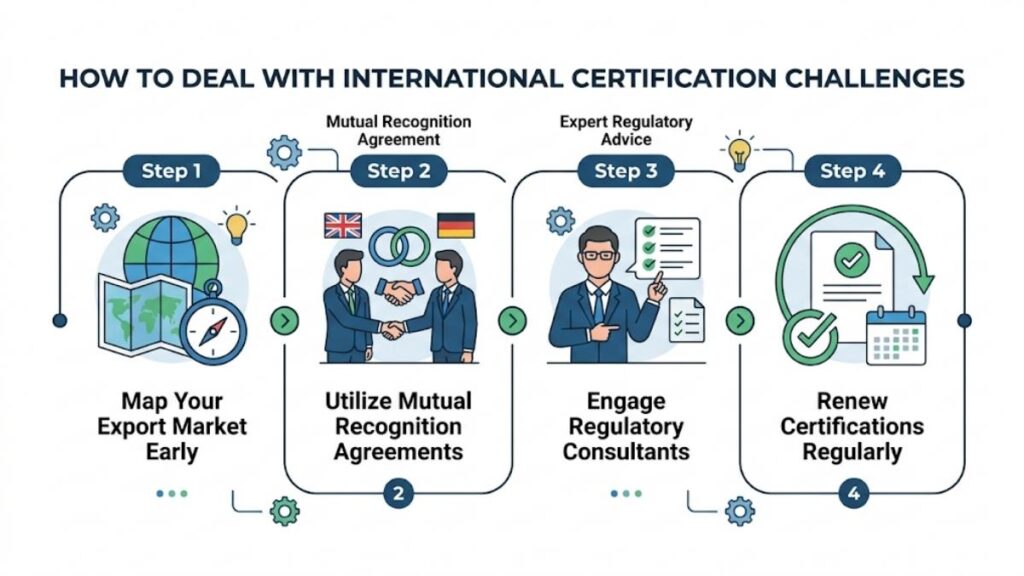
Handling international certification challenges takes a focused strategy, not simply chasing as many certificates as possible. Four methods below can help manufacturers deal with these challenges.
1. Map Your Export Target Markets Early
Identify your export destination countries before deciding which certification to prioritize. This step helps you avoid unnecessary certification costs for a market that isn’t yet a real target.
2. Take Advantage of an Existing Mutual Recognition Agreement
Check whether your destination country already has an MRA with the certification body your business holds. Using an existing MRA can save time and cost compared with applying for a new certification from scratch.
3. Bring In a Consultant Who Understands Local Regulation
Use a consultant or body with specific knowledge of the certification regulations in your destination country. That local understanding speeds up the process while reducing the risk of rejection from a misread standard.
4. Renew Certification Regularly as Regulations Change
Monitor regulatory changes in your export destination countries on a routine basis, since certification standards can shift over time. Timely renewal helps your product keep meeting market entry requirements without a sudden disruption.
Conclusion
International certification challenges tied to HACCP, ISO, and global halal mostly stem from the lack of full uniformity in standards and recognition between certification bodies across countries. This situation means food manufacturers need to understand how each standard differs before deciding on the right certification strategy.
Taking advantage of an existing Mutual Recognition Agreement and mapping target markets early are steps that can save both time and certification cost. A focused strategy helps manufacturers deal with this challenge without having to chase every certification separately and inefficiently.
FAQ
Its underlying principles reference the same Codex Alimentarius, but a number of countries still require an additional audit based on their own local regulation.
All three are food safety certification schemes, but FSSC 22000 and BRC add specific requirements beyond the basic ISO 22000 framework, which is why some buyers only accept a particular scheme.
A Mutual Recognition Agreement is an arrangement between halal certification bodies that allows a certificate from one body to be recognized directly by another without recertification.
Costs balloon because manufacturers often need to hold more than one certification to satisfy buyers in different countries, especially when no MRA exists between the relevant bodies yet.
It’s worth considering early if export is part of the plan, though the priority can be adjusted to whichever target market is most realistically reachable first.