
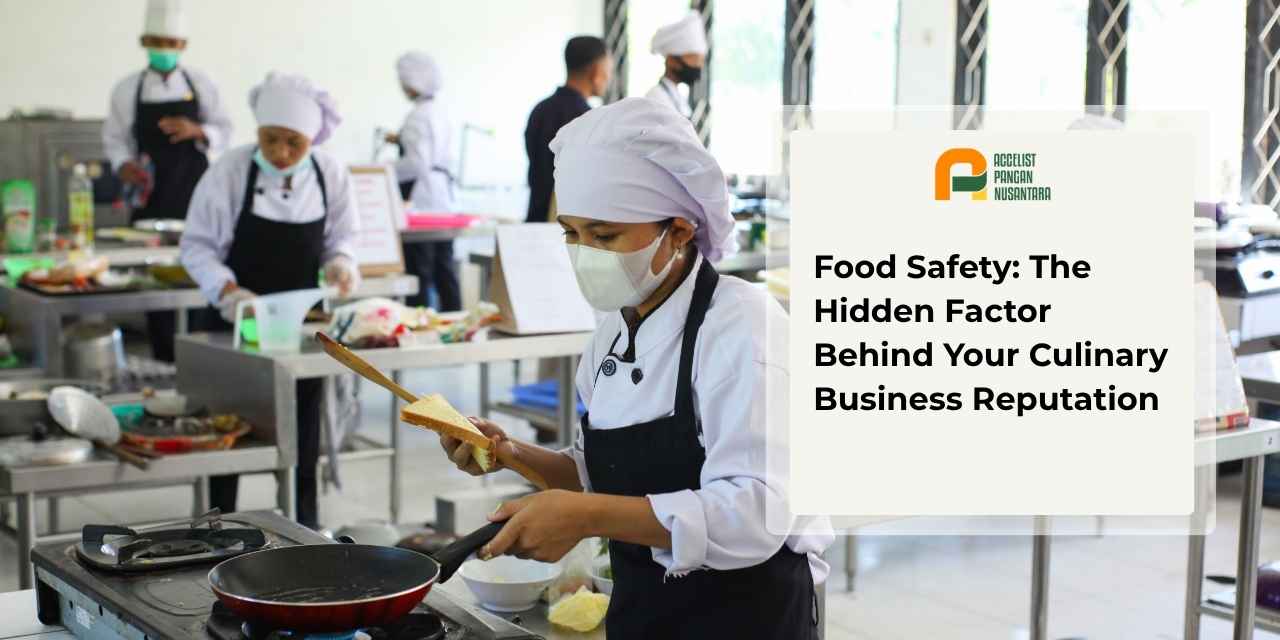
Imagine a catering business receiving a call from a wedding committee, reporting that dozens of guests experienced nausea and diarrhea hours after the reception ended. Within days, negative reviews flood social media and new customers start canceling their orders.
This scenario is not just a hypothetical story. According to the latest World Health Organization (WHO) data released ahead of World Food Safety Day 2026, unsafe food causes around 866 million people to fall ill and 1.5 million deaths every year worldwide, with children under five accounting for nearly a third of all foodborne illness cases.
Risks of this scale often start with small things that go unnoticed, from how raw materials are stored to how they are processed in the kitchen. This is why food safety should never be treated as a mere administrative matter, but as a business strategy that protects both customers and your business reputation.
What Is Food Safety, Exactly?
Food safety refers to the effort of ensuring food is free from physical, chemical, and biological hazards throughout production, processing, storage, distribution, and consumption.
In Indonesia, this obligation is regulated under Law Number 18 of 2012 on Food, which requires every food business operator to guarantee the safety of their products from raw materials to ready-to-consume goods.
Threats to food safety usually come from three different types of contamination sources, each with its own characteristics. Understanding all three helps you recognize vulegnerable points in the kitchen before problems actually occur.
- Physical contamination
Meaning foreign objects such as glass fragments, hair, or metal shavings entering food. For example, eggshell fragments accidentally mixed into cake batter when eggs are cracked manually. - Chemical contamination
Meaning harmful residues such as pesticides, detergents, or heavy metals entering food. For example, leftover dish soap that has not been properly rinsed off cooking equipment before reuse. - Biological contamination
Meaning the presence of pathogenic microorganisms such as Salmonella, E. coli, or viruses that can cause illness. For example, raw eggs with shells contaminated by chicken droppings can introduce Salmonella into batter once cracked.
The Real Impact of Ignoring Food Safety
When food safety standards are not maintained, the impact is not limited to customers who fall ill. Culinary businesses themselves bear losses that are often far greater than the raw material costs they tried to save in the first place.
- Reputational damage
Negative reviews and bad press can spread quickly through social media. A single viral food poisoning complaint can make long-time customers reluctant to return even after the issue has been fixed. - Direct financial loss
Compensation costs, product recalls, and fines become additional burdens beyond daily operations. A restaurant forced to close temporarily for a health authority investigation loses revenue throughout the process. - Legal risk
Negligent business operators can face administrative or criminal sanctions under the Food Law. Business licenses can even be revoked if violations are considered severe or repeated. - Loss of business partner trust
Distributors, malls, or delivery platforms tend to end partnerships with businesses once linked to food safety issues. Losing a single major partner can mean losing access to thousands of potential customers overnight.
The 7 Core Principles of HACCP
Hygiene and good raw material selection alone are often not enough to consistently guarantee food safety, especially at industrial production scale. This is where the HACCP (Hazard Analysis and Critical Control Point) system comes in, with seven principles established by the FDA as a globally adopted reference, including in Indonesia.
1. Conduct a Hazard Analysis
This step identifies physical, chemical, or biological hazards that may arise at every stage of production, from raw materials to the final product. The result helps you know which points carry the highest risk before a hazard actually occurs.
For instance, in egg powder production, one identified hazard is Salmonella contamination on raw eggs before the pasteurization process.
2. Determine the Critical Control Points
Once hazards are identified, determine which points in the production process serve as critical control points, meaning points where a lack of control could lead to serious risk. These points are usually located at the stage most decisive for the safety of the final product.
For example, the pasteurization stage in egg powder production becomes a critical control point because this is where pathogenic bacteria are killed.
3. Establish Critical Limits
Each critical control point requires a measurable limit, such as a specific temperature or time, that must be met for the hazard to be properly controlled. This limit becomes the benchmark for whether the process is running safely.
For example, the pasteurization temperature might be set at a specific level and duration to ensure pathogenic bacteria are fully eliminated.
4. Establish Monitoring Procedures
Monitoring is carried out regularly to ensure each critical control point stays within its established limits. Without monitoring, critical limits remain just numbers on paper with no guarantee of actual implementation.
For instance, operators record the pasteurization machine’s temperature at set intervals throughout the production process.
5. Establish Corrective Actions
If monitoring results show a critical limit has not been met, a clear corrective step must be taken immediately. This action prevents at-risk products from reaching consumers.
For example, if the pasteurization temperature turns out to be below standard, that production batch must be reprocessed or halted before moving to the next stage.
6. Establish Verification Procedures
Verification ensures the entire HACCP system is actually running as planned, not just existing as administrative paperwork. This process can take the form of internal audits or periodic product sample testing.
For example, a company may conduct periodic laboratory testing to confirm the final product is genuinely free of Salmonella.
7. Establish Record-Keeping and Documentation
All monitoring data, critical limits, and corrective actions need to be properly documented as proof that the food safety system is truly being implemented. This documentation is also useful during audits or investigations should a problem ever arise.
For instance, daily pasteurization temperature records are kept for a minimum period according to company policy.
Read also: 7 Ways to Store Eggs Properly to Keep Them Fresh and Safe to Eat
Egg Powder: A Practical Solution to Closing Food Safety Gaps in Raw Egg Materials
Eggs are among the food ingredients most vulnerable to becoming a source of biological contamination, as their shells often carry residual dirt and Salmonella bacteria. This is where Egg Powder from Accelist Pangan Nusantara comes in as an alternative that helps your kitchen close that risk gap without sacrificing the function or flavor of fresh eggs.
Compared to whole eggs in their shells, egg powder offers several practical advantages directly related to food safety principles.
- Free from Salmonella contamination risk, as it is processed through pasteurization and spray drying that kill pathogenic bacteria without damaging its nutrients.
- Longer shelf life, lasting up to one year at room temperature, far more durable than fresh eggs that only last three to five weeks in the refrigerator.
- More consistent production results, as its protein and moisture content stay uniform across every batch, unlike fresh eggs whose size can vary from one to another.
Accelist Pangan Nusantara offers egg powder in several variants, including white, yolk, mix, and salted egg powder, so you can choose the one that fits your kitchen’s needs.
Conclusion
Food safety is not a task that ends once an annual inspection or certification is completed. It is a daily habit that starts with something as small as washing your hands and extends to something as significant as choosing a trustworthy raw material supplier.
Every small choice in the kitchen, including the type of raw materials you use, contributes to whether customers come back or stay away for good. By consistently applying the principles discussed above, contamination risks can be reduced well before they turn into a reputational crisis.
If fresh eggs remain one of the vulnerable points in your kitchen, switching to Egg Powder from Accelist Pangan Nusantara can be a practical step to close that gap without changing the flavor your customers already know. Contact Us to learn more about which egg powder variant best fits your production needs.
FAQ
Food safety focuses on being free from health hazards, while food quality covers taste, texture, and nutritional value.
The government oversees food safety through several agencies, one of which is the National Agency of Drug and Food Control (BPOM) for processed food products.
Yes, because egg powder goes through a pasteurization process that kills pathogenic bacteria such as Salmonella.
A maximum of two hours, after which it should be refrigerated or reheated before serving.