
The functions of eggs in cooking include binding ingredients, thickening, forming foam, emulsifying, adding color, and adding flavor. One ingredient does the work of several, which is why eggs appear in croquettes, mayonnaise, brownies, and custard.
For cafes, bakeries, and caterers, understanding these functions helps match the right part of the egg to each menu item. Picking the wrong part changes the texture, volume, and color of the result right away.
This article explains why eggs are so versatile, walks through their eight functions, and shows how to choose between egg white and yolk. It also gives examples from Indonesian and world cuisines.
Why Are Eggs Called the Most Versatile Ingredient?
Eggs are called versatile because the white and the yolk have different properties, and those properties change with heat, whipping, and the other ingredients in the mix. This is why a single egg can act as a binder, a thickener, a leavening aid, or an emulsifier.
Egg white is rich in protein that traps air and firms up when heated. Egg yolk contains fat and lecithin that bring oil and water together, and it also adds a savory flavor and a yellow color.
That is why the outcome of a dish depends on which part of the egg you use and how you handle it.
8 Functions of Eggs in Cooking, With Examples
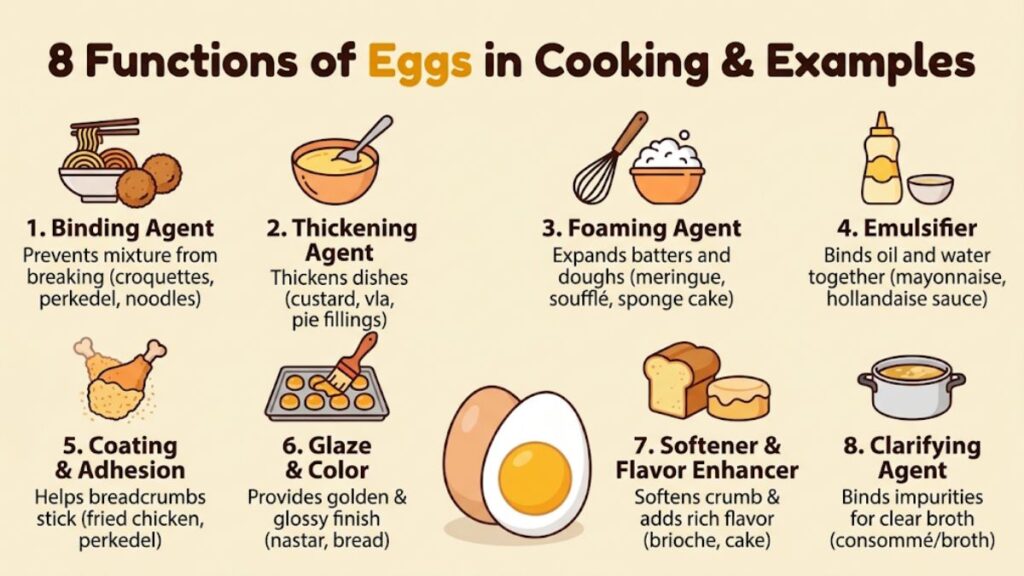
The eight functions of eggs in cooking are binder, thickener, foaming agent, emulsifier, coating adhesive, color and shine, softener and flavor enhancer, and broth clarifier. Each function works through a different part of the egg.
1. Binder
According to Understanding Ingredients for the Canadian Baker, an open textbook from the BC Cook Articulation Committee, egg proteins coagulate when heated and bind ingredients together. Croquette mixtures, perkedel (Indonesian fried potato patties), and noodle dough use egg so the ingredients hold together and the flour blends in.
2. Thickener
Once the proteins are denatured, egg white starts to firm up first, while egg yolk thickens at a higher temperature. Custard, vla (a creamy custard sauce used in Indonesian desserts), and pie fillings rely on this property.
3. Foaming Agent
Whipped egg white traps air and forms a foam that supports meringue, sponge cake, and soufflé. The American Egg Board notes that egg whites aerate batters by creating a foam up to six or eight times the volume of the original liquid.
4. Emulsifier
Egg yolk works as an emulsifier because the lecithin in it brings oil and water together. That is why mayonnaise, hollandaise sauce, and high-fat cake batters use yolk.
5. Coating Adhesive
A dip in beaten egg makes breadcrumbs stick to chicken before frying. On perkedel, the egg coating adds a savory flavor and keeps the patty from breaking apart.
6. Color and Shine
Egg yolk brushed on bread, cookies, or nastar (Indonesian pineapple tarts) gives a golden color and a glossy surface. The lecithin in the yolk helps the wash spread evenly.
7. Softener and Flavor Enhancer
The fat in egg yolk softens the crumb of cakes and makes breads like brioche taste rich. Whole eggs also add a savory flavor and aroma to doughs and batters.
8. Broth Clarifier
Beaten egg white stirred into cold broth and then heated helps make the liquid clearer. Cooks use this technique to make consommé, a clear soup.
Also read: Egg Wash: A Simple Coating for Glossy Bread and Pastries
Choosing Egg White, Egg Yolk, or Whole Egg
Choose egg white for structure and volume, egg yolk for tenderness, flavor, and emulsion, and whole egg when a recipe needs a balance of both.
| Part of the Egg | Main Function | Example Uses |
|---|---|---|
| Egg white | Foam, structure, binding | Meringue, sponge cake, soufflé |
| Egg yolk | Emulsifying, flavor, color, tenderness | Mayonnaise, hollandaise sauce, custard |
| Whole egg | Binding, balance of structure and tenderness | Bread dough, croquettes, perkedel |
Egg white produces a firmer, chewier crumb, while egg yolk produces a richer crumb with a golden color.
When you replace one part of the egg with another, note how the result changes on one small batch before scaling up to mass production.
Also read: 10 Benefits of Egg Whites, from Building Muscle to the Secret of Perfectly Risen Cakes
Eggs in Indonesian and World Cuisines
Eggs appear in Indonesian and world cuisines in different roles, such as a coating, a sauce binder, or the main source of texture. The examples below show the functions above at work in real dishes.
Indonesian Dishes
- Tahu telur goreng (fried tofu in egg) uses seasoned beaten egg as a coating, which keeps the inside of the tofu soft while the outside turns crisp.
- Semur tahu telur, a stew in sweet soy sauce, cooks the eggs in the sauce, and they absorb the seasoning while forming a thin glaze.
- Spekuk, also called lapis legit (Indonesian layer cake), uses many egg yolks for a golden color, a dense yet soft texture, and a rich flavor in every layer.
Dishes From Around the World
- Carbonara from Italy uses beaten raw egg to bind pasta water, melted meat fat, and cheese into a thick sauce without cream.
- Tamagoyaki from Japan is made by pouring a thin egg mixture into the pan and rolling it layer by layer into a dense block with a soft texture.
- Gyeran jjim from Korea mixes eggs with broth or water and steams them, so the result is soft and jiggles slightly like pudding.
- Fuyunghai from Chinese cuisine mixes beaten egg with vegetables and meat, fries it until puffed and golden, and tops it with sweet and sour sauce.
Conclusion
Eggs are versatile because egg white contributes structure and foam, while egg yolk contributes emulsion, flavor, color, and tenderness. You can see these functions in tahu telur goreng, spekuk, carbonara, and tamagoyaki.
Choose egg white, egg yolk, or whole egg according to the function a recipe needs, then test the change on one small batch before mass production.
FAQ
Why Does Egg White Turn White When Cooked?
Clear albumin loses its original structure when heated and forms a dense network that reflects light, so the egg white looks opaque white.
Can Thawed Frozen Eggs Foam as Well as Fresh Eggs?
According to a handout from Universitas Negeri Yogyakarta (in Indonesian), thawed frozen eggs produce foam that is as good as or better than fresh eggs. The same handout says dried egg white needs a longer whipping time than fresh eggs.
Can Free-Range and Conventional Chicken Eggs Replace Each Other in a Recipe?
Not always, because they differ in size, yolk color, and nutritional content, whether you cook at home or bake for a business. For recipes with precise measurements, check the result again after you switch egg types.
Why Do Custard and Scrambled Eggs Clump and Turn Watery?
Heat that is too high or too long makes egg proteins clump tightly and squeeze out water. Use low heat and take the dish off while the texture is still slightly wet, because residual heat keeps thickening it.