
Egg symbolism in Asian culture centers on one idea, the egg as the beginning of life and fertility. The idea appears in creation myths, in stories of royal founders, and in family celebrations.
Chinese families hand out red eggs for a baby’s first month, Iranians set eggs on the new year table, and Banyuwangi parades decorated eggs at the Prophet’s birthday celebration. For cafes and bakeries planning celebration menus, knowing these meanings helps you choose colors and presentation that feel respectful.
This article covers egg myths from China, Korea, and India, egg traditions in China, Iran, and Indonesia, and how they compare with Easter eggs.
Eggs in Myths of the World’s Origin and Royal Founders
In Asia, eggs appear in stories about the beginning of the world and the birth of kings. The three examples below come from China, Korea, and India.
Pangu and the Cosmic Egg in China
In Chinese creation myth, primordial chaos condenses into a large egg, and a giant named Pangu is born inside it. Pangu then splits the egg into sky and earth.
The earliest known written account of Pangu comes from Xu Zheng in the third century CE. The egg in this story stands for the state before the world took shape, whole and closed.
Hyeokgeose, the Silla Founder Born from an Egg
In Korean legend, Hyeokgeose, the founder of the Silla kingdom, was found as a baby inside an egg guarded by a white horse. When he was bathed, his body gave off light and birds and animals danced around him.
The egg was gourd-shaped, and the Korean word for gourd, bak, is linked to the origin of the surname Bak (Park). The legend’s founding date of 69 BC is also questioned by historians.
Also read: 8 Korean Egg Dishes That Have Become a Food Trend in Indonesia
Brahmanda, the Golden Egg in Hindu Texts
Hindu texts describe the world beginning as a Golden Egg called Hiranyagarbha. According to the Manu Smriti, the seed Brahma placed in the primordial waters became a golden egg as bright as the sun, and Brahma himself was born inside it.
According to the Vishnu Purana, seven layers wrap the egg, including water, fire, air, and ether.
Eggs in Family Celebrations and Traditions Across Asia
Beyond myths, eggs appear at real life milestones, namely births, new years, weddings, and religious holidays.
Chinese Red Eggs for a Baby’s First Month
According to Harmony Circle, Chinese families in Singapore serve hard-boiled eggs dyed red to guests at the man yue party, which marks a baby’s first month. The red eggs are considered indispensable because they stand for the renewal of life.
According to Goldthread, red is associated with luck, happiness, and fertility. White eggs are seen as a bad omen because of their link to death.
Guests bring gifts for the baby, and older relatives usually give gold bangles, necklaces, or anklets. A red envelope (angpao) for the host family is also welcome.
Eggs on the Nowruz Table, the Persian New Year
Nowruz is celebrated at the exact moment of the spring equinox, usually between March 19 and 21. According to Al Jazeera, the haft-sin table is often completed with painted eggs as a symbol of fertility.
Eggs are not one of the seven main items on that table, but they are a common addition.
Egg Stepping in Javanese Weddings
In the ngidak endhog ritual of Javanese weddings, the groom steps on a raw egg until it breaks, and the bride then cleans her husband’s feet. The ritual is read as a symbol of offspring and of the couple’s cooperation in building a household.
Endog-Endogan at the Prophet’s Birthday in Banyuwangi
In Banyuwangi, East Java, people decorate boiled eggs with paper flowers for Mawlid, the Prophet Muhammad’s birthday, then stick them into decorated banana tree trunks. The arrangements are paraded around the village with songs of praise for the Prophet, and some are placed in the mosque.
According to detikJatim, the tradition dates back to the early 20th century. Eggs arranged in three layers are read as faith, Islam, and ihsan (spiritual excellence).
For residents, the tradition is also a way to share their good fortune with neighbors, even if the offering is only eggs and rice.
Also read: Free-Range vs Conventional Chicken Eggs: Appearance, Nutrition, and Uses
Comparison with Easter Eggs
Outside Asia, Easter eggs carry a similar idea. For Christians, the egg symbolizes the resurrection of Jesus Christ, just as new life emerges from a shell.
The Meaning of Easter Eggs
The hard, closed shell of an egg represents the sealed tomb of Jesus, while a cracked shell represents his resurrection from death. In Orthodox and Eastern Catholic churches, priests bless Easter eggs before they are given to the congregation.
According to Britannica, the Orthodox tradition paints eggs red to symbolize the blood Jesus shed on the cross. In Western countries, eggs are decorated in bright colors as a symbol of joy and new life.
Where Do Easter Eggs Come From?
The egg was a symbol of fertility and natural renewal before Easter was celebrated, and the church later gave it the meaning of Jesus’s resurrection. Britannica notes that European pagans saw eggs as a sign of springtime regeneration, an idea early Christians adopted.
In the Middle Ages, the church banned eating eggs during Holy Week, yet hens kept laying. Eggs laid that week were marked as Holy Week eggs, and this habit gave rise to the tradition of decorating eggs.
After the fast ended on Easter Day, eggs were among the first foods eaten as a sign of joy.
Egg Symbolism in Asian Culture at a Glance
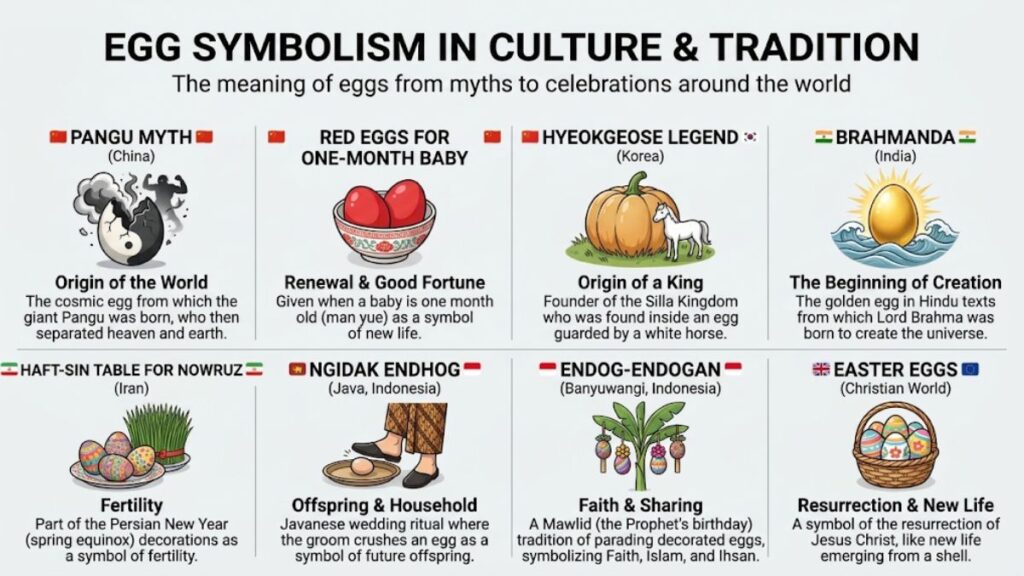
| Tradition | Origin | Role of the egg | Associated meaning |
|---|---|---|---|
| Pangu myth | China | Cosmic egg where Pangu was born | Beginning of the world |
| Red eggs for a baby’s first month | China | Boiled, dyed red, served to guests | Renewal of life, luck, fertility |
| Hyeokgeose legend | Korea | Egg in which the Silla founder was found | Origin of a king |
| Brahmanda | India | Golden egg where Brahma was born | Beginning of creation |
| Nowruz haft-sin table | Iran | Painted egg on the new year table | Fertility |
| Ngidak endhog | Java | Raw egg stepped on by the groom | Offspring |
| Endog-endogan | Banyuwangi | Boiled, decorated with paper flowers, stuck in banana trunks, paraded | Faith, Islam, ihsan, and sharing fortune |
| Easter egg | Christian world | Painted or decorated | Resurrection and new life |
The table shows two patterns. In myths, the egg is the origin of the world or of a king, while in celebrations the egg becomes a wish for birth, offspring, and fertility.
Red also means different things in each tradition, namely luck in Chinese baby celebrations and the blood of Christ in the Orthodox tradition.
Conclusion
Egg symbolism in Asian culture centers on new life, as the myths of Pangu, Hyeokgeose, and Brahmanda and the traditions of red eggs, Nowruz, ngidak endhog, and endog-endogan show. Easter eggs use the same imagery for the resurrection of Jesus Christ.
For cafes and bakeries planning celebration menus, match egg colors and motifs to the occasion, since red alone can mean luck or the blood of Christ.

FAQ
What Does Brahmanda Mean?
Brahmanda means the egg of Brahma, and the term is used for a single world system. That world system is described as oval, like an egg.
Are Decorated Eggs for Mawlid Found Only in Banyuwangi?
No. In Maros, South Sulawesi, Bugis-Makassar residents bring decorated eggs and side dishes to the mosque, and the committee then distributes them back to all households.
Do Christians in Indonesia Also Decorate Easter Eggs?
Yes, mainly among children and teenagers, even though the tradition comes from Western culture. Easter in Indonesia puts more weight on worship and regional traditions, such as the Semana Santa procession in Larantuka, East Nusa Tenggara.
What Is the Mary Magdalene Legend in the Easter Egg Tradition?
One legend says Mary Magdalene carried a basket of cooked eggs to Jesus’s tomb, and the eggs turned a brilliant red when she found the tomb empty. The legend is often linked to the origin of dyeing Easter eggs.