
The free-range vs conventional chicken eggs comparison comes down to the hen and how it is raised. In Indonesia, free-range chicken eggs come from native village chickens and conventional eggs from commercial layers, and the two differ in size, shell color, yolk color, nutrition, and price.
That is why one cannot always replace the other, whether you are cooking a family meal or mixing cake batter in a commercial kitchen. The nutritional gap, though, is smaller than many people assume.
A review by IPB University researchers puts the protein in whole free-range chicken eggs at 13.86 grams per 100 grams, compared with 12.76 grams for conventional eggs. This article covers where each egg comes from, its physical traits, contents and nutrition, uses in cooking and business, and its price and availability.
What Are Free-Range and Conventional Chicken Eggs?
Free-range chicken eggs, known in Indonesia as telur ayam kampung, come from native chickens that are not commercial crossbreeds. Conventional eggs come from commercial hens bred to lay, and Indonesian markets sell them as telur ayam negeri or telur ayam ras, two names for the same product.
In many other countries, free-range describes how hens are kept rather than their breed, so in this article the term refers to Indonesia’s native chickens.
Native chickens usually roam freely in yards or gardens, so part of their diet comes from insects and leaves they find on their own. Farmers keep commercial laying hens in coops and control the composition of their formulated feed.
The two also differ in productivity. Commercial laying hens can lay almost every day during their production period, whereas native hens stop laying when they brood and raise their chicks.
Also read: Here’s the Difference Between Egg Types Based on Animal Species and Farming Methods
Physical Traits of Free-Range and Conventional Chicken Eggs
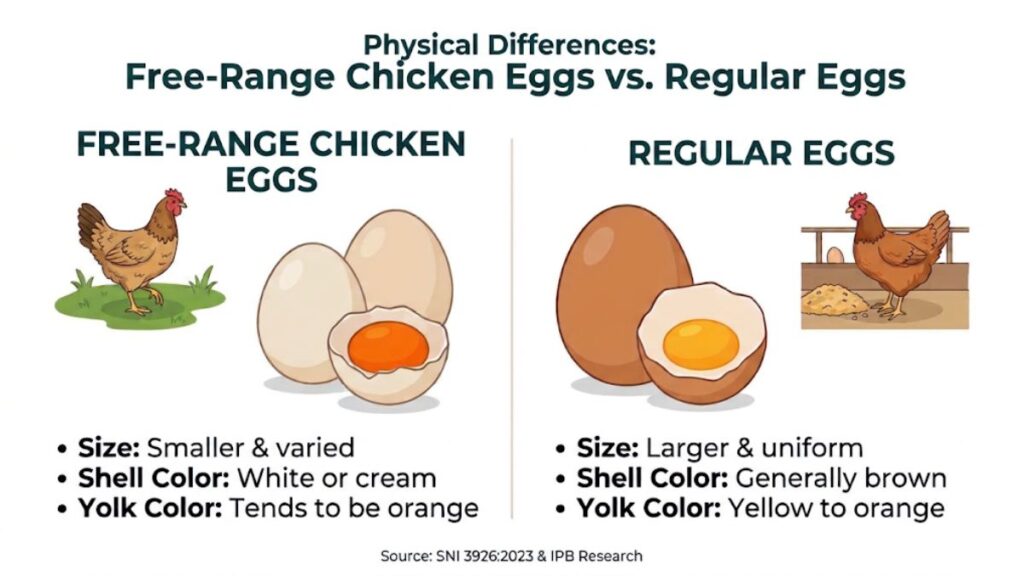
Free-range chicken eggs are smaller, with white or cream shells and yolks that lean orange, while conventional eggs are larger and have brown shells. The table below sums up the traits that are easiest to spot.
| Trait | Free-range chicken eggs | Conventional chicken eggs |
|---|---|---|
| Size | Smaller and less uniform | Larger, available by weight class |
| Shell color | White or cream | Usually brown |
| Yolk color | Tends to be orange | Yellow to orange, depending on the feed formula |
Of these three traits, size matters most in recipes because it determines how much egg goes into the batter. Shell color and yolk color affect appearance, not quality.
Size and Weight
Free-range eggs are usually smaller, and their size can vary within a single delivery. Conventional eggs are larger and can be bought by weight class.
Indonesia’s national standard for table eggs (SNI 3926:2023) sorts conventional eggs by weight into small (under 50 grams), medium (50 to 60 grams), and large (over 60 grams). The standard covers eggs from commercial layer farms, so free-range eggs from native chickens have no official weight classes.
Because their sizes differ, a recipe written per egg will produce a different batter when you switch egg types. If you swap conventional eggs for free-range eggs, measure them in grams.
Shell Color
Conventional eggs sold in Indonesia usually have brown shells, while free-range chicken eggs are white or cream. Shell color depends on the hen’s strain, so it says nothing about nutritional content.
Yolk Color
Free-range egg yolks tend to be more orange because the hens eat leaves and insects that contain carotenoids, natural yellow and red pigments. In commercial hens, yolk color follows the feed formula, so farmers can make it paler or deeper.
Because feed shapes yolk color, it is not a reliable sign of protein content or proof that an egg truly comes from a native free-range hen. In dishes that rely on color, such as kue lapis (Indonesian layer cake) or egg noodles, the final color may change when you switch egg types.
Egg Contents and Nutrition: Free-Range vs Conventional Chicken Eggs
Both eggs have the same parts: the white, a source of protein, and the yolk, which holds most of the fat. Per 100 grams, free-range chicken eggs contain slightly more protein and slightly less fat, but the gap is under 2 grams.
The yolk also contains choline, along with lutein and zeaxanthin, compounds associated with brain and eye health. The figures in the table below come from the IPB review, and results may differ for hens on other diets.
| Per 100 grams | Free-range chicken eggs | Conventional chicken eggs |
|---|---|---|
| Whole egg protein | 13.86 g | 12.76 g |
| Whole egg fat | 10.83 g | 12.08 g |
| Yolk protein | 17.12 g | 15.32 g |
| Yolk fat | 30.08 g | 31.06 g |
| Yolk energy | 350 kcal | 348 kcal |
| Egg white protein | 10.07 g | 10.26 g |
The largest gap is in yolk protein, at 1.8 grams per 100 grams, while the protein in the whites is almost the same. In other words, free-range eggs do have a nutritional edge, but it is small.
Figures per 100 grams also do not show what you get per egg. Because free-range eggs are smaller, one free-range egg may provide as much protein as one conventional egg, or less.
Uses of Free-Range and Conventional Chicken Eggs
Conventional eggs suit everyday cooking and large-scale production, while free-range eggs suit dishes that highlight yolk color or carry a free-range egg label. In the kitchen, both do the same basic jobs: the white helps batter rise, and the yolk helps oil and water blend.
Uses of Conventional Chicken Eggs
Conventional eggs are the usual choice for everyday dishes, bread, cakes, and martabak (an Indonesian street-food pancake) because they are affordable and in steady supply. Since they can be ordered by weight class, bakeries and caterers can also keep their measurements the same every day.
Conventional eggs are also the raw material for the egg processing industry. The same IPB review notes that egg powder has so far been made from conventional chicken eggs, since their supply is ample and other egg types remain limited.
Uses of Free-Range Chicken Eggs
In Indonesia, free-range chicken eggs are commonly mixed into jamu (traditional herbal drinks) or eaten soft-boiled. Food sellers also use them in dishes marketed with a free-range egg label, such as soto (spiced soup) or martabak.
Their more orange yolks also suit cakes or noodles that depend on natural yellow color.
For raw or soft-cooked dishes, the type of hen does not guarantee safety, because any egg can carry Salmonella bacteria. Use very fresh eggs with clean, intact shells, or pasteurized eggs for dishes that are not heated.
Price and Availability
Free-range chicken eggs cost more per egg and per kilogram because native hens lay fewer eggs and supply is limited. Layer farms produce conventional eggs at scale, which keeps them affordable and easy to buy in large volumes.
For daily caterers, the limited supply of free-range eggs means a risk of running short when orders spike, such as before Eid al-Fitr, known locally as Lebaran. For low-margin products like white bread or boxed rice meals, free-range eggs also push up production costs right away.
Free-Range vs Conventional Chicken Eggs: Which Is Better?
For everyday needs and routine production, conventional eggs make more sense because their nutrition is nearly the same at a lower price. Free-range eggs are worth choosing when yolk color, a flavor your customers prefer, or the free-range label itself is part of what you sell.
If the only reason to pick free-range eggs is the belief that they are far more nutritious, the data above shows that reason is weak.
Conclusion
Free-range and conventional chicken eggs differ most in size, shell color, yolk color, and price, while their protein and fat vary by less than 2 grams per 100 grams. Conventional eggs suit daily needs and routine production, and free-range eggs suit dishes that highlight yolk color or carry a free-range label.
When you swap one for the other, measure the eggs in grams and choose fresh eggs with intact shells.

FAQ
Are Free-Range Chicken Eggs Lower in Cholesterol?
Both kinds of eggs store their cholesterol in the yolk, so the type of hen is not a basis for limiting your cholesterol intake. If your cholesterol is high, follow your doctor’s or dietitian’s advice on how many eggs are safe for you.
Do Free-Range Chicken Eggs Last Longer?
How long an egg keeps depends more on its age at purchase, how clean the shell is, and the storage temperature than on the type of hen. Store both kinds in the refrigerator in their cartons, and use older stock first.
How Are Free-Range Chicken Eggs Different from Omega-3 Eggs?
Omega-3 eggs usually come from commercial laying hens fed a diet rich in omega-3 fatty acids, such as flaxseed or fish oil. The omega-3 content of free-range chicken eggs is not controlled through special feed, so it depends on the natural diet the hens eat.
Are Both Free-Range and Conventional Eggs Suitable for Baby Food?
Both can be used in complementary foods for babies as long as they are fully cooked, since their nutritional difference is small. For babies with a history of allergies or special needs, follow the advice of a pediatrician or dietitian.
How Many Free-Range Eggs Replace One Conventional Egg?
It depends on the weight of the eggs from your supplier. Weigh the contents of 10 free-range eggs without their shells, work out the average, and then match the total weight to the weight of the conventional eggs in your recipe.