

If you eat eggs every day, your body gets a steady supply of protein and choline, and for healthy adults this is generally safe. Worries about cholesterol often make people hesitate to put eggs on the daily menu.
According to the American Heart Association (AHA), healthy people can have up to one whole egg a day, although one large egg contains about 200 mg of cholesterol.
This article explains the positive effects of eggs on your body, how they relate to cholesterol, the daily limit, and who should be more careful.
Positive Effects of Eating Eggs Every Day
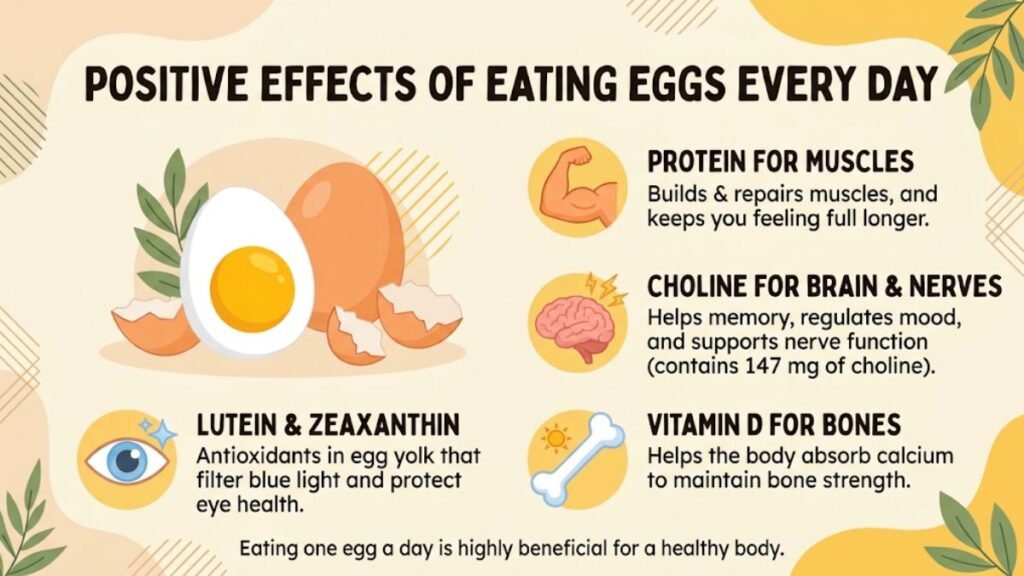
When you eat eggs every day, your body regularly takes in protein, choline, lutein, and vitamin D. An article on the website of Indonesia’s Ministry of Health notes that eggs contain almost every vitamin except vitamin C, plus minerals such as iron and phosphorus.
1. Protein for Muscle and Fullness
Your body uses egg protein to build and repair muscle. Together with the fat in the yolk, protein also delays hunger, so an egg breakfast tends to keep you full for longer.
2. Choline for the Brain and Nerves
Eggs are a source of choline, a nutrient your body uses to build cell membranes and make acetylcholine. Acetylcholine is a neurotransmitter (a chemical messenger between nerve cells) involved in memory and mood, as well as muscle control.
The NIH Office of Dietary Supplements lists 147 mg of choline, or about 27% of the Daily Value (the daily reference amount), in one large hard-boiled egg.
3. Lutein and Zeaxanthin for the Eyes
Egg yolks contain lutein and zeaxanthin, two carotenoid pigments that also accumulate in the retina. There, these pigments filter blue light and act as antioxidants.
4. Vitamin D for Bones
Vitamin D helps your body absorb calcium to keep bones strong, and egg yolks contain it. Your skin also makes vitamin D when it is exposed to sunlight, so eggs are just one source.
Are Eggs Bad for Your Cholesterol and Heart?
Eggs are high in cholesterol, but according to the AHA, one egg a day does not automatically harm the heart of a healthy person. Unlike fatty meat and butter, eggs are not high in saturated fat.
Dietary cholesterol is not the same as blood cholesterol, which circulates in your blood vessels and is partly made by your own liver. Most of an egg’s cholesterol sits in the yolk, while egg whites are not high in cholesterol.
The AHA’s 2019 science advisory notes that evidence from observational studies is inconsistent. The one-egg guideline applies to healthy people, while other groups get special caveats.
The problem often lies in what goes with the eggs. Eggs are often eaten with high-fat foods such as sausage and butter, the AHA notes, and the saturated fat in those foods also shapes how breakfast affects cholesterol.
The AHA puts more weight on an eating pattern rich in vegetables, fruits, whole grains, and fish than on any single food.
Also read: Do Eggs Contain Fat? Here Are the Facts You Need to Know
How Many Eggs Can You Safely Eat in a Day?
For healthy adults, the AHA’s limit is up to one whole egg per day or the equivalent. Older people with healthy cholesterol levels can eat two eggs a day, given the nutritional benefits and convenience.
Eggs mixed into other foods still add cholesterol. Dietary cholesterol is also found in baked goods made with eggs, butter, or cream, the AHA notes.
If your breakfast already includes an omelet, you should also count any egg-based cakes or pastries you eat as snacks.
Who Should Be More Careful with Eggs?
People with high LDL cholesterol, excess weight, a genetic predisposition to high cholesterol, diabetes, or an egg allergy need to be more careful. The table below summarizes why.
| Group | What to Keep in Mind |
|---|---|
| High LDL (“bad” cholesterol) | The AHA advises reducing sources of both saturated fat and dietary cholesterol. |
| Overweight, obesity, or other risk factors | The AHA says dietary cholesterol is a particular concern for this group. |
| Genetic predisposition to high cholesterol | Blood cholesterol levels should be checked, because this tendency runs in families. |
| Diabetes or risk of heart failure | The AHA’s 2019 science advisory also gives this group special caveats, so the egg limit is best set together with a doctor. |
| Egg allergy | Eggs and foods that contain eggs should be avoided unless a doctor says otherwise. |
Four of the five groups involve cholesterol and heart health, while an egg allergy calls for avoiding eggs from the start.
If you fall into one of these groups, ask a doctor or dietitian what egg limit suits you before making eggs a daily food.
Conclusion
Eating up to one egg a day still fits the AHA’s guidance for healthy adults, as long as what you serve with it is not high in saturated fat. Your body gets protein, choline, lutein, and vitamin D, while cholesterol remains the main concern for people at risk.
People with high LDL or diabetes should set their egg limit with a doctor or dietitian, and people with an egg allergy should avoid eggs. One step you can take right away is to count the eggs in everything you eat in a day, even in cakes and bread made with eggs.

FAQ
Does Eating Eggs Every Day Make You Gain Weight?
Eggs do not automatically cause weight gain, because body weight depends on your total daily calories. Fried eggs cooked in oil or butter add more calories than boiled eggs.
Can You Eat the Yolk Every Day, or Only the White?
Healthy people do not need to throw away the yolk, because it contains choline and vitamin D. Egg whites are an option if a doctor asks you to limit dietary cholesterol.
Can Pregnant Women and Children Eat Eggs Every Day?
The Ministry of Health article cited above says eggs are very good for growing children and for pregnant and breastfeeding women. Make sure the eggs are fully cooked, and ask a doctor or dietitian about the daily amount, especially if a child has a history of allergies.
Are Undercooked Eggs Safe to Eat Every Day?
It is better not to, because runny whites and yolks can still carry Salmonella, a bacterium that causes food poisoning. Vulnerable groups, such as young children and pregnant women, should eat only fully cooked eggs.