
Proper egg storage means keeping eggs cold and intact until you use them, without letting the shells get damp. Habits such as putting eggs on the refrigerator door shelf or washing them before storage go against that principle.
According to Indonesia’s Ministry of Agriculture, eggs keep for 15 days at room temperature and 30 days in the refrigerator. With a gap that wide, the storage spot also decides how often you have to replace your egg stock.
This article corrects seven myths about storing eggs, with the facts behind each one and steps you can apply in your kitchen right away.
Myths About Egg Storage in the Refrigerator and at Room Temperature
The refrigerator is the better place for eggs, especially in a tropical climate like Indonesia’s. The next three myths are about where eggs are kept.
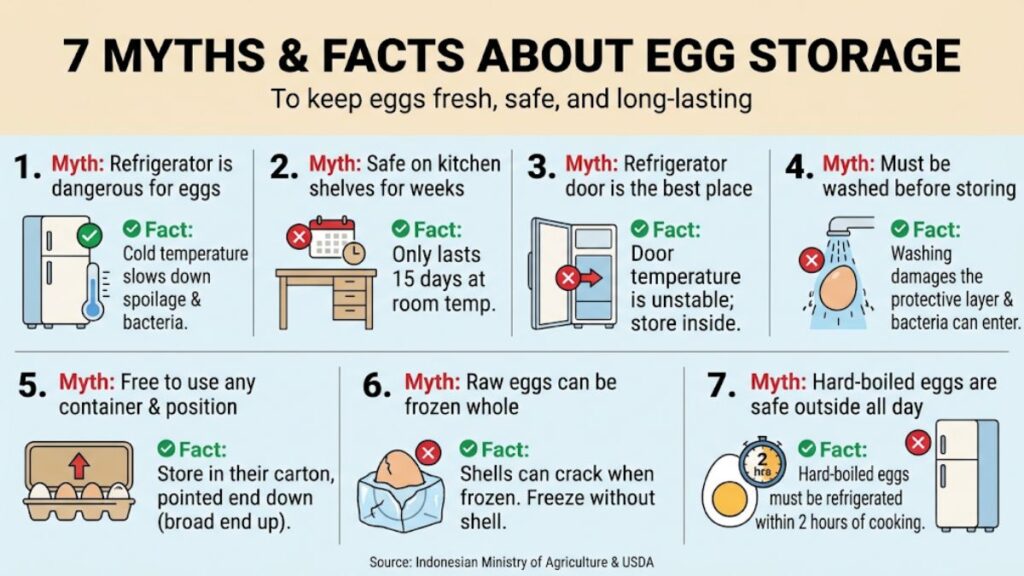
Myth 1: Storing Eggs in the Refrigerator Is Dangerous
Refrigeration does not make eggs dangerous, and the cold actually slows the decline in their quality.
IPB University researchers tested 200 Arabian chicken eggs stored either at room temperature (25°C to 27°C) or in the refrigerator (4°C to 7°C) for 45 days. By day 20, the Haugh unit (a measure of egg white thickness) was still 81.05 (Grade AA) in refrigerated eggs but only 59.45 (Grade B) at room temperature.
Cold also slows the growth of bacteria such as Salmonella but does not kill them, so you still need to cook eggs thoroughly.
What you need to avoid is a sudden change in temperature. Eggs that go from the refrigerator into a warm room develop condensation, and a damp shell makes it easier for bacteria to enter through the pores.
Myth 2: Eggs Are Safe on the Kitchen Shelf for Weeks
Eggs should not sit on the kitchen shelf for weeks, because the shell’s protection is limited, especially at tropical room temperatures. In the IPB University study above, the decline in quality at room temperature was detectable as early as day 10.
As eggs age, they lose water and gas through the pores in the shell, which lowers their weight and thins the egg white. The same pores can let bacteria in, and room temperature in Indonesia falls inside the temperature danger zone where bacteria multiply quickly.
The argument that eggs in the European Union (EU) are sold without refrigeration does not carry over to Indonesia. In the EU, eggs are generally not washed, and the climate is much cooler than in Indonesia.
For a kitchen that receives eggs once a week, the 15-day room-temperature limit means you have to use up each delivery before the delivery after next arrives. Write the receipt date on the carton and use older eggs first, as the Ministry of Agriculture recommends.
Myth 3: The Refrigerator Door Shelf Is a Good Place for Eggs
The door shelf is not the right place for eggs. The U.S. Department of Agriculture (USDA) recommends keeping eggs in their carton in the coldest part of the refrigerator, not in the door.
The door opens often, so its temperature rises and falls. Put the egg carton on an inner shelf, away from the door.
Also read: 7 Ways to Store Eggs Properly to Keep Them Fresh and Safe to Eat
Myths About Washing and Arranging Eggs
Clean eggs are best left unwashed, but the container and position still deserve attention. The next two myths cover how to clean and arrange eggs.
Myth 4: Eggs Must Be Washed Before Storing
You can store eggs that look clean without washing them. USDA says washing eggs is neither necessary nor recommended for consumers, because the shell’s pores can pull wash water into the egg and raise the risk of contamination.
In the United States, regulations require egg processors to wash and sanitize USDA-graded eggs at temperatures that keep the wash water from being sucked into the egg. Eggs from farmers or traditional markets in Indonesia may not have gone through that process.
For eggs that are visibly dirty, the Ministry of Agriculture recommends clean water without scrubbing, then drying the shell. Wiping light dirt off with a dry cloth is enough.
Myth 5: Eggs Can Go in Any Container and Any Position
Eggs belong in their carton, with the wider, blunt end facing up. USDA recommends storing eggs in the carton, while the Ministry of Agriculture advises keeping the blunt end on top.
The blunt end holds the egg’s air cell. The carton protects the shell from knocks and helps limit how much odor the shell absorbs from other foods through its pores.
Also read: 7 Ways to Choose Fresh Eggs Without Making Mistakes
Myths About Frozen Eggs and Boiled Eggs
You should not freeze raw eggs in the shell or leave boiled eggs out of the refrigerator for long. The next two myths explain why.
Myth 6: Raw Eggs Can Be Frozen in the Shell
Freezing raw eggs in the shell is risky, because the contents expand as they freeze and the shell can crack. Those cracks give bacteria a way in.
USDA’s storage chart says not to freeze raw eggs in the shell. If an egg freezes by accident, thaw it in the refrigerator and use it right away.
Raw egg whites can be frozen once separated, but yolks do not freeze well. A bakery with leftover egg whites from yolk-based batters can freeze them separately.
Myth 7: Boiled Eggs Are Safe to Leave Out All Day
USDA says to refrigerate hard-boiled eggs within 2 hours of cooking and to use them within a week.
The 2-hour rule also applies to raw eggs once you take them out of the refrigerator. For that reason, take out only the eggs you plan to use soon.
Conclusion
All seven myths point to one principle, which is that eggs last longer when they stay cold and dry.
Start right away by moving your eggs into the refrigerator in their carton and using the oldest stock first.

FAQ
What Is the Right Refrigerator Temperature for Storing Eggs?
USDA recommends a refrigerator temperature of 40°F (about 4°C) or lower. Put a thermometer inside the refrigerator and check it regularly.
How Long Can Leftover Egg Whites and Yolks Be Stored?
USDA says raw egg whites and yolks that you have separated keep for 2 to 4 days in the refrigerator. Store them in a covered container and label it with the date.
Can Eggs Share a Refrigerator with Raw Meat or Fish?
Yes, as long as the raw meat and fish sit on the bottom shelf so their juices cannot drip onto the eggs or other food. Leave the eggs in their carton.
How Should You Handle Cracked Eggs?
Separate them from intact eggs, because cracks give bacteria a way in. Avoid buying eggs that are already cracked.
How Do You Store Eggs Without a Refrigerator?
Keep the eggs blunt end up in a clean, dry place away from garbage and toxic substances. Use them within the 15-day limit set by the Ministry of Agriculture.