
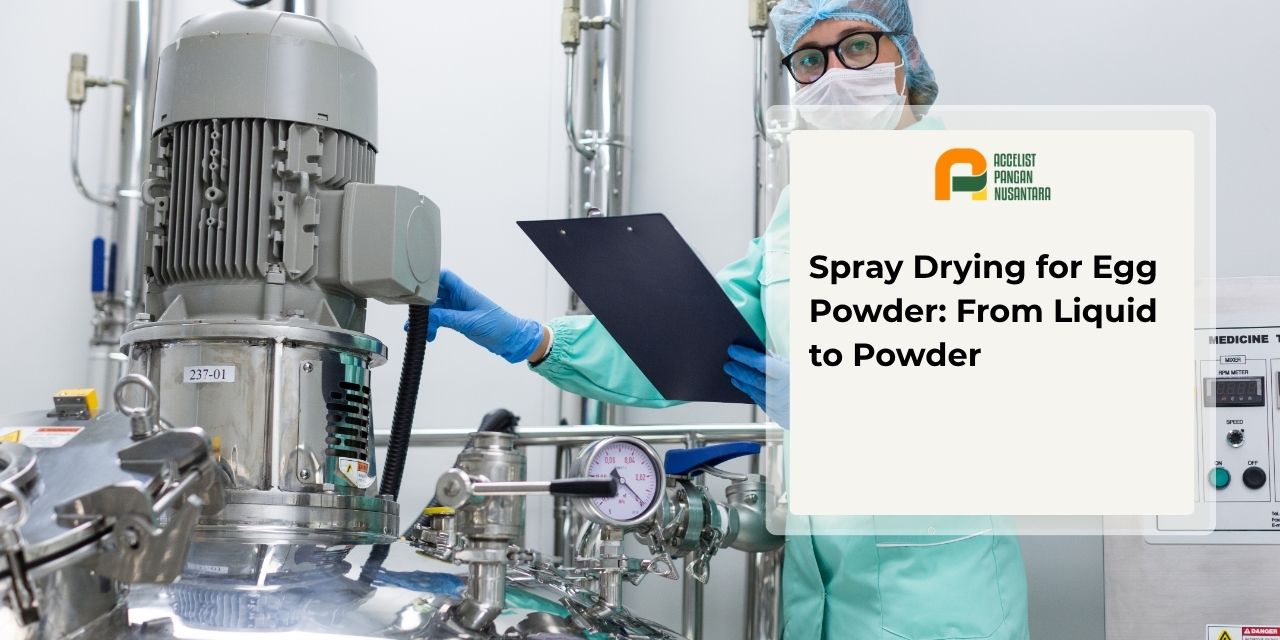
Picture a food plant that needs thousands of eggs every single day for bread mixes and sauces. Storing that much fresh egg is a logistical headache, not to mention the risk of breakage and spoilage during transport.
Indonesia’s national supply of layer chicken eggs is projected to run a surplus of 392,670 tons in 2026, so raw material availability isn’t really the bottleneck. The real problem is finding a way to preserve that supply so it still works for large-scale industry.
This is where spray drying for egg powder comes in. The method answers a simple need: egg-based raw material that lasts, takes up less space, and is ready to use whenever a plant needs it.
Why Turn Liquid Egg Into Powder At All?
Fresh eggs only stay usable for a few weeks even under refrigeration. Drying them into powder turns that storage problem into a long-term solution, and here’s why manufacturers make the switch.
- Shelf life stretches far longer: Fresh eggs last around 25 days before quality starts to drop, while whole egg powder can be stored for up to 549 days, roughly 18 months, without any refrigeration at all.
- Weight and volume shrink dramatically: Drying removes most of the water content, which cuts shipping and warehousing costs right along with it.
- It’s simpler for mass production: Bakeries, instant noodle makers, and sauce producers just measure out powder instead of cracking eggs one by one.
- Contamination risk drops: The quick heat exposure during drying also knocks down the microbial load in the raw material.
How Does the Spray Drying Process for Egg Powder Actually Work?
In short, liquid egg gets sprayed into a hot chamber and turns into powder within seconds. Five sequential steps happen before that powder is ready for packaging.
1. Preparation and Straining of Liquid Egg
Eggs are cracked, separated from their shells, then strained to remove shell fragments or the chalazae (the stringy bits attached to the yolk). This step determines how clean the final powder will be.
2. Pasteurization and Homogenization
The liquid egg is briefly heated to kill bacteria such as Salmonella, then homogenized for an even texture. Homogenization also lowers the liquid’s viscosity, which makes it easier to atomize later on.
3. Atomization Into the Drying Chamber
The liquid egg gets pumped through a high-pressure nozzle and breaks apart into a mist of fine particles. The smaller and more uniform the droplets, the faster the drying happens.
4. Drying With Hot Air
That droplet mist meets a stream of hot air inside the chamber, usually around 60 degrees Celsius to keep the egg protein from breaking down. Water in each droplet evaporates within seconds, leaving behind fine solid powder.
5. Separation and Packaging
The dried powder is separated from the hot air using a cyclone separator, then cooled before being sealed in airtight packaging. Tight sealing matters here, since it keeps the powder from absorbing moisture from the surrounding air.
What Parameters Determine Egg Powder Quality?
The final quality of egg powder hinges on four operational parameters during spray drying. Get any one of them wrong, and the powder’s moisture content or protein levels will shift along with it.
| Parameter | Effect on the Result |
|---|---|
| Feed rate | Too high a rate raises the powder’s moisture content and lowers production yield |
| Inlet and outlet temperature | Unstable temperatures can damage the egg protein or cause the powder to clump |
| Nozzle design | Determines droplet size, which directly affects how fine the powder’s texture turns out |
| Drying air humidity | High humidity slows down water evaporation from the droplets |
As an illustration, Kurniawan et al. (2014) from the National Institute of Technology (Institut Teknologi Nasional) in Bandung, presented at the National Chemical Engineering Seminar Kejuangan, tested two different nozzle designs for spray drying egg yolk and egg white.
The result, the threaded nozzle produced egg yolk powder with 6.08 percent moisture content and a 60.13 percent yield, outperforming the non-threaded design tested in the same study.
The publication doesn’t spell out the exact sample size or testing duration, but the figures still make a concrete case that getting the parameters right has a direct payoff in final product quality.
The Difference Between Spray Drying and Freeze Drying: Which Is Better for Egg Powder?
Spray drying and freeze drying are both used to dry eggs, but they run on entirely different principles. That difference shapes production cost, processing time, and which plant scale each method actually fits.
| Aspect | Spray Drying | Freeze Drying |
|---|---|---|
| Working principle | Liquid atomized into hot air | Freezing followed by water sublimation under vacuum |
| Processing time | Seconds per batch | Hours to days |
| Production capacity | Can reach 100 tons per hour at industrial scale | Typically small to mid scale |
| Operating cost | Relatively economical for mass production | Higher, due to the cooling energy required |
| Nutrient quality | Good, as long as temperature is tightly controlled | Tends to preserve nutrients more fully |
For large-scale food production, spray drying is the more realistic choice given its speed and capacity. Freeze drying only really makes sense when a product demands the highest possible nutrient retention and the output volume stays relatively small.
Conclusion
Spray drying for egg powder relies on five interconnected steps, starting with straining the liquid egg and ending with sealing the dried powder for packaging. Every parameter along the way, from feed rate to temperature to nozzle design, determines whether the powder coming out of the machine ends up consistent or not.
Compared to other drying methods like freeze drying, spray drying has the edge for large-scale production because it’s faster and handles far greater capacity. That’s exactly why the method has become the go-to choice for food manufacturers that need a steady supply of dried, long-lasting egg-based raw material.
For culinary businesses and food manufacturers looking for practical raw materials, Egg Powder can be a solid alternative that saves on storage space while keeping product taste and texture consistent. Accelist Pangan Nusantara supplies Egg Powder for a wide range of production needs.
If you’d like to learn more about product specifications and how to place an order, feel free to Contact Us.

FAQ
A small portion is lost to heat, but the main proteins stay largely intact.
Typically six months to a year at room temperature, as long as it’s sealed airtight.
Yes, as long as the water-to-powder ratio is adjusted to match what the recipe calls for.
Excess heat damages the egg protein, which makes the powder clump and become hard to dissolve.