
Picture a bakery that has to reorder pasteurized liquid egg every three days because the carton spoils fast once it is opened. Shipping costs pile up, and part of the stock ends up thrown away before it can even be used.
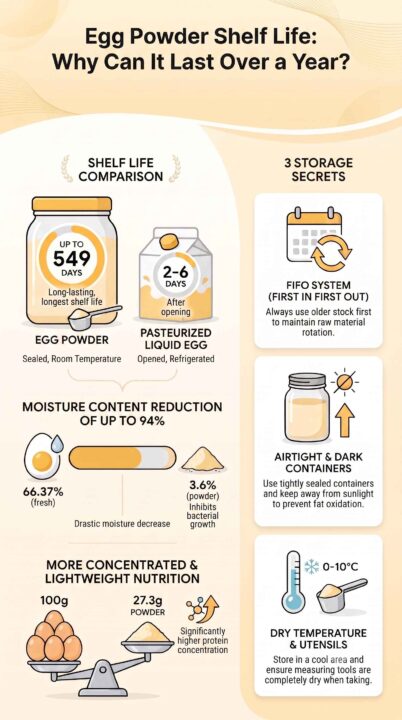
According to the U.S. Department of Agriculture’s Food Safety and Inspection Service, liquid egg products without a printed expiration date must be used within three days of opening. Compare that with whole egg powder, which researchers have measured at up to 549 days of shelf life at room temperature under the right packaging, according to a study published in Food Chemistry.
That gap is exactly why egg powder shelf life has become a serious factor for food businesses weighing their egg supply options. This article breaks down where that gap comes from, and what actually determines how long each product lasts on the shelf.
What Makes Egg Powder Last So Much Longer Than Fresh Egg?
The answer comes down to water. Once most of the moisture is removed, bacteria and mold simply have far less to work with.
A Dramatic Drop in Moisture Content
According to an overview compiled by ScienceDirect, the moisture content of egg drops from around 74 percent in liquid form to just 2 to 4 percent once dried into powder. That single change is the main reason dried egg resists spoilage so much better than its liquid counterpart.
Less Weight, More Concentrated Nutrition
Removing that much water also shrinks the product’s weight and volume considerably. The same source notes this concentrates the food value per gram, though it can come at the cost of some fresh flavor and functional properties such as aerating power.
Airtight, Low-Oxygen Packaging
Egg powder producers typically pack the product in sealed, moisture-proof containers. Keeping oxygen and humidity out slows down the fat oxidation that would otherwise cause rancid odors in a dry food.
Reducing Sugars Are Kept Under Control
The U.S. Food and Drug Administration requires egg powder to contain no more than 0.1 percent reducing sugar, most of it glucose. If that threshold is exceeded, a browning reaction can develop during storage and speed up quality loss, even if the product itself remains safe to eat.
Why Does Pasteurized Liquid Egg Spoil So Quickly Despite Being Heat-Treated?
Pasteurization only kills pathogens such as Salmonella, it does not remove the water that liquid egg still holds. That remaining moisture is still an ideal environment for other bacteria to multiply the moment storage temperature creeps up.
Pasteurization is typically carried out at around 60 to 65 degrees Celsius for several minutes, hot enough to eliminate pathogens without coagulating the egg proteins. Once that step is done, the product must be chilled quickly and kept below roughly 4.4 degrees Celsius to stay stable.
USAPEEC, the trade association representing U.S. egg exporters, notes that once opened, liquid egg should be used within two to six days of the purchase date. The moment the seal is broken, the product is exposed to airborne bacteria, so the safe window narrows fast.
Comparison Table: Egg Powder Shelf Life vs. Pasteurized Liquid Egg
The difference between these two products is not measured in days but in orders of magnitude, depending on how each one is stored. The table below summarizes published figures from industry guidance and peer-reviewed research.
| Product | Storage Condition | Estimated Shelf Life |
|---|---|---|
| Pasteurized liquid egg (unopened) | Refrigerated, below 4.4°C | Up to 7 days (without a printed expiration date) |
| Pasteurized liquid egg (opened) | Refrigerated, below 4.4°C | 2 to 6 days |
| Fresh shell eggs | Refrigerated | 3 to 5 weeks |
| Whole egg powder | Room temperature, sealed packaging | Up to 549 days |
| Plain, unstabilized egg solids | Room temperature | About 1 month |
| Plain, unstabilized egg solids | Refrigerated | About 1 year |
Data on whole egg powder shelf life comes from a peer-reviewed Food Chemistry study on shelf-life modeling, while shell egg and unstabilized egg solids figures are drawn from eggsafety.org and the American Egg Board.
4 External Factors That Affect Egg Powder Shelf Life After Production
A figure like 549 days represents a best-case outcome, not a guarantee, since handling after production still plays a big role in how long the powder actually lasts. Four external factors most often explain why egg powder spoils earlier than expected.
- Storage temperature and humidity: Egg powder holds up best between 0 and 10 degrees Celsius, though a cool, dry room temperature is still workable.
- Packaging type and quality: Airtight packaging with a barrier against light and moisture performs far better than ordinary packaging that absorbs humidity easily.
- Exposure to air and light after opening: Every time the container is opened, moisture from the surrounding air can seep in and gradually raise the powder’s water content.
- Cleanliness of the scoop or utensil used: A damp or dirty scoop can introduce microbes into the container, even if the powder itself was still in good condition beforehand.
Signs That Egg Powder Has Gone Bad or Is No Longer Safe to Use
Left unchecked, the four factors above will eventually leave visible or detectable marks on the product. Here are the warning signs worth checking before egg powder goes into production.
- A color shift toward brown: This usually signals a browning reaction between reducing sugars and protein during storage.
- A rancid or musty smell: This points to fat oxidation, typically because the packaging is no longer airtight.
- Clumping or hardening texture: This means the powder has absorbed moisture from the surrounding air.
- Visible mold spots or small pests: This is the clearest sign of all, and the product should be discarded immediately regardless of how far off the expiration date still is.
How to Store Egg Powder for Maximum Shelf Life
Preventing the four warning signs above is fairly simple as long as it’s done consistently. Here are the storage steps worth applying in a production kitchen or ingredient warehouse.
- Use an airtight container: Transfer egg powder into a tightly sealed container once the original packaging is opened, and avoid leaving it exposed to open air longer than necessary.
- Keep it away from direct sunlight: Store it in a closed cabinet or shelf, since light exposure speeds up fat oxidation inside the powder.
- Maintain a cool, dry room: An ideal range sits between 0 and 10 degrees Celsius, though a stable, non-humid room temperature also works for shorter to medium storage periods.
- Always use a completely dry measuring tool: A damp scoop or cup can introduce moisture into the container and trigger clumping much sooner.
- Follow a first-in, first-out system: Use older stock before newer stock, so nothing sits in the warehouse untouched for longer than needed.
These five steps sound basic, but they are exactly where many food businesses lose the extended shelf life egg powder is actually capable of delivering.
How to Choose Between Egg Powder and Pasteurized Liquid Egg
The right choice depends on production scale, distribution distance, and how consistently the egg supply actually gets used before it expires. Two common scenarios can serve as a simple guide before deciding.
- Large-scale production with long-distance distribution: Egg powder has the edge here, since it’s lightweight, doesn’t require a cold chain throughout transit, and carries far less risk of loss from expiration.
- Specific functional needs, such as high foaming power for meringue-based baking: Fresh or pasteurized liquid egg still performs better for certain emulsion and aerating properties, even though egg powder has closed much of that gap in recent formulations.
These two scenarios show that neither product is universally better across every condition. What matters is matching the choice to each business’s actual production needs.
Conclusion
The gap between egg powder shelf life and pasteurized liquid egg shelf life comes down to one shared variable: moisture. Liquid egg still carries a higher spoilage risk because of its remaining water content, while egg powder has already lost most of that water through drying, making it far more stable for long-term storage.
For food businesses, choosing the right egg format has a direct impact on storage and distribution costs. External factors such as temperature, packaging, and utensil cleanliness still matter, even once the product is already in powder form.
As a producer focused on turning eggs into high-quality egg powder, Accelist Pangan Nusantara understands that a long shelf life alone isn’t enough without consistent quality in every production batch. Every step of the process is monitored closely, from final moisture content to the type of packaging used.
If your business is looking for a reliable egg powder supply for long-term production needs, feel free to Contact Us for further consultation.

FAQ
Yes, the nutrient content is actually more concentrated since most of the water has been removed.
No, it should be reconstituted with water and prepared according to a recipe, just like liquid egg.
It’s best used within 7 to 10 days, stored in a cool, airtight place in the meantime.
Because pasteurization only inactivates pathogens like Salmonella, not every microbe present. Other bacteria can still multiply if the temperature isn’t controlled.