
The ideal type of packaging for egg powder isn’t just about being airtight, since every material offers a different level of protection against light, oxygen, and moisture. Choosing the right packaging type determines how long egg powder can hold onto its quality.
A study published in ScienceDirect compared three commercial packaging types for whole egg powder and found that aluminum-laminated packaging and cardboard-protected packaging both offered the best protection against light-induced oxidation during distribution. That finding shows that choosing a packaging type isn’t just a preference, but a decision that directly affects the final product’s quality.
This article covers the ideal packaging types for keeping egg powder quality intact, from a research-based comparison to other packaging types commonly used in the industry. You will also find tips for choosing packaging that fits your business needs.
Why Does Packaging Play Such an Important Role in Egg Powder Quality?
Packaging plays an important role in egg powder quality because the product is hygroscopic and contains fat that oxidizes easily when exposed to light or oxygen. Without packaging that can block all three of these factors at once, egg powder quality can decline well before it’s actually used.
Comparing Egg Powder Packaging Types Based on Research
A study tested three commercial packaging types commonly used for egg powder, then compared their performance in resisting light-induced oxidation. Here are the results of that comparison.
| Packaging Type | Characteristics | Performance Against Light and Oxidation |
|---|---|---|
| Plain polyamide (PA) packaging | Thin, transparent material | Lowest protection due to high light transmission |
| Corrugated cardboard-protected polyamide (C-PA) | Cardboard layer on the outside | High protection due to low light transmission |
| Aluminum-laminated polyethylene (PE-PP-Al) | A combination of polyethylene, polypropylene, and an aluminum layer | High protection, on par with cardboard-protected packaging |
These findings show that packaging with a low light transmission rate, whether through a cardboard or aluminum layer, is far more effective at preserving egg powder quality during distribution. Plain polyamide packaging without any additional protection is best avoided for storage or long-distance shipping.
Other Packaging Types Commonly Used for Egg Powder
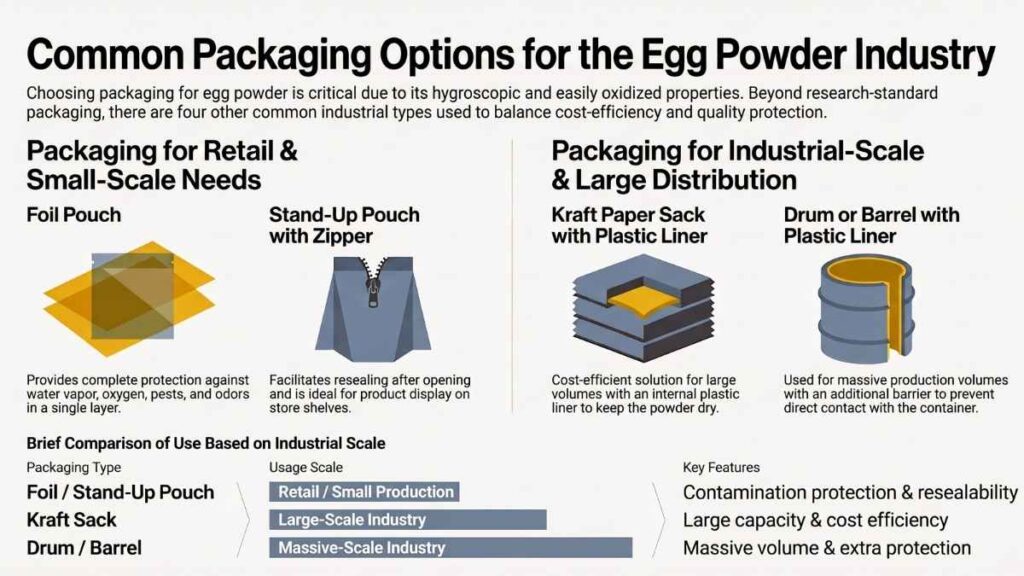
Beyond the three types tested in that study, several other packaging types are also commonly used in the egg powder industry. Here are four packaging types frequently seen.
1. Foil Pouches
Foil pouches offer protection against moisture, oxygen, pests, and odor all in a single layer of material, making them well-suited to shielding egg powder from contamination on multiple fronts. This packaging type is generally chosen for retail or small-scale production because of its compact size and ease of distribution.
2. Stand-Up Pouches With a Zipper
Stand-up pouches come with a zipper that makes it easy to reseal the packaging after it’s been opened, so egg powder stays protected even when used gradually over time. Their self-standing design also makes them easier to store and arrange on warehouse shelves or store displays.
3. Kraft Paper Sacks With a Plastic Lining
Kraft paper sacks with a plastic lining on the inside are commonly used for large-scale industrial packaging, since they can hold a greater volume of egg powder at a more efficient production cost. The plastic lining on the inside keeps egg powder dry even if the outside of the sack is exposed to moisture.
4. Drums or Barrels With a Plastic Liner
Drums or barrels are used for very large production volumes, typically by industrial-scale food manufacturers that need a large supply of egg powder all at once. The plastic liner inside the drum acts as an extra barrier that prevents direct contact between the egg powder and the drum’s surface.
Tips for Choosing the Right Packaging for Egg Powder
Choosing the right packaging takes more consideration than just the price per unit. Four tips below help you choose packaging that fits your needs.
1. Match the Packaging Type to Your Production Scale
Choose foil pouches for retail or small-scale production, and sacks or drums for large industrial needs. This kind of matching helps keep costs efficient without compromising product protection.
2. Prioritize Packaging With a Low Light Transmission Rate
Choose opaque or aluminum-laminated packaging over plain transparent packaging. Packaging with a low light transmission rate has been shown to more effectively protect egg powder from oxidation during distribution.
3. Make Sure the Packaging Has a Resealing Feature
Prioritize packaging with a zipper or another resealing feature if the product will be used gradually over time. This feature keeps egg powder from being exposed to open air every time the packaging is opened.
4. Test the Packaging Before Committing to Large-Scale Use
Run a small-batch packaging trial before committing to one packaging type across your entire production line. This trial helps confirm the packaging genuinely fits your storage and distribution conditions.
Read also: Cross-Contamination in Food Products: How Big Is Packaging’s Role?
Conclusion
The ideal packaging type for egg powder is one with a low light transmission rate, whether through a cardboard or aluminum layer, since it has been shown to more effectively prevent oxidation during distribution. Plain polyamide packaging without additional protection is best avoided for long-term storage.
Beyond choosing the right material, matching the packaging type to your production scale also shapes cost efficiency without sacrificing product quality. Testing the packaging before committing to large-scale use is the final step that helps confirm your choice is the right one.
For culinary businesses or food manufacturers that need raw material packaged in a way already proven to preserve its quality, Egg Powder from Accelist Pangan Nusantara is packaged using material designed to protect the product from light, oxygen, and moisture. Contact Us for product information and to discuss your business’s egg raw material needs.
FAQ
Not always bad, but transparent packaging without additional protection tends to be less effective at resisting light-induced oxidation than opaque or aluminum-laminated packaging.
Both are equally effective at blocking light, though aluminum-layered packaging is generally more compact and more commonly used for retail packaging than cardboard-layered packaging.
Foil pouches are better suited for retail or small-scale production, while large industrial needs typically use sacks or drums instead.
Ask the supplier directly about the material type and any protective performance test results before agreeing to a long-term partnership.
Yes, for gradual use, since a zipper feature keeps egg powder from being exposed to open air every time the packaging is reopened.