
The maximum moisture standard for egg powder is one of the parameters that matters most for this product’s quality and safety, even though it often gets less attention than protein content or color. Manufacturers who overlook this standard risk producing egg powder that clumps easily or is even unsafe to consume.
According to an egg powder production patent recorded on Google Patents, egg powder moisture content ideally stays below 5%, with an optimal range of 3% to 5% to maintain storage stability. That figure serves as a baseline for distinguishing quality egg powder from a product at risk of spoiling quickly.
This article covers the maximum moisture standard for egg powder, from the reasoning behind that figure to its connection with food safety. You will also find ways to keep egg powder moisture within standard.
Why Moisture Content Matters in Egg Powder
Moisture content is a major factor in how long egg powder can hold onto its quality before it starts to decline. Uncontrolled moisture opens the door for microbes to grow while also speeding up the breakdown of egg powder’s texture and flavor.
Egg Powder Moisture Standards: What Indonesia’s SNI Sets
Indonesia has a specific standard for egg powder moisture content through SNI 01-4323-1996 on Egg White Powder, which also covers whole egg powder and egg yolk powder. This standard sets a slightly different maximum moisture limit for each type of egg powder.
| Egg Powder Type | Maximum Moisture Under SNI |
|---|---|
| Whole egg powder | 5% |
| Egg white powder | 8% |
| Egg yolk powder | 5% |
This difference in limits reflects each powder type’s composition, since egg white powder has a protein structure that can hold slightly more moisture than whole egg or egg yolk powder. Interestingly, not every country sets such a specific figure: the American Egg Board notes that dried egg white manufacturing in the US, defined under 21 CFR 160.145, does not specify a minimum or maximum moisture content at all, leaving it to individual manufacturers to set their own internal target.
How Is Moisture Content Expressed as a Weight Percentage?
Egg powder moisture content is typically expressed as a percentage by weight, measuring how much water remains compared to the product’s total weight once drying is complete. The smaller this percentage, the drier and more stable the resulting egg powder.
Why Is Egg Powder Moisture Capped at a Maximum of 5%?
The 5% limit isn’t an arbitrary figure. It reflects consideration of four technical aspects at once. Here is a breakdown of the reasoning behind that limit.
- Moisture above 5% raises the risk of microbial growth due to higher water activity
- Excess moisture speeds up clumping in egg powder, making it harder to dissolve fully when used
- Low moisture helps slow chemical reactions that can alter egg powder’s color and aroma during storage
- Controlled moisture helps limit enzyme activity that could otherwise damage the protein in egg powder
How Does Moisture Content Connect to Egg Powder Food Safety?
Moisture content in egg powder turns out to affect more than just texture, extending into how biological hazards like Salmonella are controlled. According to USDA food safety guidance, the lower the initial moisture content in dried egg white before heat treatment, the longer it takes to reach a safe level of bacterial kill.
As an illustration, dried egg white with an initial moisture content of 6% needs up to 18 days of heat holding at 54°C to reach the required level of Salmonella kill. This fact shows that lower moisture doesn’t always mean a faster path to safety. It can actually require adjusting other parts of the process to keep the biological hazard genuinely under control.
Ways to Keep Egg Powder Moisture Within Standard
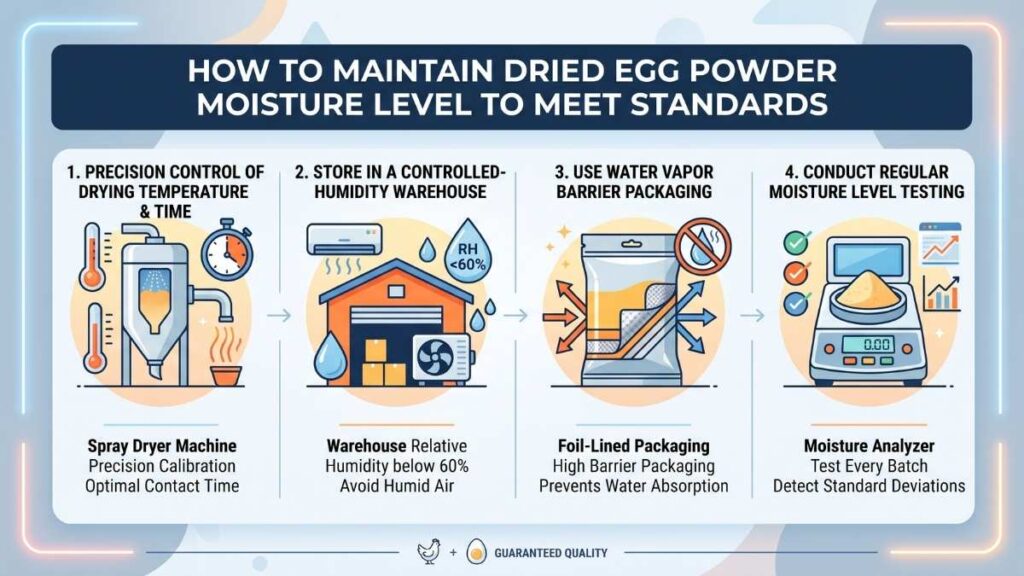
Keeping moisture content within standard requires control across four stages at once, not just during production itself. The four methods below help you maintain that consistency.
1. Precisely Control Drying Temperature and Time
Make sure the spray dryer operates at a properly calibrated temperature and contact time. Precise control helps you hit the target moisture level without needing to repeat the drying process.
2. Store in a Warehouse With Controlled Humidity
Keep the storage warehouse’s relative humidity below 60% so egg powder doesn’t reabsorb moisture from the air. A damp warehouse can raise a product’s moisture content even when the drying process itself already met standard.
3. Use Packaging With a Good Moisture Vapor Barrier
Choose packaging with a low moisture vapor transmission rate, such as aluminum-laminated packaging or foil pouches. The right packaging keeps egg powder moisture from rising during storage or distribution.
4. Test Moisture Content Regularly
Test egg powder moisture on every production batch using a dedicated instrument such as a moisture analyzer. Routine testing helps catch a deviation from standard before the product reaches the buyer.
Conclusion
The maximum moisture standard for egg powder, set below 5%, accounts for microbial growth, clumping, color and aroma changes, and enzyme activity all at once. Moisture content that falls outside this standard can lower egg powder quality well before it’s ever used.
Moisture content also turns out to connect to how biological hazards are controlled, so manufacturers need to balance moisture level with the heat treatment applied. Consistent control from production through storage is the key to keeping this standard met.
For culinary businesses or food manufacturers that need raw material with moisture content kept within standard, Egg Powder from Accelist Pangan Nusantara is produced with consistent moisture control in every batch. Contact Us for product information and to discuss your business’s egg raw material needs.

FAQ
Ideally yes, since moisture above that limit raises the risk of clumping and microbial growth during storage.
It can, since very low moisture in a product that hasn’t been pasteurized requires a longer heat treatment time to reach an adequate level of food safety.
Moisture content is usually measured using a moisture analyzer or an oven-drying method in a laboratory.
Yes, especially if the packaging or storage conditions fail to prevent moisture absorption from the surrounding air.
They generally fall within a similar range, though whole egg, egg white, and egg yolk powder can each have a slightly different specific limit depending on the production method.