

Substitute ingredients for egg powder are increasingly sought after as demand grows for egg-free products, whether due to allergies or specific dietary preferences. Even so, not every substitute ingredient can replicate all of egg powder’s functions within the same product.
A review published in PMC notes that replacing egg in food products is a challenge of its own, since a substitute ingredient has to replicate emulsifying, foaming, and gelling functions while also mimicking the original color and taste. That complexity explains why many manufacturers still consider egg powder their primary choice even as substitute ingredients keep improving.
This article covers how egg powder compares with other substitute ingredients, from each one’s strengths and weaknesses to when it makes sense to choose one over the other. You will also find tips for choosing the ingredient that fits your production needs.
Why Do Food Manufacturers Look for Substitutes for Egg Powder?
The need for an egg powder substitute usually comes down to a handful of factors tied to target market and production conditions. Here are four main reasons manufacturers consider a replacement ingredient.
- Growing global demand for vegan or animal-product-free products
- The need for allergen-free products for consumers with an egg allergy
- Fresh egg price fluctuation that pushes manufacturers to look for an alternative with more stable costs
- A sustainability preference that leads a number of manufacturers to shift toward plant-based ingredients
Comparing Egg Powder With Other Substitute Ingredients
Every substitute ingredient has different functional characteristics compared with egg powder, particularly in protein content and emulsifying capacity. Here is a comparison based on a number of scientific studies.
| Ingredient | Protein Content | Functional Characteristics |
|---|---|---|
| Whole egg powder | About 48% (dry basis) | Balanced emulsifying, foaming, and gelling function in a single ingredient |
| Aquafaba (bean cooking liquid) | About 5% to 8.5% | Good foaming and emulsifying ability, but far lower protein content |
| Soy protein concentrate | Varies, generally high | Can mimic batter volume and texture, but carries its own allergen risk |
| Flaxseed or chia | About 20% to 30% | Good binding function, but less effective for foaming |
This comparison shows that each substitute ingredient generally excels at only one or two functions, while egg powder can carry out several of those functions at once in a single ingredient. That’s why combining two or three substitute ingredients is sometimes needed to fully replace what egg powder does.
Advantages of Egg Powder Over Its Substitutes
Even as substitute ingredients keep improving, egg powder still holds onto a handful of advantages that haven’t been fully replaced. Here are four main advantages egg powder has over its substitutes.
- Can carry out emulsifying, foaming, and gelling functions at once in a single ingredient
- A generally neutral taste that doesn’t leave behind the distinct aroma some plant-based ingredients do
- More complete nutritional content, including high-quality protein and important micronutrients
- Broad compatibility across processed food categories, from noodles to bakery products
When Can a Substitute Ingredient Be the Right Choice?
A substitute ingredient still makes sense to use under certain conditions, especially when egg powder isn’t a viable option. Here are four conditions that signal a substitute ingredient is worth considering.
- A product specifically targeting vegan consumers or those avoiding animal products
- A product that must be egg-free because of a target consumer with a known allergy
- A formulation that doesn’t need all of egg powder’s functions at once, for example when only a binding function is required
- A short-term need when the egg powder supply faces a temporary disruption
Tips for Choosing Between Egg Powder and a Substitute Ingredient
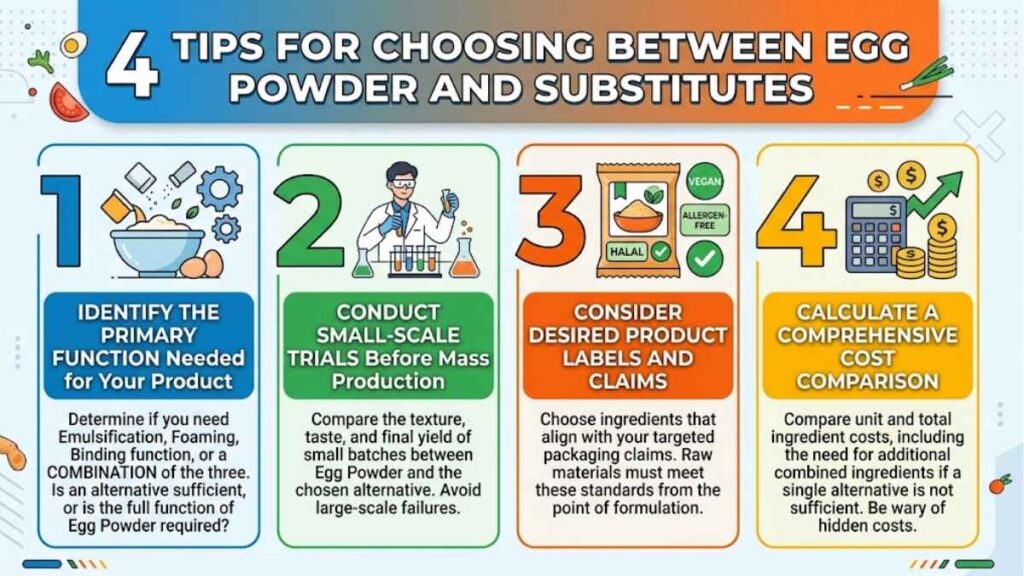
Making the right choice takes more consideration than simply following a market trend. Four tips below help you make a more focused decision.
1. Identify the Main Function Your Product Needs
Determine upfront whether your product needs emulsifying, foaming, binding, or a combination of the three. This clarity helps you decide whether a specific substitute ingredient is enough or egg powder is still needed.
2. Run a Small-Scale Trial Before Mass Production
Run a small-batch formulation trial to compare the final result between egg powder and your chosen substitute ingredient. This trial helps you avoid a large-scale production failure caused by a difference in ingredient characteristics.
3. Consider the Label and Product Claims You Want
Match your ingredient choice to the claims you want on the packaging, such as vegan, allergen-free, or Halal-certified. These claims affect which ingredient should be used from the start of the formulation.
4. Calculate the Full Cost Comparison
Compare the cost of a substitute ingredient with egg powder, including the need for additional ingredients if one substitute alone isn’t enough. A thorough calculation helps you avoid hidden costs from repeated formulation adjustments.
Conclusion
Egg powder remains difficult to fully replace because of its ability to carry out emulsifying, foaming, and gelling functions all at once in a single ingredient. Substitute ingredients such as aquafaba, soy protein, or flaxseed generally only excel at one or two specific functions.
Choosing between egg powder and a substitute ingredient ultimately depends on your product’s needs, target consumer, and the claims you want on the packaging. Understanding each ingredient’s strengths and limitations helps manufacturers make a more informed formulation decision.
For culinary businesses or food manufacturers that still need the full function of an egg-based ingredient, Egg Powder from Accelist Pangan Nusantara offers consistent emulsifying, foaming, and gelling capability in a single ingredient. Contact Us for product information and to discuss your business’s egg raw material needs.

FAQ
Not entirely, since most substitute ingredients only excel at one or two functions, while egg powder can carry out several of those functions at once.
Aquafaba and soy protein concentrate are among the most studied for their ability to mimic emulsifying and foaming function, though their protein content still differs from egg powder.
Not always, since a number of substitute ingredients actually need to be combined with other ingredients to fully mimic egg powder’s function, which can push the total cost higher.
Not always, since an ingredient like soy protein is also a common allergen and still needs to be listed on the product label.
Yes, depending on the formulation’s needs, such as using a smaller amount of egg powder combined with a substitute ingredient for cost efficiency.