
Managing egg raw material supply chain risk has become an increasingly urgent need for food manufacturers, especially since this raw material is prone to disruptions that are hard to predict. Without a systematic approach, a small disruption at one point in the supply chain can grow into a much larger production crisis.
A guide compiled by Trustwell found that 66% of business leaders rank reputational damage among their top three risks from supply chain disruption. That figure shows the impact of a supply disruption doesn’t stop at operational losses. It can also affect customer trust over the long run.
This article covers egg raw material supply chain risk management, from the types of risk worth watching for to the framework for managing them. You will also find mitigation strategies commonly applied by buyers facing supply disruptions.
Why Is the Egg Raw Material Supply Chain So Prone to Disruption?
Egg raw material has characteristics that make it more prone to disruption than a number of other food raw materials. Here are four characteristics behind that vulnerability.
- Its perishable nature, meaning it can’t be stored for long without special handling
- Dependence on a laying hen population that’s vulnerable to disease outbreaks
- Fluctuating prices driven by changes in feed cost and seasonal demand
- Reliance on a timely cold chain and logistics to maintain product quality
Types of Risk in the Egg Raw Material Supply Chain
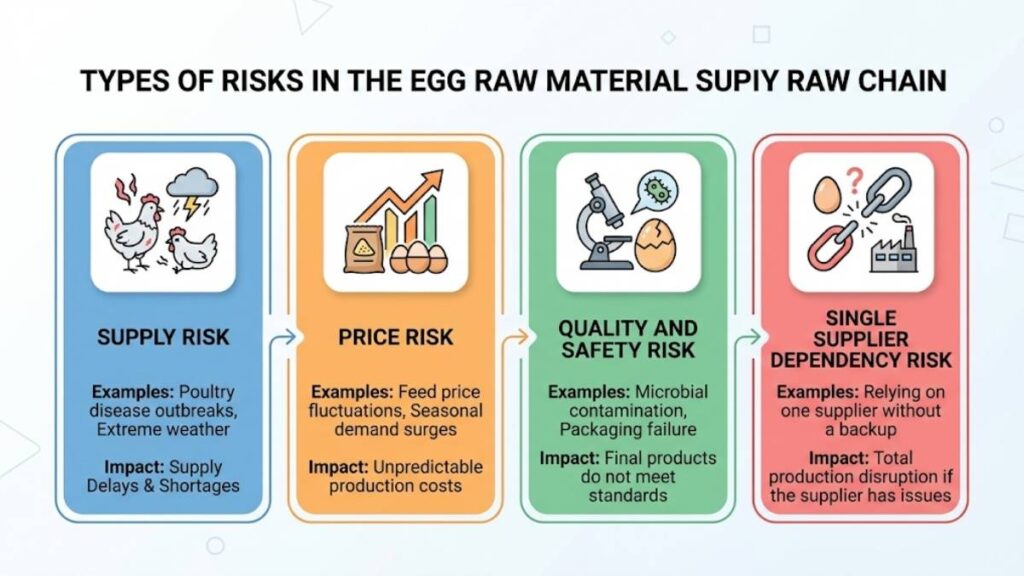
Risk in the egg raw material supply chain can be grouped into four categories based on its source and impact. Here is a breakdown of the risk categories buyers need to understand.
| Risk Type | Example | Impact on Buyers |
|---|---|---|
| Supply risk | Poultry disease outbreaks, extreme weather disruption | Delayed or short raw material supply |
| Price risk | Feed cost fluctuation, seasonal demand spikes | Production costs that are hard to predict |
| Quality and safety risk | Microbial contamination, packaging failure | A final product that falls short of standard |
| Single-supplier dependency risk | Relying on only one supplier with no backup | Total production disruption if that single supplier runs into trouble |
Each risk category calls for a different handling approach, even though all four can influence one another in practice. Understanding which category is most relevant to your business is the first step before building the right mitigation strategy.
Read also: Cross-Contamination in Food Products: How Big Is Packaging’s Role?
A Risk Management Framework You Can Apply
Managing supply chain risk takes a structured approach, not just a reaction once a problem has already occurred. Here are four framework stages commonly used in food supply chain risk management.
- Risk identification, which means mapping every raw material source and potential disruption that could occur at each supplier.
- Risk assessment and prioritization, which means evaluating how likely and how severe each identified risk is so resources can focus on the most significant ones.
- Risk mitigation, which means building a concrete strategy for each priority risk, such as supplier diversification or long-term contracts.
- Ongoing monitoring, which means regularly reviewing supply chain conditions so mitigation strategies stay relevant as market or supplier conditions change.
Mitigation Strategies Commonly Applied by Buyers
Each stage of the framework above needs a concrete strategy to actually work in practice. Here are the four strategies most commonly used by egg raw material buyers.
1. Diversify Suppliers Across Different Regions
Partner with more than one supplier from different geographic regions to reduce reliance on a single supply source. This strategy helps keep supply running even if one region faces a disruption such as a poultry disease outbreak.
2. Set Up Long-Term Contracts With Clear Pricing Clauses
Agree on a long-term contract with a trusted supplier, complete with a transparent price adjustment clause. A contract like this helps protect your business from a sudden price spike while also maintaining a long-term relationship with the supplier.
3. Invest in a Raw Material Traceability System
Use a digital record-keeping system that allows raw material to be traced back to the farm level. This traceability speeds up identifying the source of a problem whenever a quality or food safety disruption occurs.
4. Consider Hedging Instruments or Supply Chain Insurance
Look into options such as weather-index insurance or price hedging instruments to protect your business from losses tied to a farmer’s production disruption. These instruments help stabilize cash flow even when a supply disruption falls outside the buyer’s direct control.
Conclusion
Managing egg raw material supply chain risk requires understanding the various types of risk, from supply disruption to single-supplier dependency. A structured framework, from identification through ongoing monitoring, helps buyers manage that risk more systematically.
Applying mitigation strategies such as supplier diversification and long-term contracts helps a business stay stable even when facing disruptions outside its direct control. This proactive approach is far more effective than waiting for a problem to occur before looking for a solution.
FAQ
Supply risk from poultry disease outbreaks and price risk from feed cost fluctuation are the two risks faced most often.
Generally effective, though it still needs to be paired with a quality verification process for every new supplier brought on board.
It should ideally be reviewed periodically, such as every six months, or right after a significant change in market or supplier conditions.
Yes, though the scale of implementation can be adjusted to fit business capacity, such as by building good relationships with more than one small supplier.
Not yet universally, but this instrument is being considered more often as the frequency of food supply chain disruptions increases.