
The yellow color in egg yolk powder is often treated as just an aesthetic detail, when in fact color consistency is an important quality indicator for many food manufacturers. Faded or uneven color from batch to batch can make a final product look less appealing even when its nutritional content hasn’t changed.
Research published in PMC found that storage temperature significantly affects the retention rate of lutein, the main pigment behind egg yolk’s color, with greater pigment loss occurring at room temperature compared with cold storage. That finding confirms just how much egg yolk color stability depends on how the product is handled after processing.
This article covers how to keep egg yolk powder color stable, from where that color comes from to the factors that cause it to fade. You will also find out how color is measured objectively and what prevention steps manufacturers can apply.
Where Does Egg Yolk Powder’s Yellow Color Come From?
Egg yolk’s yellow color comes from carotenoid pigments, specifically lutein and zeaxanthin, which belong to the xanthophyll group. Laying hens cannot produce these pigments on their own, so egg yolk color depends entirely on the xanthophyll content of their feed.
These pigments then carry over into fresh egg yolk and remain present once the egg is processed into powder form through drying. Since the pigment originates from feed, color intensity can vary from one supplier to another depending on the feed source each farm uses.
How Is Egg Yolk Color Measured Objectively?
Egg yolk color is typically measured using one of two methods: the Roche Yolk Color Fan, which compares color against a visual scale from 1 to 15, or a colorimeter, which produces a numeric Lab* value. The b* value in this system specifically indicates yellowness, making it the most relevant reference for monitoring egg yolk powder’s color stability.
What Causes Egg Yolk Powder Color to Fade, and How to Prevent It
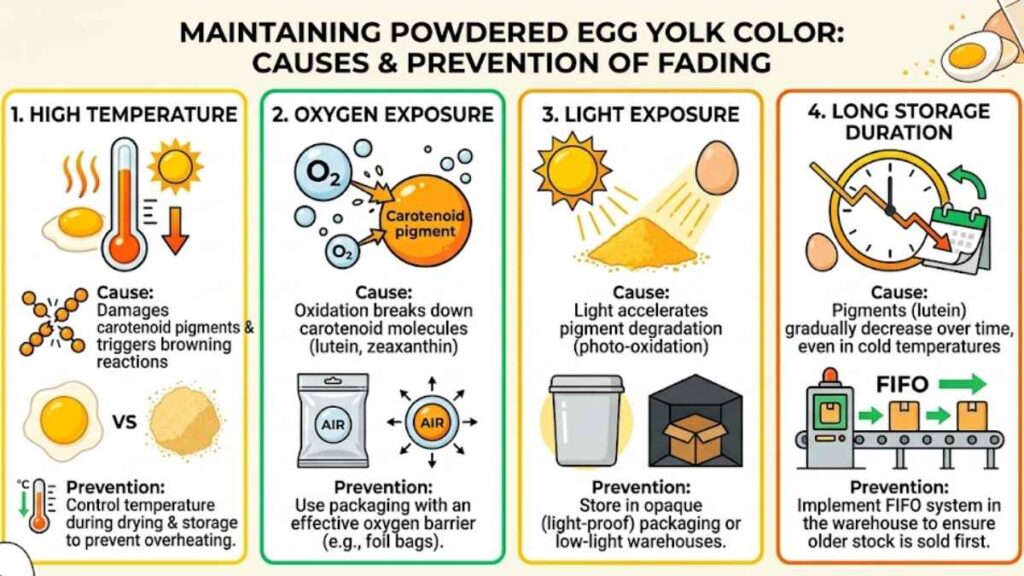
Egg yolk powder color can fade due to a number of interconnected factors during processing and storage. Here is a breakdown of those causes along with how to prevent them.
| Factor | Cause of Color Fading | How to Prevent It |
|---|---|---|
| High temperature | High temperature triggers a nonenzymatic browning reaction that damages the carotenoid structure | Control drying and storage temperature so it doesn’t run too high |
| Oxygen exposure | Carotenoids are highly sensitive to oxidation when exposed to open air | Use packaging with a good oxygen barrier |
| Light exposure | Light speeds up pigment degradation during storage and distribution | Store in opaque packaging or a storage space with minimal light |
| Extended storage duration | Lutein content still declines even under cold storage, though at a slower rate | Apply a FIFO system so older stock doesn’t sit in storage too long |
These four factors show that egg yolk powder’s color stability is actually closely tied to the same storage and packaging principles used to maintain egg powder quality overall. Controlling temperature, oxygen, light, and storage duration together is the most effective way to keep the yellow color consistent.
Conclusion
Egg yolk powder’s yellow color comes from carotenoid pigments like lutein and zeaxanthin, which are prone to fading from high temperature, oxidation, light, and extended storage. Keeping this color stable requires controlling all of these factors together, not just one at a time.
Measuring color objectively, whether through the Roche Yolk Color Fan or a colorimeter, helps manufacturers track color consistency over time. That consistency ultimately affects how consumers receive the final product, especially for products that rely on a yellow appearance as part of their appeal.
FAQ
Not necessarily, since color intensity is mostly influenced by the type of chicken feed used, not a direct indicator of nutritional content or product safety.
No, since carotenoid degradation is permanent and cannot be reversed once it happens.
Duration varies depending on storage conditions, but it’s generally more stable in cold storage than at room temperature.
Yes, a significant one, since opaque, oxygen-tight packaging helps slow down pigment degradation from light and air exposure.
Not always, since color intensity depends on the feed source used by each supplier’s laying hens.