
Halal certification for export is official proof that a food product meets the halal rules of the destination country. In countries that require it, a product without a certificate cannot enter.
This article explains three reasons halal certification is an export requirement and how Indonesia’s mandate differs from destination-country rules. You will also see what the data says about its effect on export value, and five things to prepare before you ship.
3 Reasons Halal Certification Matters for Food Exports
Halal certification matters for food exports because destination countries that require it ask for proof of halal status from an authorized body. According to LPPOM MUI, the Indonesian Ulema Council’s food, drug, and cosmetic assessment institute, the requirement rests on three reasons (source in Indonesian).
1. Destination Countries With Large Muslim Populations
The first reason is the destination itself: countries with large Muslim populations, such as members of the Organization of Islamic Cooperation (OIC). In these markets, a halal certificate serves as documentary proof that a product may enter.
2. Products Used as Ingredients in Halal Production
Your product may need a certificate even when the destination is not a Muslim-majority country, as long as it is used as an ingredient in halal production there. For example, a food manufacturer in a non-Muslim-majority country that serves the halal market may ask its ingredient suppliers for certificates so its finished products keep their halal status.
3. Logo and Labeling Rules in the Destination Country
The third reason is packaging rules. A destination country can set its own rules for halal logos on packaging, so labels and documents may need to be adjusted.
Is Halal Certification for Export Mandatory for Food Products?
It depends on the destination country, not on Indonesian rules. Indonesia’s Halal Product Assurance Law (UU JPH) requires certificates for products that enter, circulate, and are traded in Indonesia, according to BPJPH, the national halal agency (source in Indonesian).
As LPPOM MUI describes them, requirements in destination countries fall into four patterns.
| Requirement pattern | Scope covered |
|---|---|
| Company halal statement (self-declaration) | Product declared halal and free of haram ingredients such as alcohol and pork, no certificate required |
| Halal certificate for meat | Meat and processed meat products |
| Halal certificate for animal-derived products | Products that contain animal-derived ingredients |
| Halal certificate for all products | Every type of product |
The table shows that halal requirements are not uniform across markets. One country may accept a company’s own statement, while another requires a certificate for animal-derived products or for every product.
That means the same product can enter one country without a certificate and be refused entry in another that requires one. So check your product category against the destination’s pattern before you start the halal paperwork.
Also read: International Certification Challenges: HACCP, ISO, Halal
Does a Halal Certificate Really Raise Food Export Value?
Indonesian data from 2020 to 2024 shows a positive link between the number of halal certificates and food export value, but it does not prove cause and effect. The head of BPJPH says halal certification helps micro and small businesses reach more markets and build consumer trust.
You can test that view against a study in the April 2026 issue of Gudang Jurnal Multidisiplin Ilmu, an Indonesian-language journal. According to the study, the number of halal-certified products in Indonesia rose from about 57,000 in 2020 to about 3 million in 2024.
Over the same period, food product exports rose from USD 38.7 billion to USD 52.1 billion. The number of certificates grew far faster than export value.
The study’s data table has only five yearly data points, and its statistical test is significant only at a loose 10 percent threshold (p = 0.068). Read the result as an indication, not proof.
The study also mentions exchange rates and international commodity prices as other factors outside halal certification. So a halal certificate meets the entry requirement in markets that demand one, but it does not guarantee orders.
5 Things Producers Should Prepare Before Exporting Halal Food
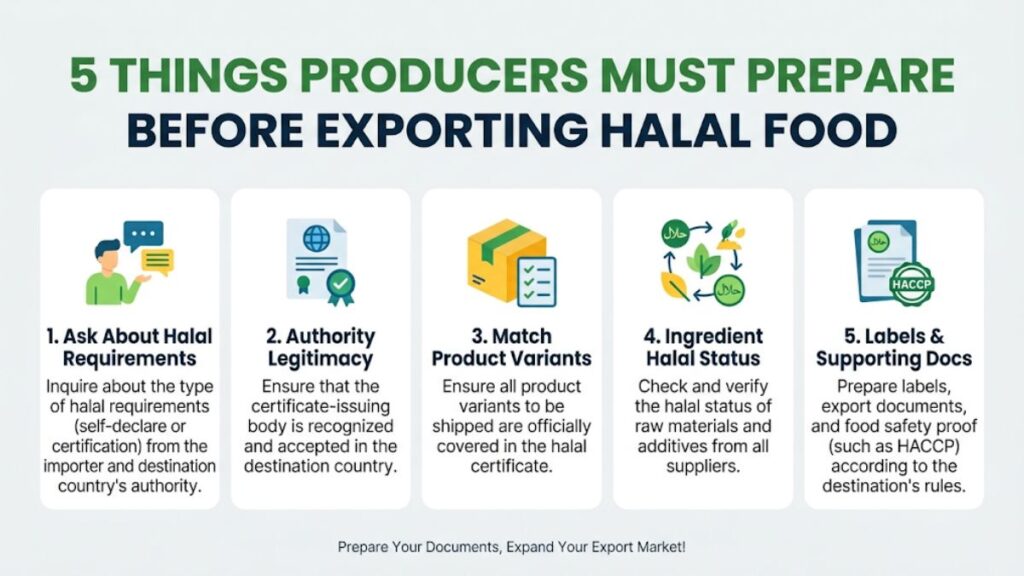
Before exporting, producers need to confirm that their halal documents match what the importer and the destination’s authorities require. These five steps help you check that one item at a time.
- Ask the importer and the destination’s authorities what form of halal proof they require. The answer tells you whether you need a company statement or a certificate, and for which product scope.
- Confirm that the certificate’s issuing body is recognized in the destination country, because a certificate from one country may not be accepted in another.
- Match the certificate’s scope to the products and variants you will ship. A certificate cannot serve as proof for a product it does not list.
- Check the halal status of raw materials and additives from every supplier. Complete records of ingredient origin make it easier to answer buyers’ questions in the destination country.
- Prepare labels and supporting documents that meet the destination’s rules, including proof of food safety such as HACCP. A halal certificate does not replace that proof.
Also read: HACCP: How Food Suppliers Keep Safety Consistent
Conclusion
Halal certification matters for export because destination countries set their own proof of halal status and labeling rules. The 2020 to 2024 data shows a positive link with food export value, but a certificate alone does not guarantee orders.
Your first step is to ask the importer in the destination country what form of halal proof it requires. Then match the issuing body and the certificate’s scope to those requirements.

FAQ
Who Issues Halal Certificates in Indonesia?
BPJPH, the Halal Product Assurance Organizing Agency, issues halal certificates in Indonesia. Halal Inspection Agencies (LPH), such as LPPOM MUI, examine the products.
What Is the Difference Between a Halal Certificate and a Halal Logo?
A halal certificate is an official document from the issuing body. A halal logo is the mark printed on packaging once the product is certified.
When Does Halal Certification Become Mandatory for Micro and Small Businesses?
For food and beverage products, the obligation for micro and small businesses starts on October 18, 2026, under Government Regulation No. 42 of 2024 (PP 42/2024). Medium and large businesses have been subject to it since October 2024.
How Can I Check Indonesian Halal Certificate Data?
BPJPH offers a Cek Produk Halal (halal product check) service on its official website. You can search by product name, business name, or certificate number.