
Building long-term supplier relationships means keeping a working partnership going from one order to the next, sustained by open communication and on-time payment. For a food business, that partnership decides whether ingredients keep arriving to specification when orders pile up.
In a supplier selection study in Bursa, Turkey, six managers from six catering companies gave crisis management, the supplier’s ability to take action against problems, the highest weight (30%). Cost received a weight of only 9%.
This article explains why these relationships matter, how to choose suppliers, six strategies, how to respond to delays and problems, and a real case from the food industry.
Why Long-Term Supplier Relationships Matter for Food Businesses
Long-term relationships with suppliers matter because a food business needs ingredients with consistent specifications from one delivery to the next. A supplier that already knows your requirements finds it easier to keep every delivery within specification.
When a supplier understands your ordering pattern, it can prepare stock early and fill peak-season orders more easily.
An established line of communication also speeds up the search for the cause when ingredient quality deviates from specification, for example through batch numbers that both sides record.
Switching suppliers also carries hidden costs. Ingredients from a new supplier need a document check and a recipe test, because small differences in an ingredient can change the texture and color of your product.
How to Choose Suppliers Worth a Long-Term Partnership
A supplier worth a long-term partnership keeps ingredient quality consistent and responds quickly to complaints. Compare prices only among suppliers that already meet your quality and reliability requirements.
| Criterion | What to check | How to check it |
|---|---|---|
| Quality consistency | The same ingredient specification from one batch to the next | Compare certificates of analysis (COAs) and the results of your incoming inspections |
| Document completeness | Valid business licenses and food safety documents | Request the documents before cooperation starts, then ask for updates when they expire |
| Delivery reliability | Goods arrive on the promised date and in the promised quantity | Log the promised and actual arrival dates, then match the quantity received to the order |
| Response to problems | How quickly the supplier answers complaints and offers solutions | Watch how it responds to your first complaint, however small the problem |
Quality consistency and response to problems are hard to judge from a quotation, so test both with a trial order before you promise large volumes.
For documents, ask for the files at the start and schedule renewals before they expire.
Also read: HACCP Documents You Should Request From Suppliers
Strategies for Building Long-Term Supplier Relationships
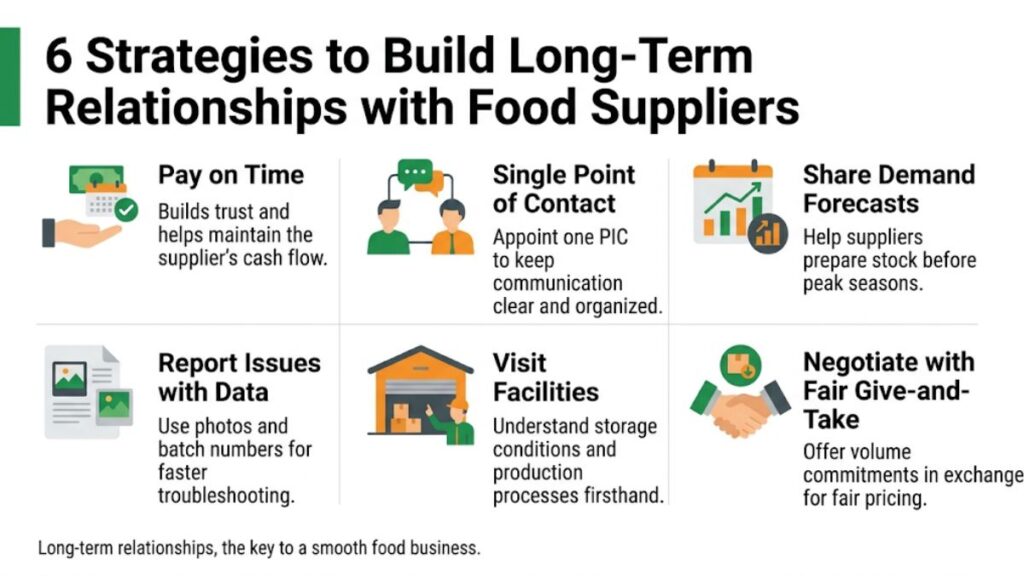
A lasting supplier relationship grows from small habits practiced consistently, namely paying on time and communicating regularly.
Pay on Time and Warn Early If You Will Be Late
On-time payment builds trust because a supplier’s cash flow depends on buyers who pay on schedule. If you may miss a payment date, contact the supplier before the due date and propose a new schedule.
A supplier finds it easier to accept a delay you announce early.
Set One Point of Contact and a Regular Communication Schedule
Name one person on your team as the main contact for the supplier, and ask the supplier to name its own. With a clear channel, important messages do not get lost between purchasing and the warehouse.
Also agree on how and when to share updates. For example, the supplier tells you the day goods ship, and you confirm when they arrive.
Share Demand Forecasts Before the Busy Season
A demand forecast helps the supplier prepare stock and production capacity before orders pile up. Send it before your busy season, such as Eid al-Fitr (Lebaran) for a bakery or wedding season for a caterer.
Forecasts can change. Tell the supplier as soon as the numbers shift, so it can adjust production.
Raise Problems with Data and Give Regular Feedback
When an ingredient has a problem, attach the batch number and photos of the goods to your first complaint. Data like this lets the supplier trace the cause, while a complaint without data is hard to act on.
Give feedback when quality meets expectations too. That way, the supplier knows which standard to maintain.
Visit the Supplier’s Facility and Meet in Person
A visit to the supplier’s warehouse or factory shows storage conditions and production processes that documents cannot reveal.
If your contract includes audit rights, the supplier has already agreed to this kind of visit. Schedule one before you renew the contract, then discuss each side’s constraints in the same meeting.
Negotiate Prices and Offer Something in Return
Price negotiations go more smoothly when you offer something in return, such as a volume commitment or a regular ordering schedule.
Hold price meetings separately from performance reviews, so the supplier does not feel that quality assessments are being used to push prices down. Record the agreement in a supply contract so both sides refer to the same figures.
How to Keep the Relationship Strong When Deliveries Run Late or Go Wrong
- Contact the supplier as soon as you learn of a delay or a quality deviation, then ask for the cause and the expected recovery time.
- Separate a one-time event from a recurring problem. A recurring problem calls for an improvement plan with a deadline.
- Look for a temporary fix with the supplier, such as staged deliveries or an equivalent substitute ingredient you have already tested in your recipe.
- Keep safety stock for ingredients that would stop production if they arrive late, so you have time to solve the problem without rushing.
- Handle the problem order apart from other orders, and pay the orders that meet requirements by their due dates.
- Record the resolution in writing, including the deadline for correction, then check the result on that date.
- Once the problem is resolved, acknowledge the supplier’s quick response and review the incident at your next meeting.
Also read: Consistent Supply: Must-Have Strategies for Large-Scale Catering
Example: Nestlé Indonesia’s Partnership with Lampung Coffee Farmers
Nestlé Indonesia’s partnership with coffee farmers in Lampung province (Tanggamus and West Lampung regencies) shows what a long-term relationship between a food manufacturer and its suppliers looks like. In 2016, the Indonesian news site Bisnis.com reported that the partnership began in 1994 and reached about 20,000 farmers, with 18,777 validated under 4C, a sustainable coffee standard.
In 2021, the partnership was still running, and Bisnis.com wrote that Nestlé’s farmer support team, AgriService, trained farmers in good agricultural practices to raise coffee productivity and quality.
For smaller food businesses, the lesson is to help suppliers meet your quality standards, for example by explaining ingredient specifications and sharing the results of your incoming inspections.
Conclusion
Building long-term supplier relationships starts with choosing partners that deliver consistent quality and respond quickly. The relationship holds through on-time payment and an open attitude when deliveries run late or go wrong.
A practical first step is to list the ingredients that would stop production if they arrived late. Then agree with those suppliers on a delivery schedule and a way to report problems.

FAQ
What Is Supplier Relationship Management (SRM)?
Supplier relationship management (SRM) is a structured approach to managing relationships with suppliers, covering supplier selection and regular performance evaluation. A small business can apply it simply with a supplier list and performance notes.
When Should You Switch Suppliers?
Consider switching when quality or delivery problems keep recurring after you have raised them with data and given the supplier a chance to fix them. Make sure the replacement has passed a document check and an ingredient test before production depends on it.
Can a Small Business with Small Order Volumes Build Long-Term Supplier Relationships?
Yes. A small cafe or bakery can build trust through on-time payment and a regular ordering schedule, whatever its volume.
How Long Does It Take to Build a Long-Term Supplier Relationship?
There is no fixed timeline, because trust builds from a repeated record of deliveries and payments. A sign that it is working is that the supplier starts telling you early when stock or delivery schedules change.