
A consistent supply strategy is a set of steps that keeps raw materials available in the right amount and at the right time, even when catering demand spikes ahead of event season. For large-scale catering businesses, this requirement carries more weight, since every event contract already locks in a date and a portion count that cannot be renegotiated.
According to data compiled by Restaurant365, around 60% of total sales at food service and catering businesses goes toward prime cost, the combined cost of raw materials and labor. Once raw material supply gets disrupted, that share of the budget is immediately at risk of being eaten up by emergency purchases at higher prices from backup suppliers who may not even be available.
This article summarizes four consistent supply strategies that large-scale catering businesses can apply, from supplier diversification to choosing raw materials with a longer shelf life. Each strategy is laid out so business owners or procurement teams running day to day catering supply chains can put it into practice right away.
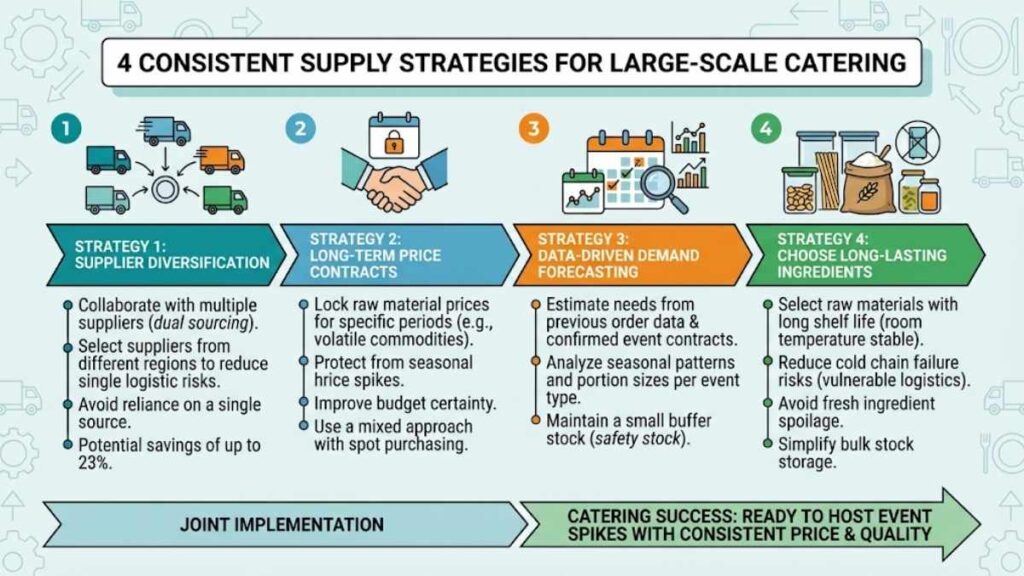
Strategy 1: Diversify Suppliers to Avoid Relying on a Single Source
Supplier diversification means working with more than one raw material provider for the same commodity, instead of relying on a single supplier for an entire production need. With only one supplier, a single problem (a failed harvest, a shipping delay, or a sudden price increase) can bring an entire catering production line to a halt.
NetSuite notes cost savings of up to 23% compared with buying from a single supplier, driven by the price competition that emerges once more than one supplier is vying for the business. A 2025 WTW survey cited in the same report also found that 50.4% of organizations had already adopted a dual sourcing strategy, up from 43% in 2023.
A backup supplier is ideally chosen from a different region or distribution route than the main supplier, so the same risk (flooding that shuts down one logistics route, for instance) does not take out both at once. Purchase volume should also be split proportionally rather than evenly, so the main supplier still gets the largest share and the long-term working relationship stays intact.
Strategy 2: Lock In Prices with Long-Term Contracts to Dampen Volatility
Locking in raw material prices with a supplier for a set period, that is the core idea behind a long-term price contract. This approach protects the budget from seasonal price spikes, especially for commodities whose prices move easily, such as eggs and cooking oil.
Long-term contracts win on price certainty, while spot buying wins when market prices happen to be falling. The table below summarizes the comparison between the two, based on a review by BuyersEdge Platform of purchasing strategies in the restaurant and catering industry.
| Aspect | Long-Term Contract | Spot Buying |
|---|---|---|
| Price certainty | Price locked for the contract period | Follows market price at time of purchase |
| Volume flexibility | Tied to the volume already agreed on | Free to adjust to sudden needs |
| Main risk | Still paying the old price even if market price drops | Budget shaken when market price spikes |
A combination of both is often the most practical choice, with long-term contracts covering staple ingredients used every day and spot buying covering seasonal needs that are not routine. BuyersEdge Platform notes this mixed approach helps catering businesses keep room to maneuver without losing budget certainty for their biggest raw material purchases.
Strategy 3: Forecast Demand Using Event Calendars and Historical Data
Demand forecasting means estimating raw material needs from past order data, rather than from a rough guess made by the kitchen team. For large-scale catering, this estimate is actually easier than for an ordinary restaurant, since every event is already locked into a contract with a date and a portion count fixed well before the event itself.
The most useful data includes usage history broken down by event type, such as the difference in portions between a wedding reception and an office gathering, plus seasonal patterns like the surge in bookings ahead of year end. Delivery lead time from each supplier is also worth tracking, so the reorder schedule does not end up running too close to a date already locked in by contract.
The gap between forecast and actual need should still be covered with a small buffer stock, not eliminated altogether even once forecasting becomes accurate. Good forecasting does shrink the buffer size needed, but removing it completely remains risky whenever one large order comes in out of nowhere.
Strategy 4: Choose Raw Materials with a Long Shelf Life to Cut Cold Chain Risk
Raw materials with a long shelf life cut reliance on the cold chain. That chain can fail at any point, from the supplier’s warehouse to the catering kitchen, and the longer the distribution route fresh raw materials have to travel, the greater the chance storage temperature slips outside a safe range.
Food Safety Magazine notes seafood products that should be stored below 41°F (5°C) are often found sitting in the mid to high 40s°F range (roughly 7 to 9°C), the result of reloading at the dock or shipping delays. Leafy greens, meanwhile, can freeze or wilt once storage temperature drifts outside the range it needs.
Dry raw materials that stay stable at room temperature, such as flour and other powdered ingredients, face none of this risk at all, since they do not depend on a cold chain anywhere along their distribution route. That choice also makes it easier to store large volumes of stock without worrying about limited cold storage capacity, something that matters once catering order volume spikes ahead of event season.
Conclusion
These four strategies, supplier diversification, long-term price contracts, data-based forecasting, and choosing raw materials with a longer shelf life, work best applied together rather than picked one at a time. Supplier diversification without accurate forecasting, for instance, can still end in excess stock that sits around and spoils before it ever gets used.
Large-scale catering businesses that run all four steps consistently are better positioned to handle seasonal order spikes without suddenly raising prices on clients or cutting corners on portions already promised. That kind of readiness also becomes a selling point of its own when negotiating with corporate clients who value long-term reliability over the lowest price.
FAQ
A consistent supply strategy is a combination of steps, such as supplier diversification, long-term price contracts, and demand forecasting, that keeps catering raw materials available on time. Its purpose is to prevent stockouts when event demand spikes.
Supplier diversification reduces the risk of a single point of failure, so a problem at one supplier does not immediately halt all production. It also opens the door to more competitive pricing, since suppliers compete against each other.
A long-term contract locks in raw material prices for a set period, while spot buying follows market price at the time of each transaction. Many catering businesses use a combination of both depending on the raw material.
Raw materials with a long shelf life do not depend on a cold chain that is prone to failing somewhere along the distribution route. They are also easier to store in large volumes without running into limited cold storage capacity.
Catering forecasting tends to be more accurate, since every event is already locked into a contract with a date and portion count fixed well before the event itself. A regular restaurant has a harder time predicting daily demand, since it lacks that same level of certainty.