
Maintaining dry raw material production equipment means routine inspection and cleaning that keeps machinery running to food safety standards. Without consistent maintenance, contamination and sudden breakdowns become risks that are hard to avoid.
According to data compiled by Processing Magazine, aging equipment accounts for 42% of unscheduled downtime in manufacturing. That figure means preventive maintenance is not a formality, but a factor that determines whether production stays on schedule.
This article covers the equipment parts most prone to failure, a sifter screen inspection schedule by type, and the preventive maintenance steps every dry raw material production line needs. Each section is written so a production team can put it into practice right away.
Why Does Well-Maintained Equipment Determine Production Safety and Efficiency?
Well-maintained equipment determines production safety and efficiency because the two are closely linked on a dry raw material processing line. Worn or dirty components slow down the process and risk contaminating whatever is being processed at the same time.
A sifter with a loose screen lets foreign particles slip into the raw material, while a motor that rarely gets lubricated wears out faster and stops without warning. Both examples are why maintenance cannot wait until a machine actually breaks down.
Read also: Cross-Contamination in Food Products: How Big Is Packaging’s Role?
Equipment Parts Most Prone to Failure
Four components are the most common source of problems in dry raw material production equipment, from screening mesh to motor bearings. Knowing the risk each one carries helps a production team set maintenance priorities.
| Component | Risk If Neglected | Maintenance Action |
|---|---|---|
| Sifter screen (mesh) | Loose metal strands contaminate the product, foreign particles slip through | Check screen tension and condition on schedule, replace at the first sign of wear |
| Air or dust filter | Raw material dust builds up and contaminates the production space | Clean or replace filters routinely based on production load |
| Conveyor belt | Sudden tearing or slack that halts the production line | Check belt tension and wear before each day’s production run |
| Drive motor bearing | Motor wears out faster and stops under heavy load | Lubricate on the manufacturer’s schedule and listen for unusual noise while running |
Filters, belts, and bearings do not have an unlimited service life, as PEMAC notes in its review of preventive maintenance at food processing facilities. Replacing these components on schedule costs far less than absorbing the downtime that comes with a sudden breakdown.
Sifter Screen Inspection Schedule by Type
Every sifter type needs a different screen inspection routine, depending on how it works and how much stress the screen takes. The table below sums up the recommended inspection schedule for the three sifter types most commonly used.
| Sifter Type | Inspection Frequency | Reason |
|---|---|---|
| Centrifugal sifter | After every batch, or daily | Forced material movement makes screen failure far more likely |
| Vibratory sifter | Routine, with a screen tension check | Prone to screen blinding if tension and vibration are not maintained |
| Gyratory sifter | Less often than the other two types | Material moves more gently across the screen, so wear stays minimal |
Checking a sifter screen, according to Powder & Bulk Solids, usually takes less than 6 minutes per check. That small amount of time is worth the risk it prevents, especially since metal strands that break loose from a screen are hard to detect once they mix into the raw material.
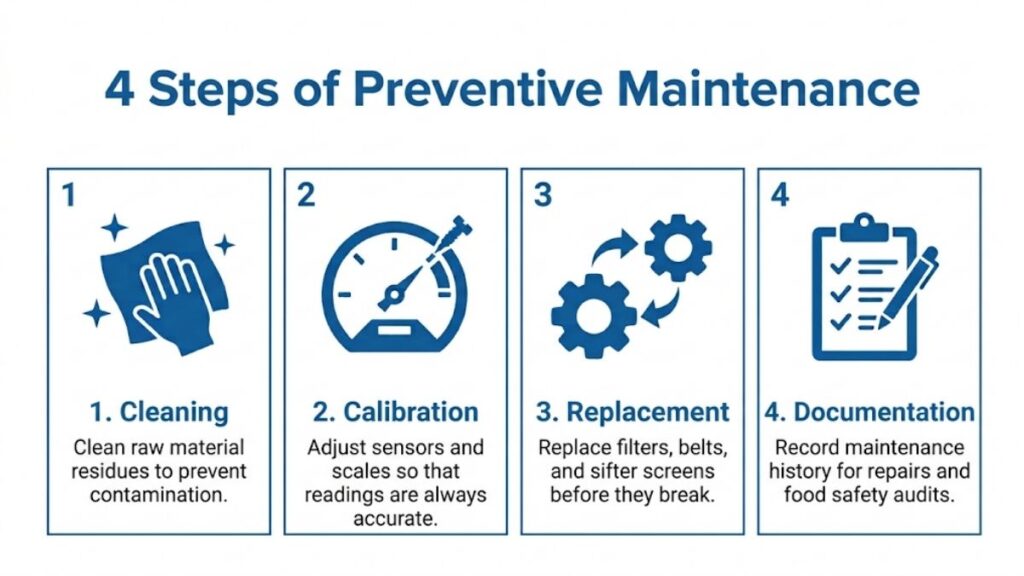
4 Steps for Preventive Maintenance That Belong in a Routine Schedule
The 4 steps below form the foundation of a preventive maintenance program for dry raw material production equipment. Applying them consistently works far better than waiting for a machine to show signs of damage.
Step 1: Routine Cleaning and Lubrication
Clean leftover dry raw material off machine surfaces after every production run, since built-up residue becomes a breeding ground for insects and other contaminants. Lubricate moving parts such as motors and bearings on the schedule the equipment manufacturer recommends.
A skipped lubrication schedule makes components grind against each other harder and wear out faster than normal. Log every cleaning and lubrication session in a maintenance record so it stays easy to trace when something goes wrong.
Step 2: Sensor and Scale Calibration
Recalibrate temperature sensors, pressure sensors, and scales on a regular basis so readings stay accurate throughout production. A sensor that has drifted out of calibration can make production parameters look normal when they have actually shifted.
Keep calibration certificates on file as proof that the equipment has been checked by a qualified party. That documentation is also something food safety auditors commonly ask to see.
Step 3: Replacing Components on Schedule
Replace filters, belts, and sifter screens before they actually fail, not after. Waiting until a component snaps or tears means accepting the risk of production stopping without warning in the middle of a shift.
Keep spare parts on hand for the components that wear out most often, such as sifter screens and conveyor belts, so replacement does not have to wait on an order to arrive. That habit cuts downtime from a matter of days to a matter of hours.
Step 4: Documenting Maintenance History
Record every maintenance activity, from daily cleaning to major component replacement, in one consistent logging system. That history helps a production team spot recurring failure patterns on a specific machine.
Clean documentation also speeds up audits and certification, since the team does not have to reconstruct when a component was last replaced. That data becomes the basis for refining the maintenance schedule in the next period.
Read also: Bahan Baku Kering: Rahasia Efisiensi Ruang Penyimpanan Gudang
Conclusion
The four most vulnerable components (sifter screens, filters, conveyor belts, and bearings) need routine attention so they do not become a source of contamination or sudden downtime. An inspection schedule matched to the equipment type, as with sifters, targets maintenance far better than a one-size-fits-all schedule.
Cleaning, lubrication, calibration, and consistent documentation form the foundation of a preventive maintenance program that is not actually complicated to run. That small investment of time costs far less than emergency repairs or a product recall caused by contamination.
FAQ
A centrifugal sifter screen should be checked after every production batch, or at least once a day. Forced material movement in this sifter type makes screen failure more likely than in other types.
The biggest risk is metal strands breaking loose from the screen and mixing into the raw material undetected. These fragments are small enough that they are hard to find without specialized detection equipment.
Filters, conveyor belts, drive motor bearings, and sifter screens are the components that wear out most often and cause downtime when not replaced on schedule. Checking all four routinely helps prevent unexpected breakdowns.
Documentation proves that equipment has been inspected and maintained on schedule, including when it was last calibrated. Food safety auditors typically request these records as part of a compliance review.
According to data compiled by Processing Magazine, aging equipment accounts for 42% of all causes of unscheduled downtime. Consistent preventive maintenance helps slow down that aging process.