
Egg food safety regulations in Indonesia are the government rules that set hygiene, licensing, quality, and labeling requirements for fresh eggs and egg products before they can be sold. For bakeries, caterers, hotels, and food manufacturers, these rules decide whether the eggs you buy, process, or sell will hold up when inspectors visit or buyers run an audit.
Oversight is split between agencies. Fresh eggs are regulated as animal products by the Ministry of Agriculture and regional livestock services, while packaged processed egg products fall under the Indonesian Food and Drug Authority (BPOM).
This guide maps the rules in force as of November 2026, including the latest amendment to the Food Safety Regulation and BPOM’s current food category rules. At the end, you will find practical steps to check your own compliance.
The ASUH Principle Behind Indonesia’s Egg Regulations
Indonesia’s egg regulations rest on the ASUH principle, short for aman, sehat, utuh, halal (safe, healthy, whole, and halal). Article 58 of Law No. 18 of 2009 on Livestock and Animal Health, as amended, requires the government to uphold this principle through supervision, inspection, testing, standardization, certification, and registration of animal products.
For eggs, the four elements translate as follows:
- Safe: the eggs carry no biological hazards such as Salmonella, chemical hazards such as antibiotic residues, or physical hazards such as shell fragments.
- Healthy: the eggs contain the nutrients the body needs and have not spoiled, for example no rotten smell and no mixing of white and yolk.
- Whole: the eggs are not mixed with or adulterated by other ingredients, so the type of egg sold matches its description.
- Halal: eggs and egg products are handled according to Islamic law, including separation from non-halal products at collection and retail points.
These principles are set out in Government Regulation (PP) No. 95 of 2012 on Veterinary Public Health and Animal Welfare. It only allows domestic animal products to circulate if they come from a business holding a Veterinary Control Number (NKV) or one under official guidance toward it.
International buyers will recognize the same farm-to-table logic in the Codex Code of Hygienic Practice for Eggs and Egg Products (CXC 15-1976, last revised in 2007), the global reference for egg hygiene. The Codex code covers eggs from primary production to consumption, while Indonesian law adds the halal requirement on top.
Indonesia’s Egg Safety Regulatory Map and the Agencies Involved
Egg safety rules are spread across laws, government regulations, ministerial regulations, BPOM regulations, and Indonesian National Standards (SNI). The table below summarizes the main rules in force as of November 2026 and what each one means for egg businesses.
| Regulation | Lead agency | What it covers for egg products |
|---|---|---|
| Law No. 18 of 2012 on Food, as amended | Multiple agencies | Businesses must apply food safety norms, standards, procedures, and criteria across the food chain |
| PP No. 86 of 2019 on Food Safety, amended by PP No. 1 of 2026 | Multiple agencies | Food sanitation, food additives, packaging, safety and quality assurance, business licensing, and administrative sanctions |
| Law No. 18 of 2009, as amended, and PP No. 95 of 2012 | Ministry of Agriculture and regional services | ASUH principle, NKV requirement for animal products, veterinary certificates, and registration of packaged animal products |
| Minister of Agriculture Regulation (Permentan) No. 11 of 2020 | Ministry of Agriculture and provincial services | NKV certification procedure, NKV levels, surveillance, and sanctions for animal product businesses |
| Permentan No. 10 of 2024 | Ministry of Agriculture and regional services | Veterinary certificates for table egg distributors and the ban on selling hatchery eggs as table eggs |
| SNI 3926:2023 Table Chicken Eggs | National Standardization Agency (BSN) | Classification, physical and microbiological quality, packaging, labeling, and storage |
| BPOM Regulation No. 13 of 2023 on Food Categories | BPOM | Category 10.0, eggs and egg products, as the basis for processed food requirements |
| BPOM Regulation No. 4 of 2024 on SPP-IRT | District and city governments, BPOM | Requirements and procedure for SPP-IRT certificates for home industry processed food |
| BPOM Regulation No. 31 of 2018 on Processed Food Labels, as amended | BPOM | Mandatory label information, permit number display, and allergen statements |
| Law No. 33 of 2014 and PP No. 42 of 2024 | Halal Product Assurance Agency (BPJPH) | Mandatory halal certification and its phase-in schedule |
This table shows two oversight tracks: the animal product track under the Ministry of Agriculture and the processed food track under BPOM. Identify your product’s track first, because the documents inspectors and buyers ask for follow that track.
PP 1/2026 also clarifies how authority is shared. The National Food Agency (Bapanas) now helps supervise fresh food and sets food additive limits for fresh food, while processed food of animal origin is supervised by BPOM together with the Ministry of Agriculture, each within its own mandate.
Licenses and Standards You Must Meet
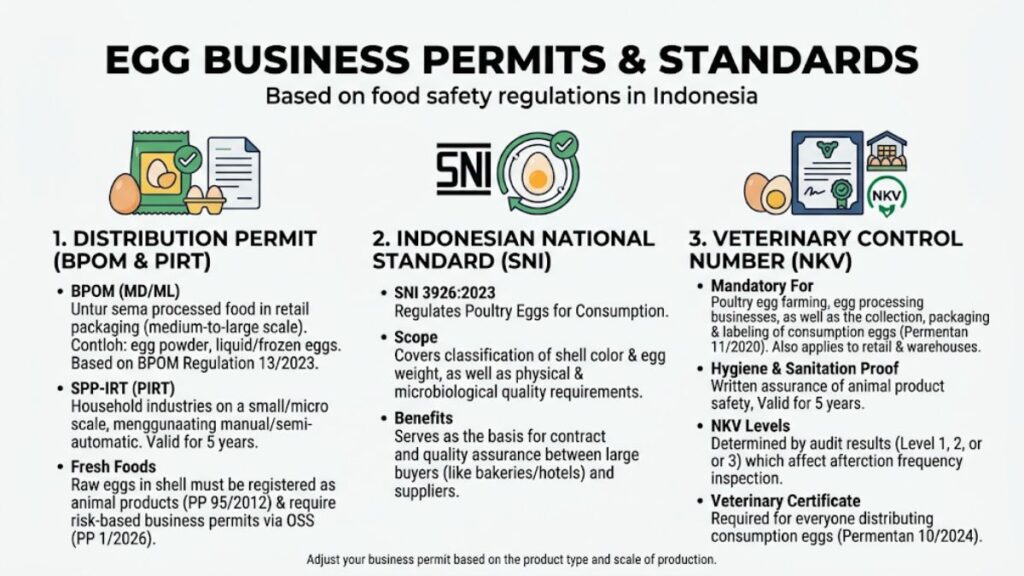
Egg businesses need three kinds of proof of compliance: a distribution permit for packaged processed products, SNI as the quality benchmark, and an NKV for the business premises. The permit you need depends on the product, whether shell eggs, salted eggs, or processed products such as egg powder and liquid egg.
Distribution Permits (BPOM and PIRT)
Packaged processed egg products sold at retail must hold a BPOM distribution permit or an SPP-IRT certificate before they reach the market. This licensing duty is set out in Article 34 of PP 86/2019 as amended by PP 1/2026, while the type of permit depends on production scale and food type.
A BPOM permit can be issued for any processed food, with numbers starting “BPOM RI MD” for domestic products and “BPOM RI ML” for imports. Requirements follow BPOM Regulation 13/2023 on Food Categories, which revoked BPOM Regulation No. 34 of 2019 and places eggs in category 10.0, eggs and egg products.
The subcategories relevant to egg businesses are:
- 10.1 for fresh eggs in shell
- 10.2 for egg products, meaning whole egg, egg white, or egg yolk processed into liquid, frozen, or dried form
- 10.2.3 for dried and/or heat-treated egg products, including egg powder
- 10.3 for preserved eggs, such as salted eggs and century eggs (pidan)
The category determines the rules on food additives, contaminants, claims, and nutrition information for your product. Microbial contamination limits are set per category in BPOM Regulation No. 13 of 2019, as amended by BPOM Regulation No. 3 of 2026.
SPP-IRT (Sertifikat Pemenuhan Komitmen Produksi Pangan Olahan Industri Rumah Tangga), commonly called PIRT, is the home industry food production certificate. It is issued by the regent or mayor through the Online Single Submission (OSS) system under BPOM Regulation No. 4 of 2024.
The certificate is only available to home-based food businesses using manual to semi-automatic equipment, for food types listed in the regulation’s annex. SPP-IRT cannot be used for food subject to mandatory SNI, food that needs special handling in production or distribution, or products carrying claims.
As a result, liquid and frozen eggs that need a cold chain generally have to go through the BPOM permit route. SPP-IRT is valid for 5 years, and renewal must be filed at least 1 month before it expires.
Within 3 months of issuance, the holder must attend food safety training and pass a facility and label inspection by the district or city health office.
Shell eggs count as fresh food, so they do not need a BPOM permit or an SPP-IRT. If sold in labeled packaging, however, they must be registered as animal products under PP 95/2012.
Since PP 1/2026 took effect on January 5, 2026, packaged and labeled fresh food of animal origin also needs a risk-based business license through OSS. Packaged egg brands should recheck their licensing status against this requirement.
Indonesian National Standard (SNI)
SNI 3926:2023 Table Chicken Eggs replaces SNI 3926:2008 and covers classification, quality requirements, packaging, labeling, and storage of table chicken eggs. Eggs are classified by shell color and weight, and quality requirements cover both physical and microbiological criteria.
For bulk egg buyers, this SNI works as the basis for specifications in supply contracts. You can ask suppliers to state the quality grade and weight class, then check them when the goods arrive.
Veterinary Control Number (NKV)
NKV (Nomor Kontrol Veteriner) is written certification that an animal product business has met hygiene and sanitation requirements as a guarantee of product safety. Article 3 of Permentan 11/2020 lists three egg business types that must hold an NKV: layer farms, egg processing plants, and businesses that collect, pack, and label table eggs.
The same list includes retailers, cold storage warehouses, and dry warehouses, so retail and warehouse operators handling eggs should check their NKV obligations too.
Applications are submitted online to the governor through the provincial livestock service, after which the provincial NKV audit team assesses technical requirements on site. The certificate is valid for 5 years and states a level that determines how often the business is re-audited.
| NKV level | Meaning | Surveillance frequency |
|---|---|---|
| Level 1 | Very good | Every year |
| Level 2 | Good | Every 6 months |
| Level 3 | Fair | Every 4 months |
The NKV level depends on the number of nonconformities found during the audit, and it can move up or down based on surveillance results. Level 3 units are audited three times as often as level 1 units, so closing audit findings early reduces the oversight burden later.
Businesses that do not yet meet NKV requirements receive guidance from the district or city livestock service for up to 5 years. If that period passes without improvement, the service can recommend that the regent or mayor revoke the business license.
Beyond the NKV, Article 15(2) of Permentan No. 10 of 2024 requires anyone distributing table eggs to hold a veterinary certificate from the provincial or district livestock and animal health service. The regulation, in force since October 2024, also bars commercial poultry breeders, integrated producers, independent producers, and cooperatives from selling fertilized or infertile hatchery eggs as table eggs.
Fertilized hatchery eggs (telur tertunas) are breeder eggs that have been fertilized for hatching. For processed food manufacturers, this ban means the origin and type of raw eggs should be stated clearly in supplier delivery documents.
Egg Product Labeling Requirements
The label is where buyers and inspectors match the NKV number, permit number, and halal statement against licensing documents. The rules differ for fresh eggs and processed egg products.
Labels for Fresh Eggs
Article 20 of Permentan 11/2020 requires the NKV number to appear as a stamp on the shell and/or on the egg packaging label. A missing NKV on the label is one of the grounds for revoking an NKV under Article 29 of the same regulation.
Eggs in labeled packaging must also show the animal product registration number under PP 95/2012. SNI 3926:2023 includes labeling provisions for table chicken eggs that you can use as a reference when designing packaging.
Labels for Processed Egg Products
Processed egg product labels follow BPOM Regulation No. 31 of 2018 on Processed Food Labels, as amended. Article 5 requires these nine minimum items:
- product name
- list of ingredients
- net weight or net volume
- name and address of the manufacturer or importer
- halal statement where required
- production date and code
- expiry date
- distribution permit number
- origin of certain ingredients
The permit number starts with BPOM RI MD or BPOM RI ML, while home industry products show “P-IRT” followed by their number. A halal statement may only appear after the product has obtained a halal certificate.
Medium and large businesses have been required to hold halal certification since October 2024. For micro and small businesses, the government has extended the phase-in for food and beverage products to October 17, 2028.
Eggs are an allergen that must be declared on the label, with allergen ingredients printed in bold in the ingredient list. Products made on equipment that also processes eggs must carry a statement such as “may contain egg” next to the ingredient list.
Egg powder or liquid egg sold to bakeries, hotels, or factories for further processing must show at least the product name, net weight, manufacturer or importer name and address, production date and code, and expiry date. If the product is distributed by anyone other than the manufacturer, the importer, or a distributor they appointed directly, the label must also carry a statement such as “not for retail sale.”
Supervision and Sanctions for Egg Regulation Violations
Violations of egg regulations carry graduated administrative sanctions that can end in revocation of the business license, alongside criminal penalties under the Food Law. Supervision is carried out by livestock and animal health services for animal products and by BPOM for processed food, each within its mandate.
| Violation | Legal basis | Sanction |
|---|---|---|
| Animal product business does not apply for an NKV | Permentan 11/2020 Articles 46 to 48 | Two written warnings 3 months apart, a temporary production halt, then license revocation 6 months later |
| Deviation that endangers consumers, or NKV missing from the label | Permentan 11/2020 Articles 29 and 30 | NKV revocation |
| Distributing table eggs without a veterinary certificate | Permentan 10/2024 Article 31 | Shipments refused entry to the receiving province, district, or city |
| Selling fertilized or infertile hatchery eggs as table eggs | Permentan 10/2024 Article 32 | Withdrawal from circulation and destruction of the eggs |
| Breach of food safety provisions | PP 86/2019 Articles 59 and 68, amended by PP 1/2026 | Fines, temporary suspension, product recall, compensation, or revocation of the business license. Fines run from Rp100 million for serious violations by large businesses down to Rp2 million for minor violations by micro businesses |
For distributors, the sanction that hits fastest is a refusal at the border, because egg shipments without a veterinary certificate can be turned away at the destination province. For plants and farms, NKV revocation removes the proof of hygiene that animal product distribution depends on.
Regulators may also publish supervision results through the mass media, and PP 1/2026 added the Ministry of Industry and the National Food Agency to the list of authorities that can do so. As a result, a single violation finding can quickly affect buyer trust in your brand.
Steps to Check Egg Regulatory Compliance in Your Business
The fastest way to check compliance is to map where your business sits in the egg supply chain, then match the documents required at that point. The steps below apply to producers and to ingredient buyers such as bakeries and caterers.
- Identify your position, whether as farmer, collector and packer, processor, distributor, or ingredient user.
- For fresh eggs, request copies of the supplier’s NKV and veterinary certificate, then match the NKV number with the stamp on the shell or the packaging label.
- For processed egg products, check the BPOM permit or SPP-IRT number, the food category, and the validity of the halal certificate.
- Request a certificate of analysis for each production lot along with the supplier’s HACCP documents, meaning proof of a hazard analysis and critical control point system, then compare them with your purchase specifications.
- For interprovincial shipments, check the entry permit requirements of the destination province. East Java, for example, requires an NKV, a Business Identification Number (NIB), a halal certificate where applicable, and accredited laboratory test results for entry permits covering table or processed eggs.
- Keep each supplier’s documents in a single file and renew them before they expire.
Read also: Supplier Evaluation Checklist for Egg Powder Raw Materials
Conclusion
Egg food safety regulations in Indonesia work through two tracks: NKV and veterinary certificates from the Ministry of Agriculture for fresh eggs, and BPOM permits and food categories for processed products. Egg processors usually deal with both tracks at once.
This week, map your position in the supply chain and collect the NKV, veterinary certificate, distribution permit, and halal certificate from every egg supplier. Also check that your product documents cite the latest rules, namely PP 1/2026 and BPOM Regulation 13/2023.

FAQ
What is the difference between an NKV and a veterinary certificate?
An NKV certifies a business unit and is valid for 5 years, while a veterinary certificate accompanies animal products when they are distributed. Applications for a veterinary certificate are usually supported by an NKV or by product inspection and test results.
How do I check the distribution permit of a processed egg product?
Enter the permit number or product name on BPOM’s Cek BPOM website. Make sure the product name, manufacturer, and packaging shown match the product you received.
Does imported egg powder also have to follow BPOM rules?
Yes, BPOM Regulation 13/2023 applies to manufacturers and importers of retail-packaged processed food. Imported food also needs an import approval under Article 44 of PP 86/2019 as amended by PP 1/2026.
Do home-made packaged salted eggs need a permit?
Salted eggs are listed under food category 10.3, but BPOM’s SPP-IRT service guide classifies both raw and cooked salted eggs as fresh food of animal origin. Labeled salted eggs therefore need a business license for fresh food of animal origin under Article 38 of PP 86/2019 as amended by PP 1/2026, although BPOM still accepts SPP-IRT registrations for this product during the transition.
Ask the district or city health office or livestock service which route applies before you register, because BPOM describes this classification as still in transition.
Where can I report egg products suspected of breaching food safety rules?
The public can report suspected violations orally or in writing to the Ministry of Agriculture or the regional government for fresh eggs, and to BPOM for processed egg products. Reports should include the reporter’s identity and initial evidence, and Article 79 of PP 86/2019 as amended by PP 1/2026 requires the receiving agency to keep that identity confidential.