
A supplier evaluation checklist for egg powder raw materials is a set of criteria food manufacturers use to judge a vendor’s fitness before any contract is signed. It usually covers product quality, legal compliance, and delivery consistency.
A survey among Indian food processors found that quality ranked as the top supplier selection factor, followed by price and delivery reliability. That pattern shows why a supplier evaluation checklist for egg powder raw materials should never be built around price alone.
This article walks procurement and QC teams through the criteria that belong in that checklist, along with common mistakes to avoid.
What Is a Supplier Evaluation Checklist for Egg Powder?
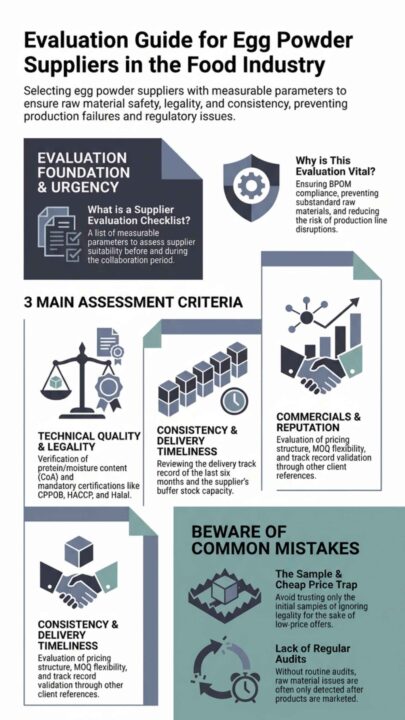
This checklist is a structured set of questions or measurable parameters that procurement and quality control teams run through when screening an egg powder vendor. Each parameter is usually marked as pass or fail.
The difference between this and a simple purchase order lies in repetition. Teams apply it every time a new vendor is considered, and again during annual audits of existing ones.
The goal is straightforward. A company wants the raw material entering its production line to be safe, consistent, and within the technical specification the formula requires.
Why Does This Checklist Matter for Food Manufacturers?
Without a clear checklist, supplier decisions often lean on subjective factors such as an existing relationship or the lowest quote on the table. That gap matters because a poor egg powder supplier choice can affect the safety of the finished product directly.
Here is why this checklist deserves a permanent spot in standard operating procedure, not just a one-off form:
- It catches moisture or protein levels outside spec before they change the texture of the finished product.
- It confirms the supplier holds food safety credentials that hold up during a regulatory audit.
- It reduces the chance of a production stoppage caused by a delivery delay nobody saw coming.
- It gives buyers a fact-based footing for price and volume negotiations, rather than guesswork.
Core Criteria for the Supplier Checklist
Five criteria form the backbone of most egg powder supplier checklists used by mid-size and large food manufacturers. They are ordered from the ones with the biggest safety impact to the ones tied to commercial terms.
1. Product Quality and Technical Specification
This criterion checks whether the egg powder on offer matches the functional specification the formula needs. Moisture content, protein content, and ash content are the parameters worth checking first.
For reference, one peer-reviewed study on spray-dried whole egg powder recorded moisture between 6.25 and 7.23 percent and protein between 47.52 and 50.90 percent, depending on drying temperature. Lower moisture generally means a longer shelf life and less room for microbial growth during storage.
Points to check under this criterion:
- A Certificate of Analysis for every shipment batch.
- Consistency of color, smell, and solubility across batches.
- Whether the product type (whole egg powder, egg yolk powder, or egg white powder) actually matches the formula’s needs.
2. Legal Compliance and Food Safety Certification
This part determines whether a supplier can be trusted on the legal and quality management side. Weak documentation here can derail a finished product’s regulatory approval later on.
Documents worth requesting from any candidate supplier:
- In the United States, egg products (including dried egg powder) fall under mandatory USDA inspection through the Egg Products Inspection Act, which also requires pasteurization before distribution.
- HACCP or ISO 22000 certification, which shows a documented critical control point system is in place.
- For suppliers targeting export markets or modern retail, FSSC 22000 certification, a scheme recognized by the Global Food Safety Initiative, is often a hard requirement from large retailers.
- Halal certification, particularly relevant for buyers selling into Muslim-majority markets.
3. Delivery Consistency and Reliability
This criterion measures whether a supplier can hold its delivery schedule beyond the first sample shipment. A late raw material delivery can stall an entire production line within hours.
What to look into:
- On-time delivery track record over the past six months with other clients.
- Production capacity and buffer stock the supplier keeps on hand.
- A documented contingency plan for disruptions in fresh egg supply, the raw input behind egg powder.
4. Price and Flexibility of Terms
Price still matters, but it rarely decides the outcome on its own. Flexibility in order volume and payment terms tends to have a bigger effect on how well a partnership holds up over time.
What to compare across candidate suppliers:
- Volume-based pricing structures, including discounts for long-term contracts.
- Minimum order quantity flexibility relative to the buyer’s production scale.
- Payment terms and how clearly force majeure clauses are written into the contract.
5. Reputation and Track Record
This criterion looks at a supplier’s history with other clients, along with its standing in the industry. References from existing clients tend to be more honest than a sales pitch.
How to check it:
- Request at least two active client references.
- Review any past complaints or product recalls tied to the supplier.
- Verify company age and legal registration through official business documents.
Common Mistakes When Evaluating Egg Powder Suppliers
Teams building this checklist for the first time tend to fall into three traps. Spotting the pattern early saves money down the line.
- Relying only on the first sample batch without verifying consistency on regular shipments afterward.
- Skipping legal documentation checks because the quoted price beats every competitor.
- Not setting up periodic audits, so problems with a new supplier only surface after the product is already on shelves.
Conclusion
A supplier evaluation checklist for egg powder raw materials is not paperwork for its own sake. It is a risk control tool that affects the safety and consistency of the finished product directly.
The five criteria covered here, from technical quality and legal compliance to delivery, price, and reputation, work best when assessed together rather than picked one at a time. Companies that apply this checklist consistently tend to handle regulatory audits and strict retailer negotiations with less friction, and the upfront time it takes is cheaper than a product recall caused by a raw material problem.
As a raw material, egg powder itself offers advantages that make this evaluation process worth the effort. Its low moisture content keeps it stable during storage, and it is far easier to handle and transport than fresh eggs.
If you are looking for an egg powder supplier with clear, consistent specifications, the Accelist Pangan Nusantara team is ready to support your production needs. Feel free to contact us to discuss the egg powder specification your formula requires.

FAQ
Whole egg powder comes from the entire egg, while egg white powder is made only from albumen with a more concentrated protein content.
One literature review study found whole egg powder can last up to 549 days versus roughly 25 days for fresh eggs, mainly due to the drastic drop in moisture content.
It is not a legal requirement everywhere, but it is strong evidence that a food safety control system is already in place.
Request business registration documents and relevant food safety certificates, then cross-check them against official records.