

A FIFO stock rotation SOP for dry ingredients is a written procedure that governs how staff receive, store, and pull flour, sugar, dried spices, and similar goods based on arrival date. This document is what separates a well-run kitchen from one that simply relies on whichever staff member happens to remember what came in first.
Restaurants waste an average of 4 to 10 percent of the food they purchase, which for a kitchen spending 10,000 euros a month on food translates into 400 to 1,000 euros lost every single month. That kind of loss rarely comes from one dramatic mistake. It builds up quietly wherever a FIFO stock rotation SOP for dry ingredients is missing or ignored.
What Is a FIFO Stock Rotation SOP for Dry Ingredients?
FIFO stands for First In, First Out, a principle requiring that dry goods received earliest be used before anything that arrived more recently. The SOP itself is the written instruction that translates this principle into daily habits, covering everything from how items get labeled to how shelves are arranged.
Without a written SOP, FIFO tends to hold up only as long as the staff who remember it stay on the team. Once new hires join or shifts rotate, the habit quietly disappears.
Who Is Responsible for a FIFO Stock Rotation SOP?
The kitchen manager or storeroom lead usually owns this responsibility, since they’re the ones who set the audit schedule and make sure the SOP stays consistent across shifts. Receiving staff and anyone pulling ingredients on the line still carry out the rotation daily, even though final accountability sits with the person in charge.
Splitting the roles this way matters because compliance shouldn’t hinge on one person being present every day. Each shift ideally has at least one team member who knows exactly who to flag when they spot an unlabeled item or a missed rotation.
Why Do Dry Storage Areas Fall Out of Order So Easily?
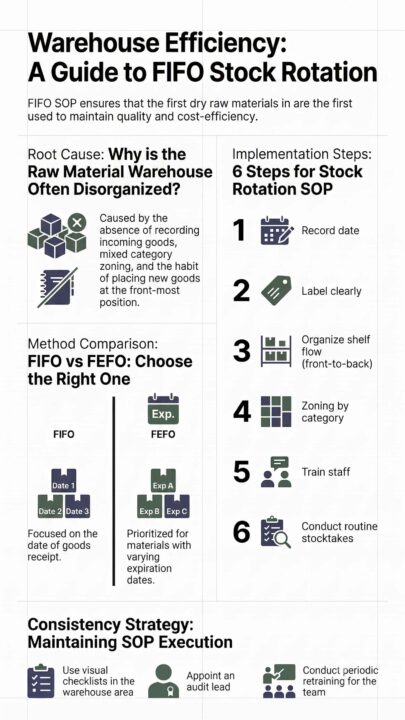
A messy dry storage area is rarely a sign of lazy staff. It usually comes down to four gaps in the workflow that nobody wrote a rule for.
- Incoming deliveries go unlogged: New stock lands on the shelf without a date check or quantity record, leaving no reference point for the next rotation.
- New stock gets placed in the most convenient spot: During a rushed delivery, staff grab the nearest open space, which is usually the front of the shelf.
- There’s no dedicated zone per ingredient category: Flour, sugar, and dried spices mixed on one shelf make arrival order impossible to track.
- Physical counts aren’t done regularly: Discrepancies between records and reality only surface once an ingredient has already spoiled or expired.
The Difference Between FIFO and FEFO for Dry Raw Materials
FIFO and FEFO are both stock rotation methods, but they anchor the rotation decision to different dates. According to WebstaurantStore’s guide on the FIFO method, the “first in, first out” rule is what governs stock rotation for dry, refrigerated, and frozen goods alike, and the table below breaks down how the two methods differ specifically for dry ingredients.
| Aspect | FIFO (First In, First Out) | FEFO (First Expired, First Out) |
|---|---|---|
| Primary reference | Date the item was received | Expiration date printed on the package |
| Best suited for | Flour, sugar, salt, and other goods with a fairly uniform shelf life | Packaged spice blends or items where expiration dates vary between batches |
| Risk if ignored | Older stock gets buried at the back of the shelf | Items closest to expiring get overlooked |
| System requirement | Receiving date labels | Receiving date labels plus expiration date labels |
In practice, most dry storage areas use both. FIFO sets the default shelving rule, while FEFO kicks in specifically for items whose expiration dates shift from one delivery to the next.
Steps to Build a FIFO Stock Rotation SOP for Dry Ingredients
Building a FIFO stock rotation SOP for dry ingredients starts with logging incoming stock and ends with routine audits that keep the rule honest on the floor. The six steps below work for a small kitchen just as well as a large-scale production facility.
- Log the receiving date for every delivery: Record the date each batch of dry ingredients arrives, along with the production date from the supplier when it’s available.
- Label every package clearly: Write the receiving date on a sticker or with a permanent marker, and place it somewhere staff will see immediately when reaching for the item.
- Set a fixed direction for shelf flow: New stock goes to the back or bottom of the shelf, while older stock gets shifted to the front or top.
- Assign a separate zone for each ingredient category: Flour, sugar, spices, and other dry goods each need their own shelf so arrival order never gets mixed up.
- Train kitchen staff regularly: Make sure every team member, including new hires, understands how to read the labels and pull stock in the correct order.
- Schedule a weekly physical count: Compare the shelf against the records to catch any older stock that got buried at the back.
How to Arrange Shelves So Rotation Happens on Its Own
A FIFO rule written on paper doesn’t mean much if the shelving itself works against it. Three physical adjustments make rotation happen naturally, without constant reminders.
- Use uniform containers so stock is easy to slide forward during rotation, instead of mismatched bins that snag on each other.
- Avoid stacking too high, since labels buried at the bottom of a tall stack become unreadable and older stock gets forgotten.
- Set up a priority zone for items nearing their use-by window, such as a dedicated shelf for anything that needs to be used within the next seven days.
Common Mistakes When Implementing a FIFO SOP
Mistakes with a FIFO SOP rarely come from staff not understanding the concept. They come from execution slipping between shifts. Kitchennmbrs notes that consistent FIFO rotation alone can cut food waste by 30 to 50 percent, which is exactly why these four slip-ups carry such a high cost.
- Receiving date labels get erased or skipped entirely, leaving staff no way to tell older stock from newer stock.
- Rotation only happens on certain shifts, tidy in the morning but ignored during a rushed evening shift.
- No one is clearly responsible, so compliance depends entirely on individual staff initiative.
- Storage zones for different categories overlap, making it hard to trace the arrival order of any single ingredient.
Tips to Keep a FIFO SOP Consistent in the Kitchen
A well-written SOP is worthless if it isn’t followed every day. Four habits below help a FIFO stock rotation SOP stick as a working routine rather than a document that sits in a drawer.
- Post a rotation checklist near the storage shelf as a daily visual reminder.
- Schedule a FIFO refresher training every three months, especially whenever new team members join.
- Assign one person to own the weekly physical count, so accountability doesn’t get lost between shift changes.
- Log every audit result in a simple record, so recurring mistakes become visible and easier to fix.
Conclusion
A FIFO stock rotation SOP for dry ingredients is more than a shelving rule. It’s the foundation that keeps product quality stable from one batch to the next.
With date logging, clear labeling, and routine audits in place, a kitchen can cut the risk of spoiled stock while keeping operating costs under control. That consistency also means staff spend less time guessing which ingredient to grab, which protects a kitchen’s reputation with customers who expect the same quality every time they order.
Consistent ingredient quality also starts with the raw material itself, and Egg Powder is a good example. It offers more stable protein content and a longer shelf life than fresh eggs, making it easier to plan around for large-scale production.
Accelist Pangan Nusantara can help supply the quality dry ingredients a production kitchen needs. Feel free to get in touch for a consultation.

FAQ
Yes, FIFO should apply to all dry ingredients since quality still declines the longer any item sits in storage.
FIFO is based on the date an item was received, while FEFO is based on the expiration date printed on its packaging.
Yes, a written SOP keeps rotation from depending on one person’s memory, which is easy to get wrong or forget.
The kitchen manager or storeroom lead owns the responsibility, while receiving staff and line staff still carry out the rotation every day.
A weekly count is usually enough for dry ingredients, as long as it happens consistently without being skipped.