
How to separate egg yolks and whites starts with cold eggs: crack them over a bowl and hold back the yolk with a separator, a slotted spoon, or clean hands. For bakeries and caterers, a single drop of yolk in the whites can keep a meringue from rising and send a whole batch to waste.
Clean separation also makes recipes easier to measure, because egg whites and yolks have different functions in a batter. Whites build foam and structure, while yolks add flavor, color, and tenderness.
This article covers how to prepare before you separate eggs, six separation methods, and how to store the whites and yolks afterward.
Preparing to Separate Egg Yolks and Whites
Separation goes smoothly when the eggs are fresh and still cold, your tools are clean and dry, and you set up three bowls before you start. The four steps below keep yolks from breaking and contaminating the whites.
Choose Fresh Eggs
Fresh eggs have thick whites and high, round yolks, so the yolk is less likely to break when you move it. Over time, the yolk absorbs water from the white and its membrane weakens, which makes older eggs harder to separate cleanly.
Separate the Eggs While They Are Cold
Eggs straight from the refrigerator separate more easily because the yolk is firmer and the white is thicker. Take out only as many eggs as you will separate right away, not the whole carton.
If the recipe calls for whipped whites, let the separated whites sit at room temperature briefly before whipping. Whites that are not too cold whip up more easily.
Set Up Three Bowls
Use one small bowl to crack and separate each egg, one bowl for the whites, and one bowl for the yolks. Pour the white into the larger bowl only if the yolk stayed intact.
That way, a broken yolk ruins only one egg, not all the whites you have already collected.
Wash and Dry Your Hands and Tools
Wash your hands with soap and dry them, because eggshells can carry bacteria such as Salmonella. Also make sure the bowl for the whites is free of grease and water, since leftover fat keeps whites from foaming when you whip them.
6 Ways to Separate Egg Yolks and Whites
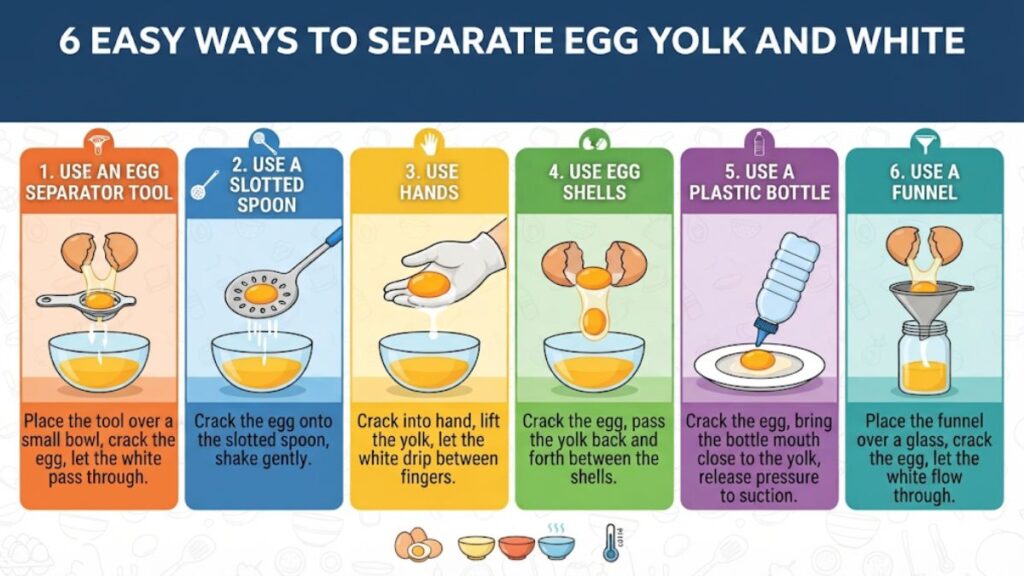
The six common methods use an egg separator, a slotted spoon, your hands, the shell, a plastic bottle, or a funnel. Choose a method based on how many eggs you have, the tools on hand, and how you plan to use the whites.
1. Use an Egg Separator
An egg separator is a small slotted cup that holds the yolk while the white drains into the container below. It suits beginners because your hands never touch the egg itself.
- Set the separator over a small bowl.
- Crack the egg on the edge of another bowl, then pour the contents into the center of the separator.
- Gently shake the separator until all the white has drained.
- Move the yolk to the yolk bowl.
2. Use a Slotted Spoon
A slotted spoon works much like an egg separator and is usually already in the kitchen. Hold the spoon over a small bowl, crack the egg onto it, and let the white drip through the slots.
Choose a spoon with a fairly deep bowl so the yolk does not slide off.
3. Use Your Hands
Crack the egg into a small bowl, then lift the yolk with slightly spread fingers and let the white run between them. This method is fast for large quantities, but your hands touch the egg directly.
In a commercial kitchen, wear clean disposable gloves and change them after you handle dirty shells.
4. Use the Eggshell
Crack the egg into two halves over a bowl, then pass the yolk back and forth between the halves until the white falls into the bowl. This method needs no tools, but the sharp edges of the shell can easily tear the yolk.
The egg also touches the outside of the shell. For that reason, use this method only for eggs you will cook thoroughly.
5. Use a Plastic Bottle
Crack the egg onto a flat plate, squeeze a clean, empty plastic bottle, hold its mouth against the yolk, and slowly release to draw the yolk up. Squeeze the bottle again over the yolk bowl to release it.
If you crack more than one egg onto the same plate, a single broken yolk will contaminate all the whites on it. Crack eggs one at a time if you plan to whip the whites.
6. Use a Funnel
Set a funnel over a glass, then crack the egg into it. The yolk stays in the neck of the funnel while the white flows into the glass.
Pick a funnel with a neck narrower than the yolk, and lift the yolk out with a spoon once the white has drained.
Also read: 10 Benefits of Egg Whites, from Building Muscle to the Secret of Perfectly Risen Cakes
How to Store Separated Egg Whites and Yolks
Store raw whites and yolks in covered containers in the refrigerator and use them within 2 to 4 days, according to the USDA egg storage chart. For longer storage, only the whites freeze well.
| Part of the Egg | Refrigerator | Freezer |
|---|---|---|
| Raw egg whites | 2 to 4 days | Up to 12 months |
| Raw egg yolks | 2 to 4 days | Not recommended |
Freeze whites in recipe-sized portions in covered containers, then thaw them in the refrigerator before use. Use leftover yolks soon in cooked dishes such as custard, sauces, or pie fillings.
Write the separation date on every container so older stock gets used first.
If your kitchen regularly needs only whites or only yolks in large quantities, egg powder can replace separating fresh eggs. Use Egg White Powder for meringue and bakery products or Egg Yolk Powder for sauces and dressings.
Also read: 7 Egg Storage Myths and Facts Worth Setting Straight
Conclusion
The keys to separating egg yolks and whites are fresh, cold eggs and the three-bowl setup. An egg separator or slotted spoon gives clean results, while gloved hands work faster for large quantities.
Once separated, store the whites and yolks in covered, date-labeled containers in the refrigerator and use them before their storage time runs out.

FAQ
How Do You Get Yolk Out of Egg Whites?
If there is only a little, scoop it out with the tip of a clean spoon or a torn piece of clean paper towel. If it is hard to remove, use those whites in a dish that calls for whole eggs.
Can You Separate Duck Eggs the Same Way?
Yes. Duck egg yolks are larger, so choose a separator or funnel with an opening wide enough that the yolk does not get squeezed and break.
Can Raw Egg Whites Be Used in Dishes That Are Not Cooked?
It is better not to, because raw egg whites can still carry Salmonella. For no-cook dishes, use pasteurized eggs or egg products.
Can You Use an Egg Separator for Quail Eggs?
Yes, but a standard separator often has slots that are too wide for small quail egg yolks. For quail eggs, a small spoon or the shell method is usually easier.