
Eggs can raise blood cholesterol, but in healthy adults who eat them in moderation, the rise is usually smaller than the effect of saturated fat from side dishes. Still, the belief that eggs raise cholesterol across the board leads people to throw away the yolk or drop eggs from daily menus, including office catering and diet meal plans.
According to the American Heart Association (AHA), a typical large egg contains 186 mg of cholesterol. Even so, the AHA suggests one egg, or two egg whites, per day for healthy people who eat eggs.
This article explains how eggs affect blood cholesterol, how the yolk compares with the white, which six myths need correcting, and how to make egg dishes cholesterol-friendly.
Do Eggs Raise Blood Cholesterol?
Blood cholesterol can rise after you eat eggs, but the effect differs from person to person and is usually smaller than the effect of saturated and trans fats. Food is only one source of cholesterol, because your body also makes its own.
Most of the cholesterol in your blood, meaning the cholesterol that circulates in your blood vessels, is made by your liver. The liver is prompted to make it mainly by saturated fat and trans fat in your diet, not by dietary cholesterol itself.
In the blood, cholesterol travels in two main carriers, LDL (low-density lipoprotein) and HDL (high-density lipoprotein). LDL is called “bad” cholesterol because it can build up in artery walls, while HDL helps carry excess cholesterol back to the liver.
People also respond differently to dietary cholesterol. Someone with a genetic tendency toward high cholesterol may see a larger rise in LDL after eating eggs, so their safe limit differs from that of a healthy person.
Egg Yolk vs Egg White Cholesterol: Which Is Higher?
Almost all of an egg’s cholesterol is in the yolk, while the white is practically cholesterol-free because it contains no fat. That means the 186 mg of cholesterol in a large egg comes from its yolk.
The review “The Golden Egg” in the journal Nutrients (2019) compiles egg composition data from the French food composition table (CIQUAL) and the USDA nutrient database. The table below shows the review’s figures per 100 grams.
| Content per 100 g | Egg Yolk | Egg White |
|---|---|---|
| Cholesterol | 939 mg | Practically none (egg white contains no fat) |
| Saturated fat | 8.47 g | Practically none |
| Protein | 15.9 g | 10.9 g |
| Choline | 680 mg | 1 mg |
| Vitamin D | 5.4 µg | 0 µg |
The yolk comes out ahead in almost every row, including cholesterol and saturated fat, while the white stands out only for protein. The yolk’s saturated fat looks high because it is measured per 100 grams, and a single yolk weighs far less than that.
In a whole egg, the white weighs more than the yolk, so the white still supplies a large share of each egg’s protein. Swapping whole eggs for egg whites does cut cholesterol, but you also lose the choline and vitamin D.
Egg Yolk: A Source of Cholesterol, Choline, and Vitamin D
The yolk holds all of the egg’s fat, so its cholesterol and saturated fat are concentrated here as well. Its yellow color comes from lutein and zeaxanthin, two carotenoid pigments that also accumulate in the retina of the eye.
At the same time, egg yolk nutrition includes choline and vitamin D, which the white barely contains. Your body uses choline to build cell membranes and support nerve function, while vitamin D helps it absorb calcium.
Egg White: Protein Without Cholesterol
Egg white is a gel made of water and protein with no fat, so it adds neither cholesterol nor saturated fat. Its main protein is ovalbumin, which makes the white set and turn opaque when heated.
That makes egg whites a good fit for people whose doctor has asked them to limit cholesterol, for example in an egg white omelet or scramble. The trade-off is that they taste blander and have a drier texture than whole eggs.
Also read: Do Eggs Contain Fat? Here Are the Facts You Need to Know
6 Egg Cholesterol Myths Worth Setting Straight
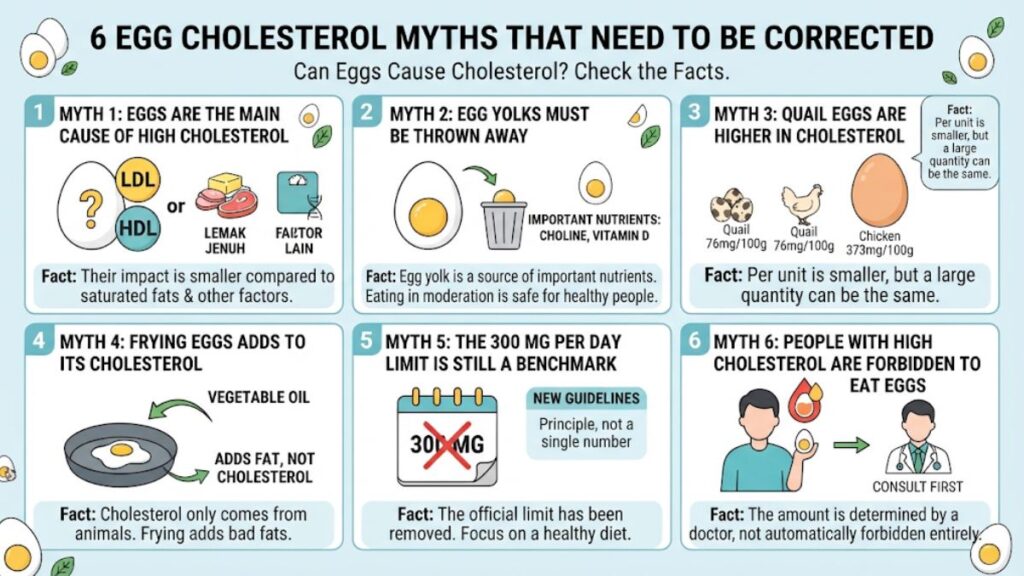
Most egg cholesterol myths come from looking at the cholesterol content in isolation, without considering portion size, cooking method, and the rest of your diet. Here are six common myths and the facts behind them.
Myth 1: Eggs Are the Main Cause of High Cholesterol
Eggs are not the main cause of high cholesterol. Saturated fat, trans fat, excess weight, physical inactivity, and family history have a bigger effect on LDL levels.
The 2015-2020 Dietary Guidelines for Americans describe egg yolks and some shellfish as foods that are higher in dietary cholesterol but not in saturated fat. That sets yolks apart from fatty meat, butter, and thick coconut milk, which are high in saturated fat.
Myth 2: You Should Throw Away the Yolk to Keep Cholesterol in Check
For healthy people, throwing away the yolk is unnecessary, and it also discards the choline and vitamin D shown in the comparison table above. The AHA still counts one whole egg a day as part of a healthy eating pattern.
Using only egg whites makes sense if a doctor or dietitian has asked you to limit cholesterol. Otherwise, whole eggs give you more complete nutrition for the same price.
Myth 3: Quail Eggs Are Higher in Cholesterol Than Chicken Eggs
Egg for egg, a quail egg contributes far less cholesterol than a chicken egg, because both the egg and its yolk are much smaller. The catch is the count, since quail eggs are rarely eaten one at a time.
In Indonesia, a single skewer of sate telur puyuh (quail egg satay) or a plate of quail eggs in semur (sweet soy sauce stew) usually holds more than one egg. A serving like that can match the cholesterol in one chicken egg, so count quail eggs one by one, not by the plate.
Myth 4: Frying an Egg Adds to Its Cholesterol
Frying does not add cholesterol to an egg, because cholesterol is found only in animal foods and vegetable oils such as palm oil contain none. What frying adds is fat, including saturated fat, which has a bigger effect on LDL.
Palm oil and butter are both sources of saturated fat, and butter also brings cholesterol because it is made from milk fat. That is why an egg fried in butter or in plenty of oil affects you differently from a boiled egg, even though the egg itself is the same.
Myth 5: The 300 mg Daily Cholesterol Limit Still Applies
The 300 mg daily limit from the 2010 edition was dropped from the U.S. dietary guidelines in the 2015-2020 edition, though health articles still cite it often. The guidelines stress that this change does not mean dietary cholesterol can be ignored.
The advice is now a principle: eat as little dietary cholesterol as possible while following a healthy eating pattern. What counts is your eating pattern as a whole, not the milligrams in a single dish.
Myth 6: People with High Cholesterol Can’t Eat Eggs at All
High cholesterol does not automatically rule out eggs, but the amount should be set by a doctor or dietitian based on blood test results and other conditions such as diabetes. The AHA’s one-egg-a-day suggestion is meant for healthy people.
While you are cutting back, egg whites can still provide protein, and tofu and tempeh (a fermented soybean cake) can add variety to daily meals.
Also read: What Happens to Your Body If You Eat Eggs Every Day?
How to Prepare Egg Dishes That Are Friendlier to Your Cholesterol
Egg dishes become friendlier to your cholesterol when you cut the extra saturated fat from cooking methods and side dishes, not when you remove the eggs. The table below maps egg dishes commonly served in Indonesian homes, canteens, and catering kitchens.
| Egg Dish | Source of Added Fat | Adjustment |
|---|---|---|
| Boiled eggs, telur pindang (eggs simmered with spices and tea leaves) | Almost none | Make these the default for daily menus |
| Sunny-side-up eggs, omelets | Cooking oil or butter | Use a little liquid vegetable oil in a nonstick pan |
| Telur dadar padang (thick, deep-fried Padang-style omelet), martabak telur (pan-fried pastry stuffed with egg and meat) | Large amounts of oil | Serve occasionally and drain the oil before serving |
| Telur balado (eggs in chili sambal) | Eggs are fried before the sambal is added | Boil the eggs, then sauté the sambal with a little oil |
| Opor, gulai, or egg curry (coconut milk curries) | Thick coconut milk | Use less thick coconut milk or replace part of it with thin coconut milk |
| Rice with eggs and sausage or corned beef | Saturated fat from processed meat | Replace the sides with vegetables, tofu, or tempeh |
The pattern is the same in every row: the eggs stay, while the oil, coconut milk, and processed meat are reduced. Telur balado is the easiest to adjust, because the boiled-egg version is already common on home and catering menus.
For food businesses, these adjustments also reduce cooking oil use per serving. The savings add up for caterers that cook eggs in large volumes every day.
Notes for Catering and Restaurant Kitchens
These steps help commercial kitchens serve egg dishes to customers who are watching their cholesterol:
- Offer an egg white omelet or a mix of one whole egg and two egg whites for customers following a doctor’s advice.
- Set a standard amount of oil per serving in your recipes, so fried eggs and omelets do not depend on each cook’s habits.
- Name the cooking method on the menu, such as “boiled-egg balado” or “egg opor with thin coconut milk,” so customers can choose.
- Avoid claims such as “low cholesterol” or “heart healthy” on the menu unless you have nutrition calculations to back them up.
Conclusion
In short, eggs can raise blood cholesterol, but in healthy adults saturated fat from oil, coconut milk, butter, and processed meat on the plate matters more. An egg’s cholesterol is concentrated in the yolk, while the white is practically cholesterol-free but lacks choline and vitamin D.
Start with the cooking method, for example by choosing boiled or pindang eggs for daily menus and counting quail eggs one by one. If your cholesterol is already high, decide how many eggs to eat together with a doctor or dietitian.

FAQ
Are Duck Eggs Higher in Cholesterol Than Chicken Eggs?
Yes, a duck egg usually contributes more cholesterol per egg because both the egg and its yolk are larger. When you plan a menu, do not treat one duck egg as equal to one chicken egg.
Are Salted Eggs Worse for Cholesterol?
Salted eggs in Indonesia are usually made from duck eggs, so their cholesterol comes from the large duck yolk, plus a high salt content from the curing process. If you are also watching your blood pressure, the salt content needs to be factored in as well.
Are Omega-3 Eggs Cholesterol-Free?
No, omega-3 eggs still contain cholesterol in the yolk. The omega-3 label reflects a higher omega-3 fatty acid content from the hens’ feed, not the removal of cholesterol.
Does Egg Powder Contain Cholesterol?
Yes, egg powder is made by drying eggs, so the cholesterol in the yolk carries over into egg yolk powder and whole egg powder. Egg white powder follows fresh egg white and is practically cholesterol-free.
Does Eating Eggs at Night Raise Cholesterol?
The time of day does not change an egg’s cholesterol content, so an egg eaten at night is no riskier than one eaten in the morning. What matters more is how many eggs you eat and what you eat with them over the day.