
As a scenario, picture a mid-sized bakery’s production kitchen, where one crate of eggs cracks while being moved to the mixing station. Three more eggs end up in the bin because their smell has already turned overnight.
This imagined scene reflects a much bigger problem. The Food and Agriculture Organization (FAO) estimates that food loss and waste costs the global economy about USD 1 trillion every year.
A share of that loss starts in small, overlooked places like production kitchens, where raw materials are handled in bulk every single day. Whatever gets damaged or thrown out there still counts as a cost, even though it never turns into revenue.
Fresh eggs are among the raw materials most prone to adding to that loss. That is why egg powder has caught the attention of food businesses looking to cut food waste in production kitchens.
What Is Food Waste in Production Kitchens?
Food waste in production kitchens is not just about leftovers on a customer’s plate. It also covers raw materials that get damaged, cracked, expired, or discarded before they even make it into a finished product.
Unlike households, food waste in production kitchens usually comes from how large volumes of raw materials are stored and handled. A small mistake at this stage can affect hundreds of servings at once.
Why Does Food Waste Happen in Production Kitchens?
There are 4 main reasons food waste happens most often in production kitchens. Most of them come down to gaps in daily operations rather than individual carelessness.
- Overproduction beyond actual demand: Kitchen teams often prepare more than needed just to be safe. Whatever goes unused eventually spoils before it can be repurposed.
- Inconsistent stock rotation: FIFO (First In, First Out) often gets skipped during busy shifts. Ingredients that arrived earlier end up pushed to the back and expire first.
- Careless handling of raw materials: Moving, cutting, or processing ingredients in bulk raises the risk of damage or spillage. The more times an ingredient changes hands, the higher the chance something goes wrong.
- Inaccurate production estimates: Ordering that is not based on actual sales data leads to inaccurate purchasing. Stock ends up piling up, or running short at the wrong time.
Fresh Eggs, One of the Most Common Sources of Food Waste in Production Kitchens
Among all the raw materials used in production kitchens, fresh eggs are one of the most common to end up as food waste. The reason is simple, their usable window is far shorter than dry staples like flour, sugar, or salt, which can be stored for months.
Their physical nature adds to the risk. The shell cracks easily during production, and once it breaks outside the planned cooking schedule, that egg is no longer usable.
There is also the waste that comes built in with every egg used, since eggshells make up around 11% of an egg’s total weight, regardless of whether the egg itself was fresh or already spoiled. Combined, these factors make fresh eggs one of the most frequent contributors to food waste in production kitchens.
4 Reasons Fresh Eggs Are Prone to Becoming Food Waste in Production Kitchens
In more detail, there are 4 reasons fresh eggs are among the raw materials most likely to turn into food waste in production kitchens. All of them stem from the natural properties of eggs themselves, not from careless handling by kitchen staff.
Short Shelf Life
According to the U.S. Food and Drug Administration (FDA), fresh eggs should be used within about 3 weeks of purchase for the best quality. If stock is not used up within that window, most of it ends up in the trash.
Prone to Breakage During Handling
An eggshell is only about 0.2 to 0.4 millimeters thick, making it easy to crack when moved in bulk between production areas. A single dropped crate means dozens of eggs become unusable at once.
Requires Dedicated Cold Storage
Keeping fresh eggs at their best quality means maintaining a chiller at a stable temperature below 4 degrees Celsius. The moment the power goes out or the temperature rises even briefly, the risk of spoiled raw material goes up.
Bacterial Contamination Risk
Both the shell and the contents of a fresh egg can carry Salmonella. Once contamination is suspected, the entire production batch that used those eggs has to be discarded for food safety reasons.
5 Ways Egg Powder Reduces Food Waste in Production Kitchens
There are 5 direct ways egg powder cuts down food waste in production kitchens. All 5 come from how dry and stable egg powder is compared to fresh eggs.
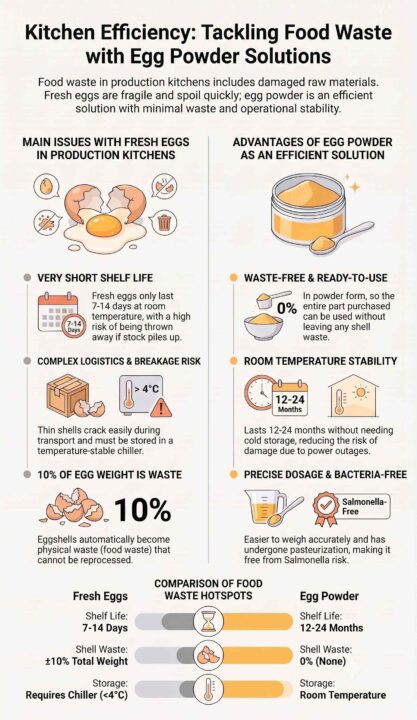
- A much longer shelf life: Egg powder can be stored for up to 12 to 24 months at room temperature, since its moisture content sits below 5%. Compare that with fresh eggs, which need to be used up within weeks.
- No shell waste at all: Around 11% of an egg’s weight is shell that normally gets thrown away. Since egg powder already comes in ready-to-use form, every part of what you buy actually gets used.
- More precise dosing, fewer failed batches: Weighing out powder is far more accurate than cracking eggs one by one, given how much size varies from egg to egg. Batches ruined by an off egg ratio become far less common.
- Less reliance on large cold storage: Egg powder only needs a sealed container at room temperature, not a chiller. The risk of spoiled raw material from a cooling malfunction disappears from the list of concerns entirely.
- Lower risk of bacterial contamination: Egg powder goes through pasteurization before drying, which leaves it Salmonella-free. Production batches are far less likely to be discarded over food safety concerns.
A product like Whole Egg Powder is even built as a drop-in replacement for fresh eggs, with no need to change a recipe. Production teams only need to adjust the reconstitution ratio.
Comparing Food Waste Potential: Fresh Eggs vs Egg Powder
To make the comparison easier, here is a summary of where food waste risk shows up most for each raw material. This table covers 5 factors that directly affect how much raw material ends up wasted in a production kitchen.
| Factor | Fresh Eggs | Egg Powder |
|---|---|---|
| Shelf Life | 3 weeks (best quality, refrigerated) | 12-24 months (room temperature) |
| Physical Waste | Shell, about 11% of egg weight | None, the entire powder is used |
| Cold Storage Needs | Requires a chiller below 4°C | Room temperature, sealed container |
| Contamination Risk | Salmonella risk on shell and contents | Low, already pasteurized |
| Dosing Precision | Varies by egg size, hard to standardize | Can be weighed precisely by the gram |
4 Tips for Using Egg Powder to Minimize Food Waste in Production Kitchens
There are 4 things worth paying attention to so that switching to egg powder actually cuts food waste in production kitchens, instead of just moving the problem around. All 4 come down to how it is stored and measured day to day.
- Apply FIFO even with a long shelf life. Whichever pack was opened first should be used up first. This habit keeps powder from sitting unused in storage indefinitely.
- Reconstitute only what that day’s production needs. Mix just enough egg powder with water for that day’s target output. Leftover reconstituted liquid spoils far faster than the dry powder does.
- Store it in an airtight container. Moisture is egg powder’s biggest enemy once a pack is opened. A tightly sealed container protects quality and keeps the powder from clumping and going to waste.
- Track daily usage with simple records. Usage data helps the production team calculate the right stock level instead of guessing. More accurate purchasing directly lowers the risk of raw material piling up and expiring.
Conclusion
Food waste in production kitchens rarely comes from a single cause. Fresh eggs, with their short shelf life and high risk of breakage, are one of the contributors that gets overlooked the most often.
Should fresh eggs be dropped altogether? Not necessarily, but cutting back on fresh eggs at the riskiest points is already enough to move the needle on margins, since every raw material that actually gets used means every dollar spent stops ending up in the trash.
Egg powder is one option worth considering for that purpose, especially for businesses that process eggs in large volumes every day. If you would like to discuss which raw material fits your production line best, feel free to Contact Us.

FAQ
Yes, especially for bread, cakes, and processed meat, as long as you follow the reconstitution ratio on the packaging.
Quite a while, provided it is kept in an airtight container in a cool, dry place, though FIFO is still recommended.
Yes, since it goes through pasteurization that eliminates harmful pathogens before drying.
Yes, since every variant is shell-free and shelf-stable, they only differ in their technical function.