
Measuring training effectiveness for production teams is the process of checking whether training actually changes how people work on the line and what the line produces. The check compares the team before and after training using indicators that can be recorded, such as test scores and the number of defective products.
A 2019 Association for Talent Development (ATD) survey of 779 talent development professionals found that about 8 in 10 organizations measured training at the reaction and learning levels. Only 54% measured whether people applied new skills on the job, 38% measured business results, and 16% calculated ROI.
This article explains how to measure training effectiveness for production teams: what to measure, how to set a baseline, which indicators fit each type of training, when to measure, and which mistakes to avoid. The examples come from food processing lines.
What Should You Measure in Production Team Training?
Production team training is measured at four levels: reaction, learning, behavior, and results, as set out in the FAO training manual on food hygiene. Food Safety Magazine credits Jack Phillips with adding a fifth level, ROI (return on investment), to Donald Kirkpatrick’s four-step model, and a University of Idaho Extension bulletin describes the resulting five-step model as an industry standard.
| Level | What It Assesses | Main Measurement Tool |
|---|---|---|
| 1. Reaction | Participants’ impressions of the training, such as its clarity and usefulness | A short survey on a scale of 1 to 4 |
| 2. Learning | Knowledge and skills gained | Written, oral, or skill tests |
| 3. Behavior | Use of the material on the line | Supervisor appraisal on the line and internal audits |
| 4. Results | Impact on production performance | Production and quality data compared with the baseline |
For routine training such as an employee hygiene refresher, measuring up to level 3 is enough. Level 4 and ROI are better reserved for programs with a measurable production target or a large budget.
ROI is calculated by dividing the net benefit of the training (the value of the benefits minus its cost) by the cost, then multiplying by 100%. As an illustration, a US$2,000 training program that produces US$5,000 in savings from fewer downgraded products delivers a net benefit of US$3,000, or an ROI of 150%.
How Do You Set a Baseline Before Measuring Training Effectiveness?
A baseline is the starting data recorded before training to serve as a point of comparison, ideally collected over a full month. Without those starting numbers, any improvement after training is only an estimate.
Baseline data covers four items: pre-training test scores, initial observation results from a checklist, the latest internal audit findings, and production data for the past month. Record the product and shift in the same format that will be used after the training.
Lines with seasonal production, such as holiday cookies, should be compared with the same period in the previous year. A demand surge changes workload and target pressure at the same time, which makes month-to-month comparisons unfair.
Which Indicators Fit Each Type of Training on the Production Line?
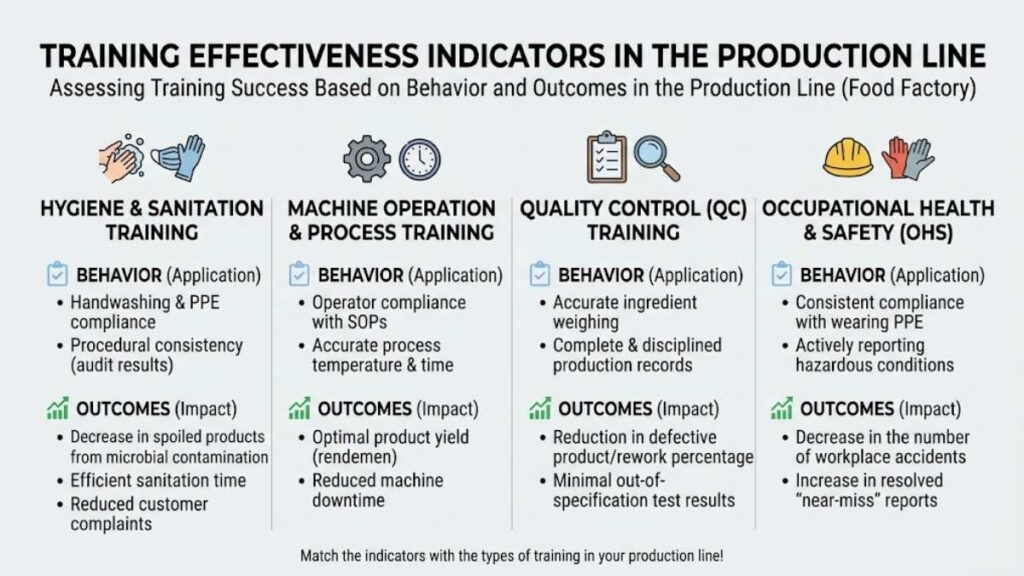
Indicators should follow the content of the training: hygiene training is judged by procedural compliance and audit findings, while equipment training is judged by how smoothly the line runs and what it produces. Below are four types of training in a food plant, each with example indicators for behavior and results.
1. Hygiene and Sanitation Training
Supervisors can observe handwashing and personal protective equipment (PPE) compliance, while internal audit findings show whether procedures are followed consistently. At the results level, Food Safety Magazine gives examples such as downgraded product from elevated microbiological contamination, sanitation time, and customer complaints.
2. Equipment and Process Operation Training
Operator compliance with standard operating procedures (SOPs) shows up in accurate temperatures and process times on the work sheet. Results appear in yield, meaning the amount of finished product from the raw material used, and in machine downtime.
3. Quality Control Training
Accurate ingredient weighing and complete production records show whether quality staff are applying the training. Results appear in the percentage of products that are defective or must be reworked and in the number of test results that fall outside specification.
4. Workplace Safety Training
Wearing PPE and a habit of reporting hazards are behavior indicators that can be checked with a checklist. Workplace accidents are the results indicator, but near-miss reports may rise after training because reporting improves.
Read also: Maintaining Dry Raw Material Equipment to Prevent Contamination
When Should Training Effectiveness Be Measured?
Measurement starts before the training begins and ends after one full production reporting cycle, with behavior assessed 30 to 90 days after the class. That window comes from Food Safety Magazine, while the timing of the results assessment follows each plant’s own reporting cycle.
- Before the training, record the baseline and give a pre-test.
- When the session ends, participants complete a reaction survey and a final test before leaving the training room.
- At 30 to 90 days after the training, supervisors observe application on the line and the quality team compares internal audit findings with the baseline.
- At the next production reporting cycle, results indicators are compared with the baseline to decide whether the material continues or needs revision.
Read also: International Certification Challenges: HACCP, ISO, Halal
What Mistakes Make Training Effectiveness Measurement Misleading?
Measurement misleads when it relies only on participant satisfaction, treats test scores as behavior, uses no comparison, or stops once the data is collected. All four can be prevented at the planning stage.
1. Stopping at Participant Satisfaction
According to a research summary from the Quality Improvement Center for Workforce Development (QIC-WD) that cites a 2008 meta-analysis by Sitzmann and colleagues, trainee reactions are only modestly related to immediate knowledge outcomes and unrelated to delayed knowledge. A satisfaction survey is still useful for improving materials and delivery, but it is not enough to show that the team has mastered the procedures.
2. Treating Test Scores as Behavior
A systematic review and meta-analysis that included 31 studies on food safety and hygiene training for food handlers (Foods, 2020) found an effect size of 1.24 for knowledge but only 0.45 for observed practices. The larger the number, the stronger the effect of the training.
So a good test score does not guarantee that habits on the line will change. According to the FAO manual, behavior is best evaluated through appraisal by on-the-job supervisors.
3. Measuring Without a Comparison
The top barrier to evaluation, reported by 41% of respondents in the ATD survey, was difficulty isolating a training program’s influence on results. ATD says control groups can help isolate those effects.
On a plant floor, a shift that has not yet been trained can serve as the comparison, as long as it runs the same products and equipment. Without a comparison, an improvement may come from a change of raw material supplier or new equipment, so every such change should be logged during the observation period.
4. Stopping Once the Data Is Collected
The Codex code of practice on General Principles of Food Hygiene (1997 revision, reproduced in the FAO training manual) says that periodic assessments of the effectiveness of training and instruction programs should be made, along with routine supervision and checks. Training programs should also be routinely reviewed and updated where necessary, so measurement findings should lead to better materials or coaching on the line.
Conclusion
Where to start? With one results indicator that is already recorded in the quality report and one observation checklist for supervisors, with the starting numbers logged before the class begins.
During the measurement period, keep other factors stable, including the specification of the raw materials used on the line. That way, the before-and-after difference is easier to attribute to the training.

How do you measure training effectiveness for production teams?
Measure at four levels (reaction, learning, behavior, and results) against baseline data recorded before the training. Jack Phillips added a fifth level, ROI, to Donald Kirkpatrick’s four-step model, according to Food Safety Magazine.
How long after training should behavior be assessed?
Food Safety Magazine places the assessment of on-the-job application 30 to 90 days after the class ends. The final test is given right after the session.
Is a participant satisfaction survey enough to measure training effectiveness?
No, because trainee reactions are only modestly related to immediate knowledge outcomes, according to a QIC-WD research summary. Surveys are still useful for improving materials and delivery.
Which indicators can be used to evaluate training on a production line?
Food Safety Magazine gives internal audit nonconformities as an example for assessing application, and downgraded product, sanitation time, and customer complaints for assessing results. Choose indicators that are already recorded and match the content of the training.
How do you separate the effect of training from other factors?
Use a control group, for example a shift that has not yet been trained, and log any other changes during the observation period. In the ATD survey, 41% of respondents named difficulty isolating a program’s influence on results as the top barrier to evaluation.