
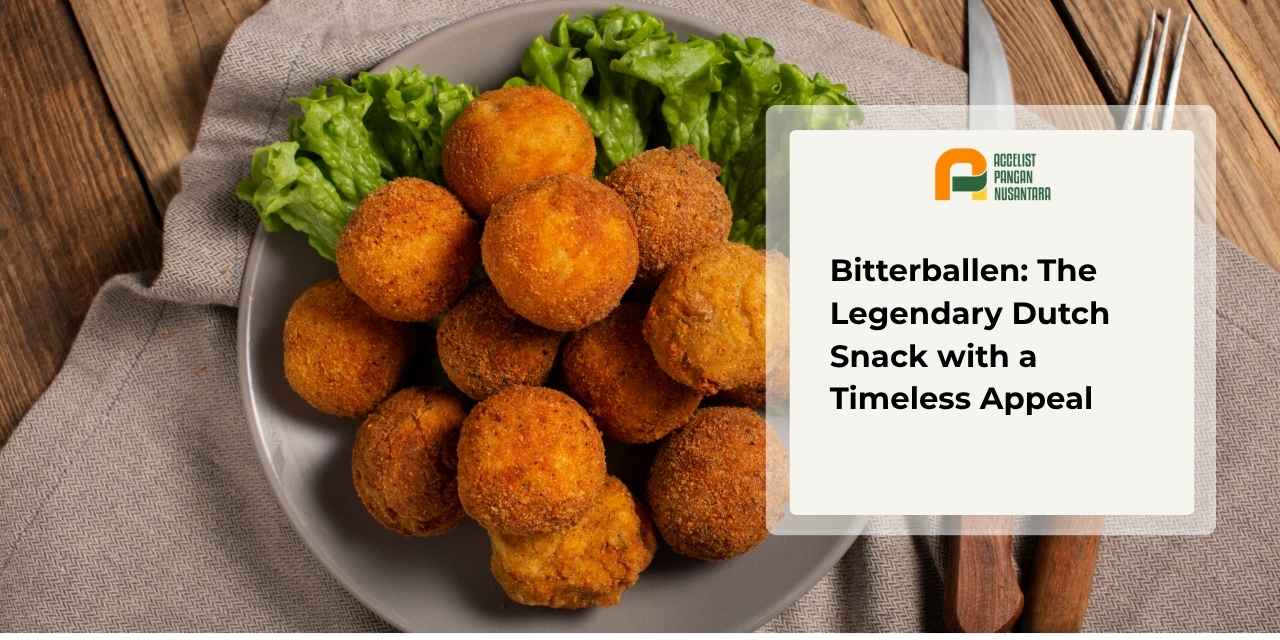
Who doesn’t know Bitterballen?
This small, round snack has long won over food lovers in Indonesia. You’ll find it at traditional wedding receptions, old-school cafes, and appetizer menus at modern restaurants alike. One bite rarely feels like enough.
Beneath that golden, crispy shell is a soft, savory, creamy ragout filling. The contrast between the two textures is exactly what keeps people reaching for more.
As one of the most popular culinary legacies of the colonial era, Bitterballen is far more than a fried snack. It carries a long history and a specific preparation method that sets it apart from anything else on the table.
What Is Bitterballen?
Simply put, Bitterballen is ragout (a thick meat mixture made with milk and stock), chilled until firm, shaped into small balls, coated in breadcrumbs, and deep-fried until golden.
What makes it special is the filling. When served hot, it melts in your mouth. But the ball holds its shape when you pick it up. That’s the standard. Unlike fried meatballs, which are chewy throughout, Bitterballen must have a creamy interior.
Where Does Bitterballen Come From?
Bitterballen is a Dutch snack. Full stop.
It’s one of the clearest examples of Dutch culinary influence that remains in Indonesia today. Back in the Netherlands, the recipe goes back centuries and has always been tied to the country’s social culture.
Why Is It Called “Bitterballen”?
A lot of people assume the name has something to do with a bitter taste. It doesn’t. Bitterballen is savory, not bitter at all.
The name comes from how it was traditionally served in the Netherlands. It was a companion snack for Bittertje, a Dutch herbal spirit with a slightly bitter flavor, similar to gin.
So “Bitterballen” literally means “balls for drinking bitter.”
The Difference Between Bitterballen and Croquettes
Bitterballen and Kroket (Kroketten) are easy to mix up. The base ingredients are nearly identical and so is the taste. But there are a few real differences worth knowing:
- Shape: Bitterballen is round and spherical, about 3 to 4 cm in diameter. Kroket is oblong or cylindrical.
- When it’s eaten: Bitterballen is a bite-sized snack, meant to be eaten in one or two bites. In the Netherlands, Kroket is more of a lunch staple, often served tucked inside a bread roll (Broodje Kroket).
- What’s inside: Both use ragout, but traditional Bitterballen tends to have a slightly higher ratio of minced meat to roux. The idea is to pack more meat flavor into a smaller size.
Ingredients and How It’s Served
The heart of a good Bitterballen is the ragout.
The core ingredients are butter, plain flour, rich beef stock, milk, minced beef, and the essential seasonings: nutmeg, pepper, and salt.
Once the ragout is cooked and cooled (usually left in the refrigerator overnight to firm up properly), it’s shaped into balls and moved to the coating stage.
The Coating: Where Many Recipes Go Wrong
The coating process (flour, egg wash, breadcrumbs) is critical. Every part of the ball needs to be fully sealed so the ragout doesn’t leak during frying.
The most common problem, both at home and in a commercial kitchen, is the egg wash. Using fresh eggs can be messy, inconsistent in texture, and makes it harder for breadcrumbs to stick evenly.
For more consistent, practical, and hygienic results, using Whole Egg Powder (Tepung Telur Mix) is the recommended approach.
Why is Accelist Pangan Nusantara’s Egg Flour Mix the modern solution for this classic recipe?
- Balanced composition: Made from a blend of egg white and yolk, it provides strong binding between the ragout and the breadcrumb coating.
- Easy to use: Just dissolve in water for an egg wash with consistent thickness every time, with no cracking shells and no mess.
- Longer shelf life: Far more practical for storing Bitterballen ingredients, especially useful when producing frozen batches at scale.
- Consistent results: The coating comes out evenly crispy and holds together without going patchy.
To serve: Deep-fry the Bitterballen in hot oil until golden brown. Drain, and serve immediately while still hot. The traditional accompaniment is yellow mustard, whose sharp, tangy flavor balances the richness of the creamy filling
Conclusion
Bitterballen shows that a simple recipe can become a legend when the technique and ingredients are right.
Whether you’re making it for family at home or building it into your food business menu (as frozen stock or a dine-in item), the quality of your ingredients matters.
The use of innovations as Egg Flour Mix helps simplify the process of making this classic snack without compromising its authentic flavor, saving time and ensuring more consistent results.
FAQ
Yes. After coating with breadcrumbs, store the Bitterballen in a sealed container in the freezer. Use hygienic coating ingredients to extend shelf life.
It works as a binding agent, helping the breadcrumbs adhere firmly to the ragout and preventing leaks during frying. It’s also more hygienic than raw fresh eggs.
Whole Egg Powder combines both white and yolk. It’s a complete egg substitute. Egg Yolk Powder uses only the yolk, which adds rich flavor and natural color. For Bitterballen coating, Whole Egg Powder is the better choice.
Accelist Pangan Nusantara offers a quality Tepung Telur Mix formulated for food industry and HORECA applications. Contact them directly for product and order details.