
Picture a tanker of liquid egg arriving at a food manufacturer with its temperature already three degrees above the safe limit. Without a clear checkpoint system, that batch could slip through and end up in a customer’s kitchen before anyone notices the risk.
The World Health Organization estimates that unsafe food causes 600 million illnesses and 420,000 deaths every year worldwide. Perishable items such as eggs, dairy, and poultry are consistently among the products most linked to these incidents.
This is exactly why HACCP (Hazard Analysis and Critical Control Point) has stopped being optional for food suppliers and become a baseline requirement. This article walks through how suppliers can guarantee food safety under HACCP, from its core principles to how a supplier can actually prove compliance to a buyer.
What HACCP Is and Why Suppliers Need It
HACCP is a food safety management system built around prevention, not just end-product testing. For a supplier, that means raw materials, storage, and shipping are monitored from the start, instead of being checked only after something goes wrong.
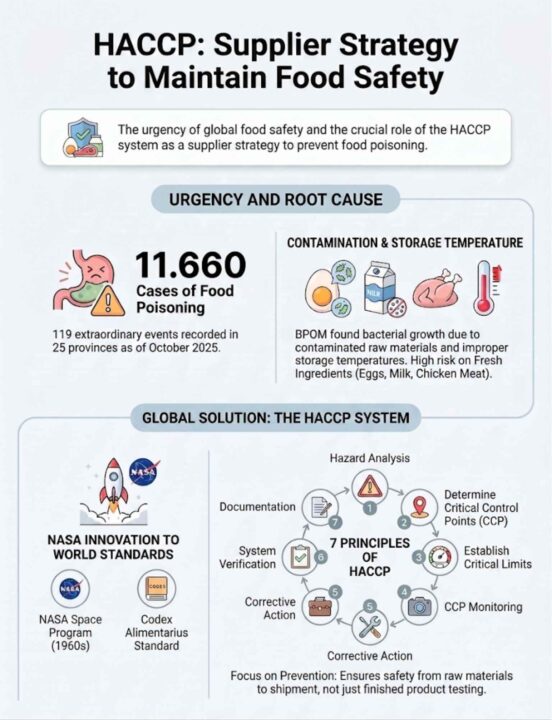
The system traces back to NASA’s collaboration with Pillsbury in the 1960s, developed to keep astronauts safe from foodborne illness in space. Today it forms the backbone of the Codex Alimentarius General Principles of Food Hygiene (CXC 1-1969), the food hygiene framework jointly maintained by the FAO and WHO and referenced by food regulators around the world.
Ignoring this system carries more risk than a warning letter. According to a CDC analysis of outbreak data from 2014 to 2022, contamination of raw materials before final preparation, inadequate cooking or holding temperatures, and poor worker hygiene remain the most common contributing factors behind foodborne illness outbreaks.
The 7 HACCP Principles Every Supplier Should Master
These seven principles, as defined by the U.S. Food and Drug Administration, form the official framework behind every HACCP-based food safety system. A supplier who masters all seven can map risk across the entire supply chain instead of guessing where problems might occur.
- Conduct a hazard analysis: Identify biological, chemical, and physical hazards at every stage, from raw material intake to the moment a product leaves the warehouse.
- Determine critical control points (CCPs): Pinpoint where a hazard can be prevented, eliminated, or reduced to a safe level, such as cold storage temperature.
- Establish critical limits: Set an exact, measurable value for each CCP, for example a maximum of 4 degrees Celsius for frozen goods.
- Establish monitoring procedures: Build a routine checking process so every CCP stays within its set limit.
- Establish corrective actions: Prepare a fix for the moment a deviation occurs, rather than waiting until the product reaches the customer.
- Establish verification procedures: Run periodic audits to confirm the whole system genuinely works, not just that it exists on paper.
- Establish record-keeping and documentation: Keep every process record as proof of compliance and as a tool for tracing the source of a problem if one ever surfaces.
Concrete Steps Suppliers Take to Apply HACCP Along the Supply Chain
Applying HACCP on the ground means turning the seven principles above into daily procedures the whole team can follow. Here is the sequence most food suppliers use to put the system into practice.
- Form an internal HACCP team that includes warehouse staff, quality control, and logistics.
- Map the process flow from raw material receiving through to product dispatch.
- Identify CCPs at the riskiest points, such as goods receiving, storage, and packaging.
- Train field staff to read temperature equipment correctly and log monitoring data without errors.
- Schedule internal audits at least every three months to check consistency.
Skip these five steps and a HACCP binder stays a paperwork exercise. Consistency on the floor is what decides whether the system genuinely protects consumers or just decorates an office wall.
Common Challenges Suppliers Face When Running HACCP
Rolling out HACCP rarely goes smoothly from day one, especially for small and mid-sized suppliers. Here are the obstacles that show up most often in the field, several of which line up with the CDC’s own contributing-factor data on temperature control and hygiene.
- Investment costs for temperature monitoring equipment and staff training, which some businesses still treat as a low priority.
- Limited understanding among field staff about how to read and log critical control points accurately.
- Storage facilities that fall short, letting product temperature drift during distribution.
- Weak management commitment to treating HACCP audits as a routine agenda item rather than a one-time certification requirement.
None of these obstacles justifies delaying HACCP adoption. If anything, the faster they get fixed, the smaller the chance a defective product reaches a customer.
How Suppliers Prove HACCP Compliance to Buyers
Having a HACCP system internally is not enough if a buyer cannot easily verify it. Here is what a supplier needs ready so its compliance is visible, not just a claim on a brochure.
- Keep a valid HACCP certificate or equivalent document available to show on request at any time.
- Explain openly how a shipment is handled if a temperature deviation happens in transit.
- Open up internal and external audit records, including how past customer complaints were resolved.
- Maintain a written traceability system that can be pulled up quickly if a problem is ever found.
These four points separate a supplier that genuinely runs HACCP from one that only prints the logo on its packaging. Buyer trust is built on this kind of transparency, not on the lowest quote.
Conclusion
Food safety is not an accident. It is the result of a system maintained consistently at every point in the supply chain. Suppliers who apply the seven HACCP principles with discipline hold far more control over their product quality, long before that product ever reaches a customer.
Choosing a supply partner can no longer come down to the lowest price or the fastest delivery either. Proof of consistent HACCP compliance, from documentation to readiness for handling a deviation, is a far stronger indicator of a dependable long-term partnership.
As one of the higher-risk raw materials in food production, eggs demand careful handling from farm to finished product. Accelist Pangan Nusantara processes fresh eggs into Egg Powder through a production process built around food safety at every stage, giving food manufacturers a longer shelf life, easier storage, and consistent quality for their operations.
Contact Us to learn more about our products and to discuss a supply partnership for safe, reliable food ingredients.

FAQ
Not in every sector, but it is strongly recommended for perishable products such as eggs and processed meat.
Typically three to six months, depending on the size of the business and how ready the team is.
HACCP focuses specifically on hazard analysis and critical control points, while ISO 22000 is a broader food safety management standard that usually incorporates HACCP principles within it.