
Imagine a small bakery that just bought five kilograms of egg powder to last a month of production. In a rush, the staff leaves it on an open shelf near the dishwashing area, where the air stays damp all day.
Two weeks later, the powder starts clumping and gives off an unusual smell. According to a classic study on dried whole egg, the product should contain no more than 5 percent moisture, and preferably 2 percent or less, to keep its quality during storage, a finding still referenced in food science literature on dried eggs and their hygroscopic nature.
Once that moisture limit is crossed due to damp air exposure, the impact of humidity on egg powder quality becomes obvious in texture, smell, and shelf life. This article breaks down exactly how humidity affects egg powder, what the safe moisture limit looks like, and how to store it properly.
What Is Egg Powder and Why Is Humidity Its Biggest Threat?
Egg powder is made by drying fresh eggs, whether whole, whites only, or yolks only, until the moisture content drops far below that of liquid eggs. This drying process is exactly what allows egg powder to stay shelf stable for a year or more, compared to just a few weeks for fresh eggs.
The problem is that this same dryness makes egg powder highly hygroscopic, meaning it readily absorbs moisture from the surrounding air. That is why the humidity of the storage environment matters just as much as temperature, if not more.
What Factors Affect Humidity Exposure in Egg Powder?
Four main factors determine how quickly egg powder picks up moisture from its surroundings. Here is a closer look at each one.
- Relative humidity (RH) of the storage room: The higher the RH around the storage area, the faster egg powder absorbs moisture from the air.
- Type of packaging used: Packaging that is not airtight, such as thin plastic bags or containers opened repeatedly, lets moisture in more easily.
- Storage temperature: Warmer room temperatures tend to raise the relative humidity inside a container, especially where ventilation is poor.
- Frequency and duration of open-air exposure: The more often a container is opened and closed, or the longer the powder sits exposed, the greater the chance moisture gets in.
How Does Humidity Affect Egg Powder Quality?
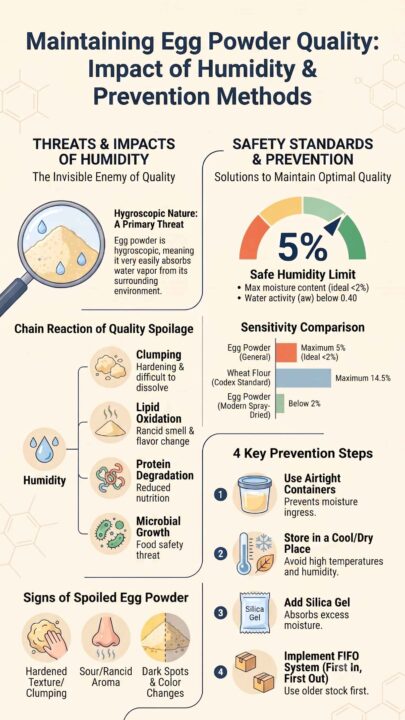
In short, damp air causes egg powder to absorb moisture beyond its safe limit, triggering four chain reactions: clumping, fat oxidation, loss of functional properties, and microbial growth. Here is how each one plays out.
1. Moisture Absorption That Causes Clumping
Egg powder particles are hygroscopic, so they keep drawing in water vapor whenever the relative humidity around them stays high. As a result, the fine powder turns into wet clumps that dissolve poorly when mixed into a batter or dough.
2. Fat Oxidation That Leads to Rancid Odors
Egg yolk powder contains a substantial amount of fat, and that fat is prone to oxidation once moisture content rises. A study on egg powder water activity published in the Journal of Food Processing and Preservation found that egg yolk powder tends to reach a higher water activity (aw) than whole egg or egg white powder under the same conditions. A higher aw speeds up fat oxidation, which is what produces that distinct rancid smell.
3. Loss of Functional Properties (Foaming and Emulsifying Power)
Egg powder is valued for specific functional traits, such as the foaming ability of egg white powder and the emulsifying capacity of egg yolk powder. Excess moisture damages the protein structures responsible for both traits, which is why baked goods made with it often turn out less fluffy.
4. Higher Risk of Microbial Growth
As humidity pushes moisture content up, water activity (aw) rises along with it, creating conditions where microorganisms can thrive. Dry food powders are generally kept at an aw below 0.40 for this reason, since going above that range is what typically triggers texture changes, caking, and eventual spoilage in low-moisture products like egg powder.
What Is the Safe Moisture Limit for Egg Powder?
The generally accepted benchmark comes from decades-old food science research, and it still holds up in modern production. Here is a quick comparison table.
| Egg Powder Type | Moisture Limit |
|---|---|
| Dried whole egg (general guideline) | maximum 5%, ideally 2% or lower |
| Modern spray-dried egg powder | typically below 2% |
| Powdered eggs (industry standard) | below 5%, with water activity under 0.40 |
For comparison, the Codex Alimentarius, the international food standards collection published by FAO and WHO, sets a maximum moisture content of 14.5 percent for wheat-based flour products. This shows that egg powder is far more sensitive to moisture than flour, which means it needs more careful handling.
4 Ways to Store Egg Powder to Prevent Moisture Damage
Keeping egg powder fresh really comes down to four simple habits applied consistently. Here are the steps.
- Use an airtight container: Transfer egg powder into a tightly sealed container as soon as the original packaging is opened, rather than just rolling and clipping the bag shut.
- Store it somewhere cool and dry: Avoid areas near stoves, sinks, or windows, since these are common moisture sources that often go unnoticed.
- Add food-grade silica gel inside the container: This helps absorb any residual moisture that sneaks in every time the container is opened.
- Apply a First In First Out (FIFO) system: Use older stock first and label containers with purchase dates so rotation stays easy to track.
What Are the Signs That Egg Powder Has Been Damaged by Humidity?
There are three main signs that do not require any special equipment to spot, namely changes in texture, smell, and color. Here is what to look for.
- Clumping or hardening: Powder that should be fine and loose turns into small chunks that are hard to break apart with a spoon.
- A sour or rancid smell: This odor signals that fat oxidation has already begun, and it is different from a plain musty smell.
- Darker color or visible specks: Dark specks often indicate the early stages of mold growth, and the powder should no longer be used at that point.
Conclusion
Humidity is never a minor detail when it comes to storing egg powder. Once moisture content crosses the safe threshold, texture, smell, and product safety all come under threat, ranging from clumping to a higher risk of microbial growth.
The four storage habits covered above, an airtight container, a cool environment, silica gel, and a FIFO system, go a long way in reducing that risk. Applying them consistently matters far more than simply knowing the theory behind them.
For culinary businesses and food manufacturers, choosing raw materials with quality control built in from the start is a meaningful step toward reducing moisture-related losses. Egg powder from a producer that follows proper production and packaging standards makes it easier to maintain stable quality throughout long-term storage.
Accelist Pangan Nusantara produces egg powder with careful attention to moisture control and handling, in line with recognized quality standards, so the product stays stable for long-term production needs. Contact Us to learn more about egg powder options suited to your business.

FAQ
When stored properly in an airtight container in a cool, dry place, egg powder can last more than a year without significant quality loss.
Yes, as long as the container is truly airtight so the powder does not absorb moisture or odors from other food inside the fridge.
Egg yolk powder tends to be more vulnerable because of its higher fat content, which means oxidation from moisture exposure happens faster than in egg white powder.