
Picture a raw material warehouse crammed full right before month end. Shelves are maxed out, orders keep rolling in, and the warehouse team scrambles to find space for new stock.
This scenario is common among catering businesses, bakeries, and food manufacturers that rely heavily on fresh ingredients. Storage space shrinks, warehouse rental costs climb, and the risk of spoilage before ingredients even reach production goes up.
Storage space efficiency is one of the most overlooked operational issues, even though it directly affects cash flow and production flow. This article breaks down why dry ingredients can be the answer, backed by data and practical steps you can apply right away.
Why Storage Space Becomes a Problem for Food Businesses
Limited storage space often forces food businesses to pile up stock wherever it fits, sometimes blocking the kitchen team’s workflow entirely. This problem tends to get worse for companies handling large stock volumes or a wide variety of products, which makes careful warehouse layout planning essential from the start.
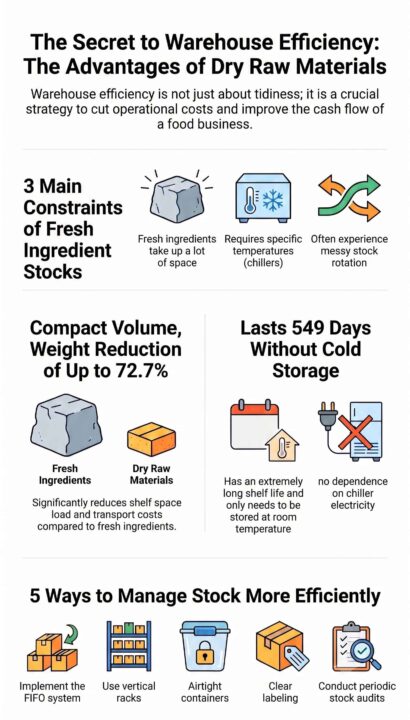
Here are the three most common root causes found on the ground:
- Fresh ingredients take up a lot of space: Vegetables, meat, and eggs need large containers plus spacing between stacks to avoid damage.
- Special temperature requirements: Perishable ingredients demand refrigeration or chiller units, and those aren’t cheap to run.
- Messy stock rotation: Without a clear first in, first out system, older stock often gets buried under newer stock until it expires.
How Dry Ingredients Solve the Storage Space Problem
Dry ingredients shrink storage volume because most of their water content has already been removed through the drying process. The effect: warehouses can hold far more stock without expanding the building.
1) Volume and Weight Are Drastically Reduced
The drying process cuts ingredient weight significantly, since water is the largest component in fresh ingredients. According to a food science overview published on ScienceDirect, converting eggs into powder reduces their moisture content from around 74 percent down to just 2 to 4 percent, resulting in a substantial cut in both weight and volume.
2) Shelf Life Is Far Longer
Low moisture content means dry ingredients are a poor breeding ground for microbes. A comparative study published by Universitas Jenderal Soedirman’s animal science proceedings in Indonesia found that whole egg powder can be stored for up to 549 days, far surpassing fresh eggs, which last only around 25 days.
That kind of shelf life range means businesses don’t need to reorder ingredients as often. Stock can be purchased in bulk in a single order without worrying about spoilage sitting in the warehouse.
3) No Need for Special Cold Storage
Dry ingredients generally only need to be kept at room temperature with controlled humidity, not in a chiller or freezer. Egg powder, for instance, no longer requires the large cold storage space that fresh eggs do, and it carries minimal risk of breakage during handling.
The savings go beyond space alone. Electricity costs for refrigeration also drop, since the workload on chiller units is reduced.
Practical Ways to Optimize Dry Ingredient Storage
Having dry ingredients on hand isn’t enough if warehouse management is still haphazard. The five steps below can help maximize every square foot of available space.
- Apply a FIFO (first in, first out) system: Ingredients that arrive first should be used first, so nothing gets forgotten in a corner of the shelf.
- Make use of vertical racking: Storing upward is far more space-efficient than expanding floor area, especially for lightweight dry ingredients.
- Use airtight containers: Humidity is the main enemy of dry ingredients. According to Virginia Tech Cooperative Extension, humidity levels above 60 percent can cause dry foods to absorb moisture, resulting in caking and staleness, which makes tightly sealed containers a must.
- Label production and expiration dates: Clear labeling speeds up stock checks without needing to open every single package.
- Conduct regular stock audits: Routine checks help catch ingredients nearing expiration before they end up as waste.
Examples of Dry Ingredients Improving Storage Efficiency
The two ingredients below illustrate how a shift to dry form can cut down on warehouse space needs. Both are also staple ingredients widely used across bakery, catering, and processed food industries.
1) Egg Powder
The comparison between fresh eggs and egg powder is the clearest illustration of how dry ingredients affect warehouse space. The table below summarizes the differences in volume, shelf life, and handling requirements.
| Aspect | Fresh Eggs | Egg Powder |
|---|---|---|
| Space needed | Large, fragile, requires special containers | Compact, can be stacked in sacks or airtight packaging |
| Shelf life | Around 25 days at room temperature | Can reach 549 days or more |
| Temperature needs | Ideally refrigerated | Room temperature, dry conditions are enough |
| Damage risk | High, prone to breaking and spoiling | Low, since moisture content is minimal |
That shelf life gap isn’t a small number for businesses relying on large egg supplies. One kilogram of egg powder is equivalent to dozens of fresh eggs, meaning a single small sack can replace a stack of egg crates in the warehouse.
2) Milk Powder
Fresh and liquid milk generally require a cold chain from distributor all the way to the production warehouse, which means chiller costs running nonstop. Milk powder cuts that need for a few reasons.
- Much smaller volume: A single sack of milk powder can replace dozens of liters of liquid milk that previously needed extensive refrigerated shelving.
- No mandatory cold storage: Milk powder can simply sit on a dry shelf as long as it’s protected from humidity and direct sunlight.
- Longer shelf life: Without a freezing process, milk powder can still be used for months after opening, as long as the packaging is resealed tightly.
Conclusion
Storage space efficiency isn’t just about tidying up a warehouse, it’s a strategy that directly impacts operational costs and production flow. Switching to dry ingredients has been shown to cut volume, extend shelf life, and reduce dependence on expensive cold storage.
Small steps like applying FIFO, vertical racking, and regular stock audits matter just as much for maximizing those results. Combining the right ingredient choices with disciplined warehouse management is the key to a warehouse that’s both spacious and efficient to run.
One ingredient worth considering to support this efficiency is egg powder, given its long shelf life and everyday handling convenience. It can serve as a simple starting point before a business begins shifting other raw materials into dry form as well.
If you’d like to explore how egg powder can be applied to your production line, the team at Accelist Pangan Nusantara is ready to help. Contact us for a consultation on dry ingredient needs tailored to your business scale.

FAQ
Food ingredients that have had their moisture content reduced through drying, such as flour and powdered seasonings.
Because their weight and volume shrink significantly once moisture is reduced, so the same amount of stock fits in a much smaller space.
Most can, from vegetables to animal protein like eggs, as long as the right drying method is used.
Much longer than fresh ingredients. Egg powder, for example, can last over a year in airtight packaging.