
Fresh egg price impact on egg powder price is often treated as a simple cause-and-effect relationship, when the actual mechanism involves a fairly specific conversion calculation. Manufacturers and buyers of egg powder both need to understand this mechanism so they don’t misjudge how big a price increase they’re about to face.
The production process actually requires a far larger volume of fresh egg than the weight of egg powder it yields, so even a small price increase at the farm level can end up feeling multiplied by the time it reaches the egg powder manufacturer. The bigger that volume gap, the bigger the impact that ultimately gets felt.
This article covers the impact of fresh egg prices on egg powder prices, from the conversion ratio to the factors that keep this impact from showing up instantly. You will also find tips for anticipating this kind of price increase as a buyer.
How Much Fresh Egg Is Needed to Produce Egg Powder?
According to technical data from the American Egg Board, the standard conversion ratio for whole egg powder is 4 to 1, meaning 4 kilograms of liquid egg yields 1 kilogram of egg powder once the moisture is removed. That ratio holds steady because fresh egg is made up of roughly 75% water, which gets removed during the drying process.
The conversion ratio can vary slightly depending on the type of egg powder being produced, whether it’s whole egg, egg white, or egg yolk powder. For comparison, 1 kilogram of egg powder is roughly equivalent to 80 to 90 whole eggs, depending on egg size and the production method used.
How Does This Conversion Ratio Affect Egg Powder Cost Calculations?
This 4-to-1 ratio isn’t just a technical figure. It directly determines how much a fresh egg price increase ends up being felt in the price of egg powder. Here’s a simple illustration to help make sense of the impact.
As an example, if the price of fresh egg rises by $0.10 per kilogram, the added raw material cost for producing 1 kilogram of egg powder could reach $0.40, not just $0.10. This is why a fresh egg price increase that looks small at the consumer level can end up hitting egg powder manufacturers far harder.
Why Doesn’t the Increase Show Up Immediately in Egg Powder Prices?
Even though the conversion ratio points to significant potential impact, egg powder prices in the market don’t always move instantly in step with fresh egg prices. Here are four factors that delay or soften that impact.
- Long-term contracts between manufacturers and farmers that lock in fresh egg prices for a set period
- Raw material stock purchased before the price increase took effect, meaning manufacturers don’t need to adjust their selling price right away
- Other production costs such as energy, packaging, and distribution that also shape the final price, so not all of the egg price increase gets passed through
- Manufacturers choosing to absorb the margin hit temporarily to protect customer loyalty before eventually raising prices
Tips for Buyers Anticipating a Fresh Egg Price Increase
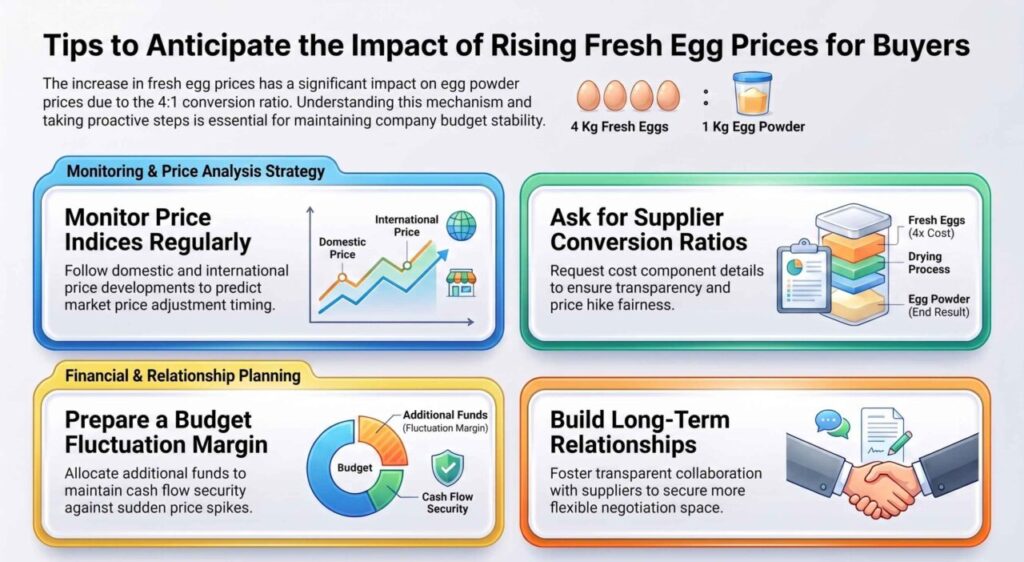
Understanding the mechanism behind this price impact isn’t enough without the right steps to prepare for it. Four tips below can help you handle this situation as a buyer.
1. Track the Fresh Egg Price Index Regularly
Follow developments in fresh egg prices in both domestic and international markets on a routine basis. This information helps you anticipate when egg powder prices are likely to be adjusted.
2. Ask Your Supplier About Their Conversion Ratio
Ask your supplier to explain the conversion ratio and cost components that make up their egg powder pricing. This transparency helps you judge whether a price increase a supplier applies is actually reasonable.
3. Build Fluctuation Margin Into Your Budget
Set aside a raw material purchasing budget with extra margin to prepare for an unexpected rise in fresh egg prices. This step helps prevent a cash flow disruption once prices actually go up.
4. Build a Long-Term Relationship With Your Supplier
Establish a long-term partnership with an egg powder supplier who is transparent about their pricing structure. A relationship like this usually gives you more room to negotiate once fresh egg prices start to fluctuate.
Conclusion
Fresh egg price impact on egg powder price is shaped by a conversion ratio of roughly 4 to 1, meaning a raw material price increase can end up hitting egg powder production costs four times harder. Understanding this mechanism helps buyers avoid misjudging how large a coming price increase might be.
Even so, the impact isn’t always instant, since buffering factors such as long-term contracts and previously purchased stock come into play. Understanding both sides, the potential scale of the impact and what softens it, helps buyers stay realistic when planning their budget.
For culinary businesses or food manufacturers looking for more stable and transparent egg powder pricing, Egg Powder from Accelist Pangan Nusantara is backed by a well-managed supply chain designed to minimize sudden price swings. Contact Us for product information and to discuss your business’s egg raw material needs.
FAQ
Not always, since egg white powder or egg yolk powder have a slightly different moisture content and conversion ratio than whole egg powder.
Because it takes about 4 kilograms of fresh egg to produce 1 kilogram of egg powder, so a price increase per kilogram of fresh egg gets multiplied by that same ratio.
Not always instantly, since long-term contracts and existing raw material stock can delay the impact for a while.
Ask your supplier directly or request an explanation of their production cost structure before agreeing to a partnership.
Yes, especially if they already have a long-term relationship and pricing transparency with their supplier.