
Egg powder prices are never truly stable, since the main raw material comes from a food commodity whose price shifts easily. Food manufacturers who rely on egg powder as a raw material need to understand what drives those price swings.
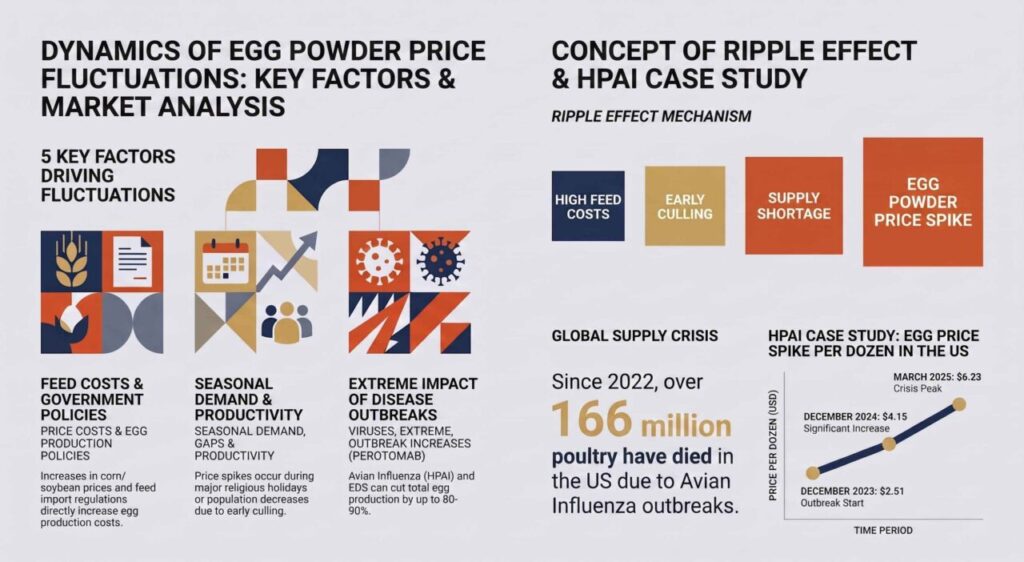
Bird flu outbreaks in the United States have killed more than 166 million wild and domestic birds since the outbreak began in 2022, triggering egg price spikes of up to 65% in a single year. That case shows just how much a disruption in egg supply can ripple through to the price of egg powder as a downstream product.
This article covers the factors behind egg powder price fluctuation, from fresh egg prices to the impact of poultry disease outbreaks. You will also find tips for dealing with these price swings as a buyer.
What Is Egg Powder Price Fluctuation?
Egg powder price fluctuation refers to changes in egg powder’s selling price over time due to a range of external factors, not simply a one-sided decision by manufacturers. These changes can happen within weeks or months, depending on how severe the disruption to the supply chain turns out to be.
Why Is Fresh Egg Price the Main Driver of Egg Powder Price?
Fresh egg is the primary raw material in egg powder production, so most of the production cost comes from this single component. When fresh egg prices rise due to a supply disruption or higher production costs for farmers, that increase eventually passes through to egg powder prices at both the manufacturer and buyer level.
Factors Behind Egg Powder Price Fluctuation
Beyond fresh egg prices, a handful of other factors also affect how stable egg powder prices stay in the market. Here is a breakdown of the five main factors typically behind it.
1. Feed Costs
Poultry feed, mainly corn and soybean meal, makes up 60% to 70% of production costs for egg farmers. When feed prices rise, farmers tend to pass that increase along to the price of fresh eggs and, in turn, egg powder.
2. Seasonal Demand
Egg demand spikes ahead of major holidays, school breaks, and certain events such as the World Cup. Demand surges during these periods are often not matched by an equivalent rise in supply, pushing prices up temporarily.
3. Laying Hen Population and Productivity
A decline in the laying hen population, whether from early culling or disease, directly reduces the egg supply reaching the market. The fewer productive hens there are, the more pressure builds on both fresh egg and egg powder prices at the manufacturer level.
4. Government Policy
Feed import regulations and pricing policies both indirectly affect farmers’ production costs. A policy that restricts corn imports, for example, can push feed prices up and ultimately drive egg prices higher too.
5. Disease Outbreaks
Poultry diseases such as bird flu can kill tens of millions of laying hens within a matter of weeks, making disease outbreaks the single most disruptive factor on this list. In December 2024 alone, H5N1 killed 13.2 million commercial egg-laying hens in the US, a disruption severe enough to ripple through to egg powder prices as a downstream product.
Case Study: The Bird Flu Outbreak in the United States
The highly pathogenic avian influenza (HPAI) outbreak that has hit US poultry farms since 2022 is a clear example of this kind of drastic impact. Egg prices in the country jumped from $2.51 a dozen in December 2023 to $4.15 a dozen in December 2024, and briefly crossed $6.23 a dozen in March 2025.
These five factors rarely act alone, since one factor can trigger a chain reaction into the next. A spike in feed prices, for example, can push farmers to cull laying hens earlier than planned, which further shrinks the egg supply reaching the market.
Tips for Buyers Dealing With Egg Powder Price Fluctuation
Price fluctuation can’t be avoided entirely, but its impact on your business can be minimized with the right strategy. Four steps below can help you deal with this situation.
1. Lock In a Long-Term Contract With a Trusted Supplier
Agree on a price contract for a set period with a supplier whose reliability is already proven, rather than buying on a seasonal basis without a clear agreement. This helps protect your business from sudden price spikes caused by supply disruptions.
2. Track Feed Price Trends and Farm Conditions
Follow developments in corn and soybean meal prices, along with poultry disease outbreak reports, on a regular basis. This information helps you anticipate a potential rise in egg powder prices three to six months out.
3. Diversify Your Supplier Base
Work with more than one egg powder supplier to reduce reliance on a single source. Diversification helps keep production running smoothly even if one supplier runs into a disruption.
4. Adjust Purchase Volume to Match Seasonal Projections
Build up stock ahead of high-demand periods such as major holidays, then scale purchase volume back down once that period has passed. This kind of planning helps you avoid buying at peak prices driven by seasonal demand spikes.
Conclusion
Egg powder price fluctuation is largely driven by fresh egg prices as the main raw material, which in turn is shaped by feed costs, disease outbreaks, and seasonal demand. Disease outbreaks stand out as the single most drastic factor affecting egg availability and price.
Understanding these factors helps buyers prepare for a price increase before it actually hits, rather than reacting after the impact has already shown up in production costs. A combination of long-term contracts, trend monitoring, and supplier diversification is the most effective strategy for navigating this fluctuation.
For culinary businesses or food manufacturers that want a more predictable supply of egg raw material in terms of both price and quality, Egg Powder from Accelist Pangan Nusantara offers a solution backed by a well-managed supply chain. Contact Us for product information and to discuss your business’s egg raw material needs.
FAQ
Mostly yes, since fresh egg is the main production cost component, though processing and distribution costs also factor into the final price.
Duration varies, ranging from two to four weeks for seasonal disruptions to several months when the cause is a widespread disease outbreak.
It can help cushion the impact, though it won’t fully eliminate the risk if a severe supply disruption occurs.
Indirectly, yes, especially for countries that depend on imported feed ingredients or that experience a similar outbreak domestically.
Usually ahead of major holidays and holiday seasons, when demand for processed food products like cakes and bread rises.