
A food ingredient supply contract is a written agreement between a buyer and a supplier that sets out ingredient specifications, pricing, delivery schedules, and who is responsible when something goes wrong. It serves as the main reference when ingredients arrive off-spec or a shipment runs late.
A 2012 study by the Grocery Manufacturers Association and the Food Marketing Institute, as cited by Food Safety Magazine, put the average cost of a single food recall in the United States at US$10 million. Without a clear clause on who bears that cost, a buyer can face a major loss with no basis for recovering it.
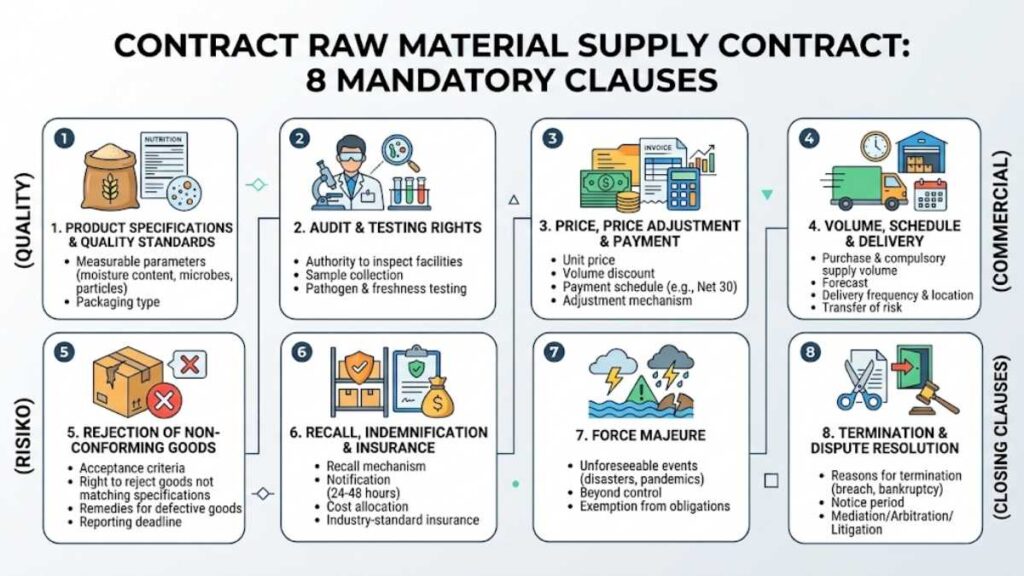
This article covers 8 essential elements of a food ingredient supply contract, grouped into four parts: quality, commercial terms, risk, and closing provisions. Each element comes with example clause content so it can go straight into discussions with legal teams and suppliers.
Quality Clauses That Make Sure Ingredients Meet Your Needs
Quality clauses make sure delivered ingredients meet production needs in two ways: by setting measurable specifications and by giving the buyer the right to check them. Both need to be in writing, since standards agreed only verbally are hard to rely on in a complaint.
Element 1: Product Specifications and Quality Standards
A specification describes exactly what is being bought, in measurable terms rather than just a product name. Law firm Loeb & Loeb, in its guide to co-manufacturer agreements, says specifications should outline the ingredients to be used, product characteristics, and testing requirements.
For powdered ingredients such as flour, parameters commonly written into the contract include moisture content, microbial limits, particle size, and packaging type. LegalVision likewise advises defining quality standards and packaging requirements up front as part of the scope of supply.
Element 2: Audit and Testing Rights
Audit and testing rights let a buyer inspect ingredients and the supplier’s facility on a regular basis, rather than simply accepting the supplier’s own reports. LegalVision gives examples such as random sampling, testing for pathogens and freshness, and audits held quarterly or annually.
Loeb & Loeb adds that this clause should set out inspection rights, required testing protocols, and clear remedies for nonconforming products. A certificate of analysis (COA) for each batch can be made a condition of shipment, giving the buyer reference data when running its own tests on samples.
Commercial Clauses That Keep Pricing and Supply Under Control
Commercial clauses keep costs and supply under control by spelling out pricing, payment schedules, volumes, and delivery schedules in detail. The more specific the numbers, the less room there is for disputes when market conditions change.
Element 3: Pricing, Price Adjustments, and Payment
A pricing clause covers the unit price, volume discounts, rebates, and the payment schedule. LegalVision gives the example of a 10% discount on orders above a set value and a net 30 day payment term.
A price adjustment mechanism should be defined so increases cannot be imposed unilaterally. Sprintlaw recommends that contracts include a price adjustment mechanism and penalties for late payment, while Loeb & Loeb treats price increase provisions as a separate item.
Element 4: Volume, Scheduling, and Delivery
A volume clause sets how much the buyer must purchase and the supplier must supply, for example through binding forecasts and minimum order quantities. Loeb & Loeb lists both as part of volume commitments.
The delivery schedule should state frequency, quantity per delivery, and destination, as in LegalVision’s example of twice-weekly deliveries to a commercial kitchen. The contract should also say when title and risk of loss pass from supplier to buyer and what happens if a delivery is late, as Sprintlaw recommends.
Read also: Why Does Egg Powder Price Go Up and Down? Here’s Why
Risk Clauses That Decide Who Bears the Loss
Risk clauses decide who bears the loss when ingredients fail to meet standards, are pulled from the market, or trigger third-party claims. The two core elements are the rejection mechanism and the recall and indemnity arrangements.
Element 5: Rejection of Nonconforming Goods
A rejection clause sets the acceptance criteria and the buyer’s right to refuse ingredients that do not meet specification. Sprintlaw points to inspection rights, acceptance criteria, and remedies for defective goods as items a supply contract should address.
Remedies usually take the form of replacement, a refund, or a deduction from the invoice, and the options should be written out explicitly. A reporting deadline after receipt, such as 7 business days, should also be included so both sides work from the same benchmark.
Element 6: Recall, Indemnity, and Insurance
A recall clause sets who decides on a product recall, when the other party must be notified, and who pays the costs. ContractKen notes that notification windows are often 24 to 48 hours from when a potential recall trigger becomes known.
According to ContractKen, recall cost allocation generally falls into one of three market positions, summarized in the table below. The costs involved include direct costs (notification, returns, replacement product, disposal), administrative costs, regulatory penalties, and consequential losses such as lost profits.
| Contract Position | Costs Borne by the Supplier |
|---|---|
| Supplier-favorable | Minimal cost responsibility |
| Market standard | Direct costs arising from defects in the supplier’s product |
| Buyer-favorable | All costs, including lost profits and brand damage |
Buyers should also make sure recall costs are carved out of the liability cap, as ContractKen advises. Loeb & Loeb says suppliers should carry industry-standard insurance with indemnification for manufacturing defects and contamination.
Closing Clauses That Cover the Unexpected and the End of the Contract
Closing clauses govern what happens when events outside anyone’s control block supply, and how the contract ends or disputes get resolved. These provisions are rarely touched while the relationship is going well, yet they are the ones most often invoked when it turns sour.
Element 7: Force Majeure
Force majeure excuses a party that fails to perform because of events beyond its control, such as natural disasters or pandemics. LegalVision describes it as unforeseeable events or circumstances beyond either party’s control.
The list of qualifying events should be spelled out, including whether crop failure, ingredient shortages, transport disruption, or sudden price spikes count as force majeure. That clarity stops a supplier from claiming force majeure simply because market prices moved.
Element 8: Termination and Dispute Resolution
A termination clause sets the grounds for ending the contract, the notice period, and what happens to obligations still outstanding. LegalVision cites breach of contract, insolvency, and force majeure events as example grounds, while Loeb & Loeb adds a termination for convenience right.
Dispute resolution is chosen from mediation, arbitration, or litigation, along with governing law and jurisdiction, as LegalVision outlines. The choice is best made before a dispute arises, since both sides find it easier to agree while the relationship is still good.
Conclusion
These eight elements lock together: a specification without audit rights is hard to enforce, and a recall clause without insurance is hard to collect on. A contract that is strong in only one area, such as detailed on pricing but loose on quality, still leaves gaps where a problem would cost the most.
A contract does not need to be long to be effective, but every clause should pass one simple test: what happens if the other party fails to meet this part? Buyers who ask that question before signing tend to find gaps faster than when a dispute is already underway.
FAQ
The main elements cover specifications and quality standards, audit rights, pricing, volume and delivery, rejection of goods, recall and indemnity, force majeure, and termination and dispute resolution. These eight elements work together.
A written specification gives an objective basis for accepting or rejecting goods. Without it, disagreements over quality are hard to settle because there is no agreed reference.
It depends on the contract, and ContractKen describes three positions: the supplier bears minimal costs, direct costs, or all costs including lost profits. The market-standard position is that the supplier pays direct costs arising from defects in its own product.
Not automatically, since the scope of force majeure depends on how the contract words it. That is why the list of qualifying events should be spelled out from the start.
A contract can be ended on the grounds it lists, such as breach or insolvency, or through a termination for convenience right if one is agreed. The notice period and any outstanding obligations should also be set out.