
An emulsifier is an ingredient that lets oil and water, two liquids that repel each other, mix evenly and stay mixed. That even mixture is called an emulsion.
Why does mayonnaise, which is mostly oil, not separate? The US Food and Drug Administration (FDA) sets a mayonnaise standard in 21 CFR 169.140 that requires at least 65% vegetable oil by weight and an egg yolk-containing ingredient.
This article explains what emulsifiers in food are, how they work, the main types, and how to choose one. It also covers their role in bread and sponge cake, ice cream, and mayonnaise, and what regulators and research say about their safety.
What Is an Emulsifier?
The Codex Alimentarius, the FAO and WHO food standards program, defines an emulsifier as a food additive that forms or maintains a uniform emulsion of two or more phases in a food. Oklahoma State University (OSU) Extension adds that emulsifiers are chemical compounds that can come from natural sources or be made synthetically.
How Do Emulsifiers Make Oil and Water Mix?
Emulsifiers make oil and water mix by attaching to the boundary between them and lowering the interfacial tension. Each molecule has a water-loving region and a fat-loving region, OSU Extension explains, which promotes emulsion formation and keeps droplets from clumping together.
Emulsions come in two basic forms: oil in water (O/W) and water in oil (W/O). OSU Extension lists milk, sauces, beverages, yogurts, ice cream, and mayonnaise as examples of O/W emulsions, and butter and margarine as W/O emulsions.
How Do Emulsifiers Differ From Stabilizers and Thickeners?
An emulsifier forms or maintains an emulsion, a stabilizer keeps two or more components evenly dispersed, and a thickener increases the viscosity of a food. Codex lists the three as separate functional classes.
What Types of Emulsifiers Are Used in Food?
The FDA lists soy lecithin, mono- and diglycerides, egg yolks, polysorbates, and sorbitan monostearate as emulsifier names that may appear on product labels. The table below summarizes four chemical families of food emulsifiers, with example uses.
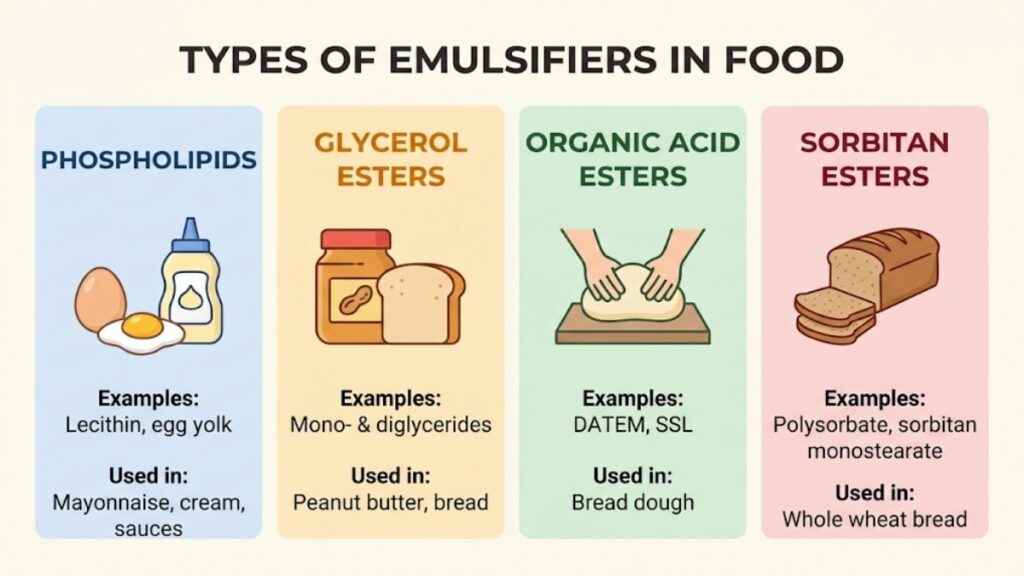
| Family | Example Emulsifiers | Example Uses |
|---|---|---|
| Phospholipids | Lecithin, egg yolk | Mayonnaise, creams, and sauces |
| Glycerol fatty acid esters | Mono- and diglycerides | Peanut butter and bread |
| Organic acid esters (tartaric and lactic) | DATEM (diacetyl tartaric acid esters of mono- and diglycerides), SSL (sodium stearoyl lactylate) | Bread dough |
| Sorbitan esters | Polysorbates, sorbitan monostearate | Whole wheat bread dough (polysorbate 80) |
OSU Extension notes that proteins, polysaccharides, and saponins from natural sources also have good emulsifying properties, with whey proteins, caseins, egg protein, and gelatin as common animal-based examples. Phospholipids themselves come from milk, vegetable oils (such as soybean, rapeseed, or sunflower), egg yolk, meat, and fish.
What Do Emulsifiers Do in Food Products?
The FDA says emulsifiers allow ingredients to mix smoothly, prevent separation, reduce stickiness, and control crystallization. In peanut butter, for example, OSU Extension says a small amount of monoglycerides can keep the peanut oil from separating.
Emulsifiers in Bread and Sponge Cake
Baking Business reports that DATEM and SSL have been used for decades to strengthen dough, while monoglycerides are used for crumb softening and shelf life. A 2022 study of whole wheat dough in Grain & Oil Science and Technology tested five emulsifiers, and only soy lecithin and polysorbate 80 produced a statistically significant increase in loaf volume compared with the control.
Sponge cakes rely on incorporated air for volume and texture, according to a 1987 study in Cereal Chemistry on sucrose ester emulsifiers. Sucrose esters added as a powder to the dry ingredients increased cake volume and tenderness, and hydrating them first produced cake volumes that averaged 20 to 160 cm³ greater than the powder form.
Emulsifiers in Ice Cream
In ice cream, the emulsifier’s job is reversed: it lowers the stability of the fat emulsion on purpose. Douglas Goff explains in his Ice Cream Technology e-book that the fat then partially coalesces during whipping and stabilizes the air bubbles for a smooth texture.
Emulsifiers in Mayonnaise
Egg yolk is a good emulsifier and a required ingredient in mayonnaise, according to a 2022 study in Food Materials Research. Under the FDA’s mayonnaise standard, that ingredient can be liquid, frozen, or dried, and it can be egg yolks alone or whole eggs.
How Do You Choose the Right Emulsifier for a Product?
Choosing an emulsifier takes four steps: match the emulsion type, match the function, check the rules, and test on a small scale. The first step uses the hydrophilic-lipophilic balance (HLB), a 0 to 20 scale that reflects the balance between the water-loving and oil-loving groups in an emulsifier.
- Identify the emulsion type: HLB 8 to 18 is most commonly used for oil-in-water emulsions, while HLB 3.5 to 6.0 suits water-in-oil emulsions (OSU Extension).
- Match the function you need, for example DATEM or SSL to strengthen bread dough and monoglycerides to soften the crumb.
- Check the additive rules of the target market (the EU, for example, requires every additive to be authorized and listed with conditions of use), then ask the supplier for specification sheets and certificates such as Halal.
- Test on a small scale, then compare emulsion stability, texture, and shelf life against the previous formulation.
A blend is a common choice in commercial bakeries. Baking Business notes that DATEM, SSL, and mono- or diglycerides are often combined to balance dough strength on the processing line.
Are Emulsifiers Safe to Eat?
It depends on the emulsifier. Lecithin was judged not to need a numerical acceptable daily intake (ADI), while one large cohort study associated higher intakes of five other emulsifiers with cardiovascular disease, and that association still needs confirmation.
EFSA’s Assessment of Lecithin
The European Food Safety Authority (EFSA), the European Union’s food safety agency, concluded in its 2017 re-evaluation of lecithins (E 322) that a numerical ADI was not needed. EFSA also found no safety concern for the general population above one year of age at the reported uses, but the conclusion applies only to lecithin.
Findings From the NutriNet-Santé Cohort in France
The NutriNet-Santé cohort study, published in the BMJ in 2023, followed 95,442 adults in France for a median of 7.4 years. Higher intakes of five individual emulsifiers and two groups of emulsifiers were associated with a higher risk of cardiovascular disease.
The emulsifiers named include celluloses (E460 to E468), carboxymethylcellulose (E466), and mono- and diglycerides of fatty acids (E471 and E472). The study was observational, so the authors could not confirm that emulsifiers cause cardiovascular disease.
Residual confounding, which is bias left over from factors the analysis could not fully adjust for, cannot be entirely ruled out either. The findings should be replicated in other cohorts, and the mechanisms should be tested in experimental studies.
Conclusion
How do oil and water stay mixed? Emulsifiers attach to the boundary between them, and their job differs by product: they prevent separation in mayonnaise, but in ice cream they reduce the stability of the fat emulsion.
The right emulsifier comes from matching the emulsion type and the function you need, checking the rules of the target market, and testing on a small scale. On safety, rely on the relevant authority’s assessment of each specific emulsifier, and watch for replication of observational studies like NutriNet-Santé, which cannot establish cause and effect on their own.

FAQ
How do emulsifiers differ from stabilizers and thickeners?
Emulsifiers form or maintain an emulsion, stabilizers keep components evenly dispersed, and thickeners raise the viscosity of a food. The Codex Alimentarius lists them as three separate functional classes.
Is egg yolk an emulsifier?
Yes, the FDA lists egg yolks among the emulsifier names that may appear on food labels. Its mayonnaise standard also requires an egg yolk-containing ingredient, which may be liquid, frozen, or dried.
What are examples of emulsifiers in food?
The FDA’s list includes soy lecithin, mono- and diglycerides, egg yolks, polysorbates, and sorbitan monostearate. OSU Extension also names sodium stearoyl lactylate (SSL), saponins, and proteins such as whey proteins, caseins, egg protein, and gelatin.
Are emulsifiers safe to eat?
It depends on the emulsifier: the European Food Safety Authority (EFSA) found in 2017 that lecithin (E 322) needs no numerical acceptable daily intake (ADI). A 2023 BMJ cohort study associated higher intakes of five other emulsifiers with cardiovascular disease, but as an observational study it could not confirm cause and effect.
What do emulsifiers do in bread?
According to Baking Business, DATEM and SSL strengthen dough, while monoglycerides are used to soften the crumb and extend shelf life. In a 2022 study of whole wheat dough, only soy lecithin and polysorbate 80 produced a statistically significant increase in loaf volume.