
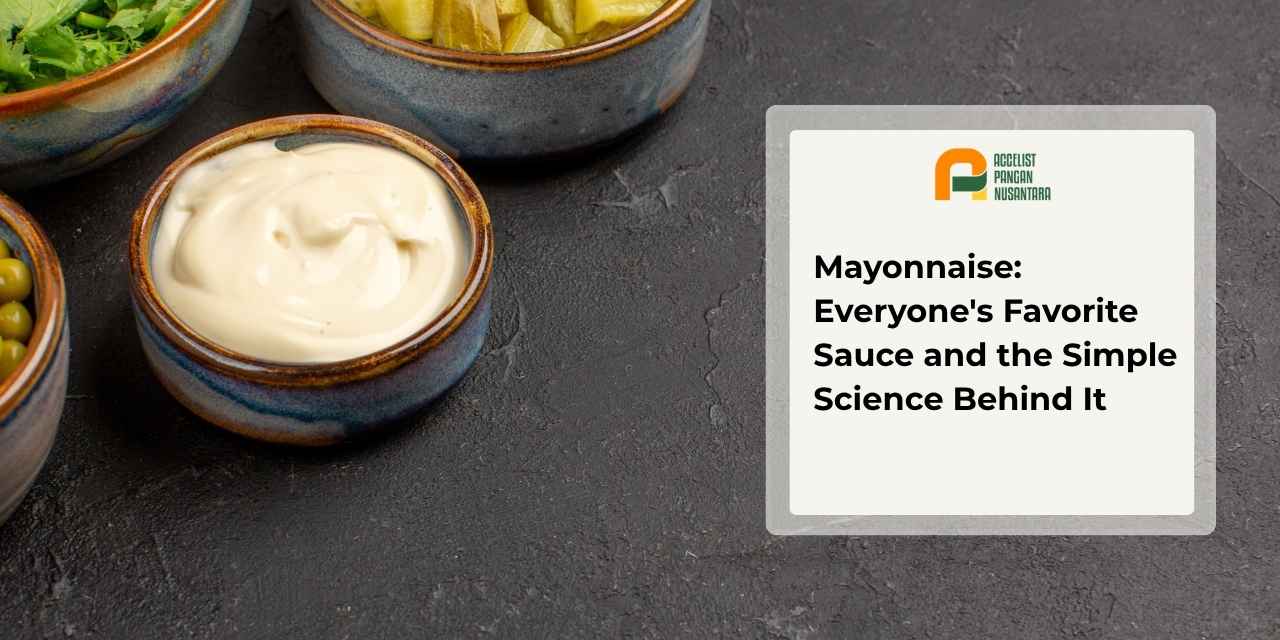
A weekend family table in Indonesia rarely feels complete without one thick, white sauce, whether as a topping for a vegetable salad, a filling in a chicken sandwich, or a dip for fritters fresh out of the hot oil. Its rich flavor and smooth texture almost always make a simple dish feel a little more special.
Demand for dressing-style sauces, including mayonnaise, has been growing quickly in Indonesia’s domestic market. According to a report by Investor Daily, Indonesia’s dressing and mayonnaise business has grown by roughly 30 percent every year over the past five years.
Despite its popularity, many people don’t actually know what gives this sauce its distinctive texture. Put simply, mayonnaise is a thick emulsion sauce formed by combining vegetable oil, egg yolk, and an acidic ingredient such as vinegar or lemon juice.
What Is Mayonnaise?
Technically speaking, mayonnaise is classified as a semi-solid, stable emulsion of oil and water. Indonesia’s National Standardization Agency (BSN), through standard SNI 01-4473-1998, defines mayonnaise as a processed product in the form of a semi-solid emulsion made from vegetable oil, egg yolk, and other food ingredients, with or without permitted food additives.
By comparison, a typical liquid salad dressing will easily separate into its oil and water components if left standing for a while. Mayonnaise, on the other hand, stays thick and well blended because the egg yolk inside it acts as a natural emulsifier that binds the two together.
A Brief History of Mayonnaise
According to Chefler Foods, a US based sauce manufacturer, mayonnaise is believed to have become known in the early 19th century, even though traces of oil and egg mixtures as food date back to ancient Egypt and Rome. The modern version we know today is generally credited to French chefs.
The most popular story claims the sauce was first made in 1756 as part of a victory celebration after French forces captured Port Mahon on the island of Minorca. The chef ran out of cream for his signature sauce, so he substituted olive oil instead, and that improvised creation was later named mayonnaise in honor of its birthplace.
Another version of this story claims the chef actually learned the recipe from local residents of Minorca. Years later, French chef Marie Antoine Carême refined the recipe by blending vegetable oil and egg yolk into a lighter emulsion, and it was this version that eventually became popular worldwide.
Mayonnaise only crossed over to the United States in the 19th century, and was initially served only in upscale restaurants such as Delmonico’s in New York. Richard Hellmann, founder of the Hellmann’s brand, later turned mayonnaise into an everyday kitchen staple after his wife’s homemade mayonnaise, sold at his deli in 1912, became more popular with customers than the salads it was meant to accompany, prompting him to start producing it on a larger scale.
The Main Ingredients That Make Up Mayonnaise
Mayonnaise’s rich flavor and smooth texture don’t happen by accident, but result from a combination of ingredients that each play a specific role. Here are four groups of ingredients commonly found in mayonnaise, whether homemade or produced industrially.
1. Vegetable Oil as the Largest Component
Vegetable oil makes up the largest share of mayonnaise, with a minimum of 65 percent under Indonesia’s SNI standard and typically reaching 70 to 80 percent in commercial products, according to ScienceDirect. The type of oil chosen has a major influence on the final flavor, ranging from neutral to strongly aromatic.
For example, mayonnaise made with soybean oil tends to taste light and neutral on the palate. Mayonnaise made with extra virgin olive oil, by contrast, has a more distinctive, sharper flavor with a slightly bitter edge.
2. Egg Yolk as a Natural Emulsifier
Egg yolk acts as the emulsifier in mayonnaise because it contains lecithin, a compound that can bind oil and water molecules together so they don’t separate. Without egg yolk, the oil and vinegar in mayonnaise would separate again just like ordinary oil and water.
As a general guide, in a classic homemade mayonnaise recipe, a single egg yolk is usually enough to bind around 200 milliliters of oil into a stable emulsion. This is why the quality and freshness of the egg yolk greatly affects the final result of the mayonnaise.
3. Acidic Ingredients and Flavor Balancing Seasonings
White vinegar, apple cider vinegar, or lemon juice are commonly added to give a fresh taste while lowering the acidity level (pH) of the mayonnaise. This drop in pH also naturally helps slow down bacterial growth.
Mustard is often added to the mix because it brings a sharp flavor while also strengthening the emulsion’s stability. French style mayonnaise, for instance, typically uses Dijon mustard, which gives it a distinctive flavor compared to ordinary mustard.
4. Additional Ingredients for Stability and Shelf Life
Besides those three main components, some commercial mayonnaise also contains additional ingredients such as sugar, salt, or approved preservatives. These are meant to balance the flavor and extend the product’s shelf life once the packaging has been opened.
Potassium sorbate, for example, is often used in packaged mayonnaise to prevent mold growth during storage at room temperature. This is why reading the ingredient label matters for consumers who want to know exactly what’s inside the product they are buying.
How Does Mayonnaise Get So Thick and Smooth?
Scientifically, mayonnaise forms through the principle of an oil in water emulsion, often abbreviated as O/W. The oil becomes the dispersed phase in the form of extremely small droplets, while the acidic liquid acts as the continuous phase surrounding them.
Lecithin from the egg yolk then coats each of these oil droplets so they don’t merge back into larger clumps. Consistent whisking, whether done by hand or with a mixer, also determines how fine and stable the resulting emulsion will be.
Compare this to vinaigrette or most liquid salad dressings, which need to be shaken again before serving because the oil and vinegar separate easily. Mayonnaise doesn’t have this problem as long as its emulsion stays intact, which keeps its texture consistently thick from the first spoonful to the last.
Types of Mayonnaise on the Market
As consumer preferences have evolved, mayonnaise now comes in a range of varieties tailored to different dietary needs and tastes. Here are some of the most common types found, whether on minimarket shelves or in restaurant kitchens.
1. Original (Full Fat) Mayonnaise
This type uses a full oil content with no reduction, giving it the richest flavor and thickest texture of all the varieties. Original mayonnaise is usually the go to choice for salad dressings or dips for fried foods that call for a bold flavor.
2. Light or Reduced Fat Mayonnaise
In this variant, part of the oil content is replaced with water or a thickening agent such as starch to lower the calorie and fat content. Reduced fat mayonnaise sold in stores commonly carries a light label on its packaging to target consumers who are watching their calorie intake.
3. Vegan Mayonnaise
This variant contains no egg at all, making it suitable for vegetarians, vegans, or people with an egg allergy. Soy milk, almond milk, or avocado are often used instead as alternative emulsifiers that still produce a creamy texture.
4. Mayonnaise Made with Alternative Oils
Some producers now replace soybean or canola oil with avocado oil, sesame oil, or olive oil to give the mayonnaise a different flavor character. This type is usually marketed as a more premium option with a fat profile claimed to be healthier.
5. Flavored Mayonnaise Varieties
To reach a wider market segment, many brands add extra flavors such as spicy, roasted sesame, or cheese to the base mayonnaise. Spicy mayonnaise, for instance, has become a favorite dip for fried snacks and grilled sausages at many local eateries.
The Role of Mayonnaise in Culinary and Food Business
Mayonnaise’s role has long gone beyond being a simple condiment at the family dinner table. Its uses now extend across businesses of every scale, from small restaurant kitchens to packaged food production lines.
- As a direct dressing
Mayonnaise is often spread on sandwiches and burgers, or mixed into vegetable and fruit salads. Its rich flavor and creamy texture make a dish feel more indulgent without needing any other added ingredients. - As a base for derivative sauces
Mayonnaise forms the foundation for thousand island dressing, tartar sauce, and the mentai sauce popular in Japanese style dishes. Just add chili sauce, pickles, or seaweed powder, and a new derivative sauce is ready to serve. - In the HoReCa business (hotels, restaurants, cafes)
Mayonnaise is used in large quantities for everyday menu items such as mayo stuffed risoles, onigiri, or salad bars. Consistency in flavor and texture is a top priority, since customers expect the same result every time they order. - At the food processing industry level
Mayonnaise is also a component in packaged products such as sauce sachets, bottled dressings, or ready to use spreads. This large scale production demands raw materials that are stable and microbiologically safe, especially when it comes to the egg yolk.
Food Safety Challenges in Large Scale Mayonnaise Production
One of the biggest challenges in large scale mayonnaise production lies in the egg yolk used as the emulsifier. Raw eggs carry a risk of Salmonella contamination, and that risk is higher still because mayonnaise is made through a cold emulsion process without the heating step that would normally kill off bacteria.
Beyond the safety issue, the quality of fresh eggs also tends to vary depending on size, season, and storage conditions, which can make the final mayonnaise differ from one production batch to the next. As a result, many food businesses are now turning to egg yolk in the form of powdered, pasteurized, and standardized products, such as egg powder, specifically egg yolk powder from Accelist Pangan Nusantara.
Here are a few advantages of Egg Yolk Powder that matter for consistent mayonnaise production:
- Free of Salmonella thanks to the pasteurization process.
- More consistent quality and composition across every production batch.
- A much longer shelf life with no need for special refrigeration.
- Easier to measure and less wasteful than fresh eggs in their shells.
- Halal certified, making it safe to use across a wide range of market segments.
Tips for Choosing and Storing Mayonnaise Properly
Beyond knowing its ingredients and types, consumers also need to know how to choose and store mayonnaise properly to keep its quality intact. A few simple habits below can help prevent mayonnaise from spoiling quickly or changing flavor.
- Check the ingredient label before buying, especially the type of oil used and whether any preservatives have been added. Consumers looking for a healthier fat profile, for example, can opt for varieties made with olive or canola oil.
- Pay attention to the expiration date on the packaging, since the fat in mayonnaise can oxidize and change flavor once that date has passed. Mayonnaise that has already developed a rancid smell shouldn’t be eaten, even if the packaging isn’t finished yet.
- Store mayonnaise in the refrigerator at a stable temperature once it’s opened, since fluctuating room temperatures can speed up bacterial growth. Single serve mayonnaise sachets that have been opened should be used up in one go to avoid contamination.
- Use a clean spoon or spatula every time you scoop mayonnaise from the jar, and avoid dipping in utensils that have already been used. This small habit is effective at preventing cross contamination that could shorten the mayonnaise’s shelf life at home.
Conclusion
As the explanation above shows, mayonnaise is actually built on a simple scientific principle, an emulsion of oil and water stabilized by egg yolk. It is precisely this simplicity of ingredients that makes mayonnaise so easy to adapt, from homemade versions to vegan options to the trendy flavors sold in stores today.
Behind that simplicity, however, flavor consistency and food safety become real challenges once mayonnaise production scales up to a business or industrial level. The egg yolk, as the main emulsifier, is the most critical factor of all, affecting everything from flavor and texture to the risk of bacterial contamination.
Egg Yolk Powder from Accelist Pangan Nusantara is ready to be a raw material partner for commercial kitchens and food industry players that prioritize product consistency and safety, as explained in the section above. Contact Us today to discuss product specifications and ordering details for your business needs.
FAQ
No, pure mayonnaise is made only from oil and egg yolk, with no dairy at all.
Mayonnaise is thicker and more stable, while regular salad dressing is thinner and separates more easily.
Generally one to two months in the refrigerator, following the instructions on the packaging label.
Soy milk, almond milk, or avocado, all three can produce a similarly creamy texture.
Commercially produced mayonnaise is relatively safer since it uses pasteurized egg yolk, but it is still best to check with a doctor.