
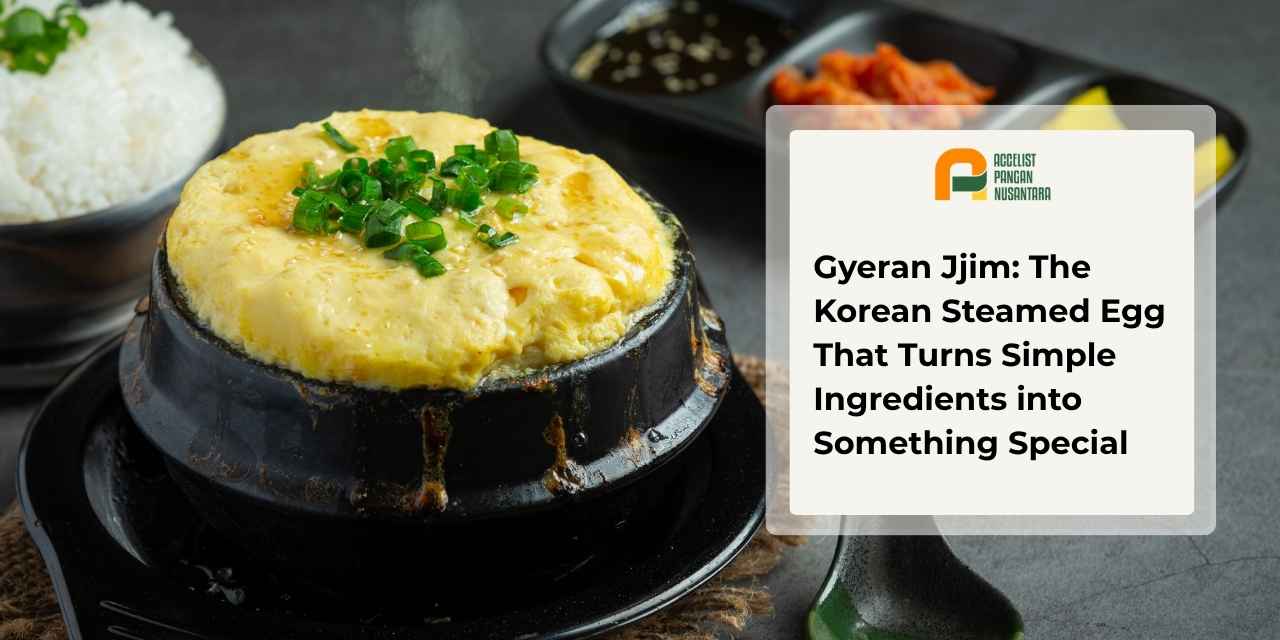
Many Korean BBQ restaurants have a small bowl that always catches new visitors’ attention. Inside sits a pale yellow steamed egg, still puffed up and steaming the moment it lands on the table.
Korean restaurants have become increasingly common across major Indonesian cities, from Jakarta to Surabaya. A simple egg dish like this one has ridden that same wave of popularity, even though it is rarely ordered on purpose as a main course.
That dish is called gyeran jjim, a Korean steamed egg far softer than a regular steamed omelet. Behind its simplicity sits a history and a range of variations most people never hear about.
What Is Gyeran Jjim?
Gyeran means egg in Korean, while jjim refers to a slow steaming technique. Together, the name tells you exactly what is in the bowl, which is egg cooked through steam rather than fried or boiled.
The dish also goes by another name, dalgyal-jjim, since dalgyal is the native Korean word for egg that predates gyeran, a term borrowed from Chinese characters. Both names point to the exact same dish.
The texture is soft, slightly wobbly like pudding, yet the flavor stays entirely savory without a trace of sugar. Its pale yellow color comes from the egg itself, not from any dye or additive.
The History Behind Gyeran Jjim
Jjim, the steaming technique behind this dish, has long been valued in Korean cooking as a method believed to preserve a food’s nutrients. Eggs became a natural fit for this technique because they were affordable and easy to find in Korean households.
About fifty years ago, according to Blonde Kimchi, many Korean families raised their own chickens in the yard, making eggs one of the most accessible protein sources compared to meat. That habit helped egg dishes, gyeran jjim included, grow into an everyday staple at the dinner table.
From home kitchens, gyeran jjim eventually made its way onto restaurant tables as banchan, the term for side dishes in Korean dining culture. It is usually served in a ttukbaegi, a clay pot that retains heat long enough to keep the egg puffed and bubbling when it arrives.
The version commonly seen at Korean BBQ restaurants today has an interesting backstory. Maangchi, a well known figure in Korean home cooking, traced this serving style to servers pouring the egg mixture straight onto the hot grill plate without much stirring, letting it rise like a small, slowly erupting volcano.
Read also: Oyakodon: The Iconic Japanese Rice Bowl, Its History, and What Makes It Unique
Ingredients and Serving Style
The recipe for gyeran jjim is genuinely simple, though a handful of ingredients show up in nearly every version of it. Here are the ingredients commonly used to make gyeran jjim, whether at home or in a restaurant:
- Eggs as the main ingredient, usually four to five for one family-sized portion
- Anchovy broth or plain water to thin the egg mixture for a smoother texture
- Saeujeot, salted fermented baby shrimp, or fish sauce for seasoning
- Chopped scallions for aroma
- Sesame oil and toasted sesame seeds as a finishing touch
In many Korean households, the simplest version uses just eggs, water, and a pinch of salt, topped with scallions right before serving. There is no strict rule on extra ingredients, as long as the texture stays soft once cooked.
Variations Found Across Different Settings
The basic recipe branches into several versions once gyeran jjim leaves the home kitchen and enters different serving contexts. The most common differences show up in cooking method, spice level, and the extra ingredients used.
1. Classic Gyeran Jjim in a Ttukbaegi
This is the version most often seen at Korean BBQ restaurants, cooked directly on the stove in a clay pot with very little stirring. The result puffs up high and is still bubbling hot by the time it reaches the table.
At many grilled meat restaurants in Seoul, servers pour the egg mixture into the channel along the grill plate just before the meat finishes cooking. Gyeran jjim ends up ready at the same time as the main dish, with no extra cookware needed.
2. Microwave Gyeran Jjim for Modern Kitchens
For a faster option, many people in Korea cook gyeran jjim straight in the microwave for three to five minutes. This method removes the risk of a burnt bottom that sometimes happens when cooking on the stove.
Students living alone in small Seoul apartments often choose this method because it can be ready before heading to class. There is no need to watch the stove, just wait for the microwave to beep.
3. Spicy Gyeran Jjim with Gochugaru
Some modern versions add gochugaru, Korean chili flakes, to bring a spicy edge to an egg dish that is normally plain and savory. Its pale yellow color shifts slightly toward red once the chili flakes are mixed in.
This version is common at casual eateries aimed at younger diners, usually paired with ramyeon or a bowl of hot rice.
4. Fusion and Local Adaptations
Outside Korea, gyeran jjim often gets adjusted to whatever ingredients are easier to find or to local taste. Cheese, sliced sausage, and even an egg-free version using silken tofu for a vegan option have all made their way into different kitchens.
In Indonesia, some food content creators add grated carrot and sweet corn to the mixture. That kind of addition is not found in the traditional version, but it still keeps gyeran jjim’s signature soft texture.
Read also: Omakase: The Japanese Culinary Art That Makes Trust the Main Course
The Nutrition Behind That Soft Texture
Beyond its comforting taste, gyeran jjim also carries decent nutritional value thanks to its main ingredient. Here are a few nutrients that come from the eggs used in this dish:
- High quality protein, with Healthline noting that one large egg carries about 6 grams of it
- Choline, a nutrient tied to brain function and memory
- Vitamin D and vitamin B12, which support bone health and red blood cell production
- Fat, mostly unsaturated rather than saturated, contrary to what many people assume
Because the egg in gyeran jjim gets diluted with broth or water, a single serving usually carries fewer calories than a regular omelet made with the same number of eggs. That is one reason gyeran jjim shows up fairly often on menus aimed at people watching what they eat.
The Difference Between Gyeran Jjim and Chawanmushi
Many people immediately think of chawanmushi, the Japanese steamed egg custard, the moment gyeran jjim gets described. Yet despite sharing eggs and a steaming method, the two dishes carry quite different characters, as shown in the table below:
| Aspect | Gyeran Jjim | Chawanmushi |
| Origin | South Korea | Japan |
| Main broth | Water or anchovy broth | Dashi broth |
| Filling | Scallions, occasionally carrot | Chicken, shrimp, shiitake mushroom, kamaboko |
| Serving vessel | Ttukbaegi or a heatproof bowl | Small lidded ceramic cup |
| Texture | Light and slightly wobbly | Smooth and dense like custard |
| Dining context | Everyday banchan | Opening course of a formal kaiseki meal |
Based on the table above, gyeran jjim leans toward everyday home cooking, while chawanmushi leans toward a formal dish that demands more precise temperature control. Both still share one thing in common: turning plain eggs into something that feels far more special than the ingredient itself.
Conclusion
Gyeran jjim proves that a dish as simple as egg and water can still earn a permanent spot at the table, even after passing through generations and different serving contexts. From home kitchens that use nothing but salt to BBQ restaurants serving it bubbling hot, its core character stays the same, such as soft, savory, and comforting.
Understanding its short history and range of variations makes gyeran jjim feel like far more than just another steamed egg. Anyone wanting to try it at home does not need any special equipment, just eggs, a bit of broth, and the patience to cook it over low heat.
For anyone looking to make gyeran jjim consistently at a larger scale, whether for a catering business or a commercial kitchen, Whole Egg Powder from Accelist Pangan Nusantara is worth considering, since it combines egg white and yolk in one package without the need to measure fresh eggs one by one. Contact us for product information and ordering details.
FAQ
Not quite. Gyeran jjim is thinned with broth or water, which gives it a much softer texture.
Yes, a heatproof bowl or even a microwave works, though it will not puff up as high as the ttukbaegi version.
No. The spicy version with gochugaru is a modern twist.
It is best eaten right away, and if stored, should be finished within a day.
Yes, as long as seasonings like saeujeot are reduced or left out.