
Egg powder that is no longer fit for use does not always show obvious signs from the outside, especially if the damage is still in its early stages. Many food manufacturers only notice the problem after the egg powder has already been used and the final result falls short.
According to Kitchen Sterling, powdered eggs stored properly at 50°F to 70°F (10°C to 21°C) with humidity below 60% can hold their quality for a fairly long time, but the wrong conditions can speed up spoilage well before the printed expiration date. That gap is a reminder that recognizing the signs of spoilage matters just as much as maintaining proper storage conditions in the first place.
This article covers the signs that egg powder is no longer fit for use, from visual cues to a simple test you can run yourself. You will also find tips for keeping egg powder from spoiling too quickly.
Why Does Egg Powder Become Unfit for Use?
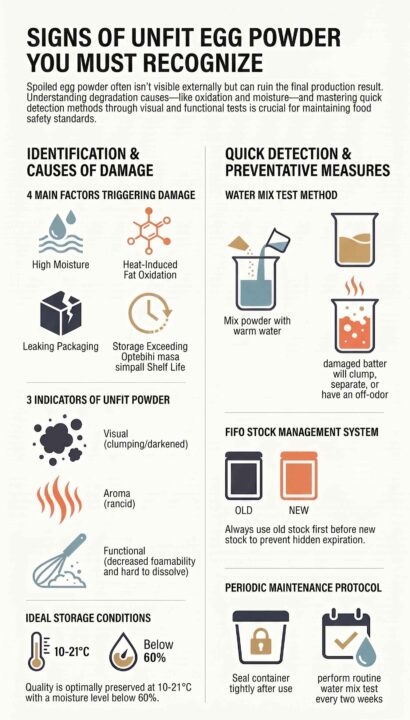
Egg powder spoilage is rarely caused by a single factor. Here are the four most common causes.
- Exposure to high humidity, which causes egg powder to absorb moisture and clump
- Fat oxidation from prolonged exposure to heat or light, especially in whole egg powder, which has a higher fat content
- Packaging that is no longer airtight once opened or that gets damaged during shipping
- Storage that runs past its optimal shelf life even when the surrounding conditions are reasonably good
Signs Your Egg Powder Is No Longer Fit for Use
Signs of spoilage in egg powder can be grouped into three categories, depending on how they show up. Here is a breakdown of each category and what to look for.
| Category | What to Look For |
|---|---|
| Visual | Clumped or hardened texture, color turning darker or dull, visible mold spots |
| Smell and taste | A rancid smell from fat oxidation, a change in taste once mixed into a batter |
| Functional | Not dissolving smoothly when mixed with water, reduced foaming and emulsifying capacity when whipped |
Functional signs are often the hardest to catch, since they only show up once the egg powder is actually put to use in production. This is why a simple test before large-scale production is a step worth never skipping.
Read also: 6 Signs of Spoiled Hard-Boiled Eggs You Should Know Before Eating
How to Check Egg Powder With a Water Mix Test
A water mix test is the most practical way to confirm the condition of egg powder before using it in large quantities. Here are the simple steps you can follow.
- Mix a small amount of egg powder with water, following the ratio recommended on the packaging.
- Stir the mixture until even and pay attention to its texture.
- Egg powder that is still in good condition will form a smooth mixture that blends fully with the water.
- If the mixture feels lumpy, separates, or gives off an unpleasant smell, that egg powder should not be used.
Tips for Keeping Egg Powder From Spoiling Too Quickly
Preventing egg powder from spoiling is far easier than dealing with it after the fact. Four steps below help keep egg powder in good condition for longer.
1. Store It Somewhere Cool and Dry
Keep the storage temperature steady between 50°F and 70°F (10°C and 21°C) with humidity below 60%. This condition helps slow down fat oxidation and prevents moisture absorption.
2. Reseal the Packaging Tightly After Each Use
Make sure the egg powder packaging is sealed tightly every time after use. Air and moisture getting in through an open package are the main reason egg powder spoils quickly.
3. Apply a First In, First Out (FIFO) System
Use the egg powder stock that arrived earliest before the stock that just came in. This keeps any batch from sitting in storage too long and running past its optimal shelf life.
4. Run a Water Mix Test Periodically
Test a small amount of egg powder every two weeks, especially if you keep a large stock on hand. This habit helps you catch spoilage early, before the egg powder gets used in production.
Conclusion
Signs that egg powder is no longer fit for use can be spotted through visual changes, smell, and functional properties that show up once it’s mixed with water. Recognizing these three categories of signs helps you avoid using a raw material that has actually already dropped in quality.
A simple water mix test is the most practical way to confirm egg powder is still usable before it goes into large-scale production. Combining routine checks with proper storage helps keep your final product consistent.
For culinary businesses or food manufacturers who want to minimize the risk of raw material spoiling too soon, Egg Powder from Accelist Pangan Nusantara is packaged to a standard that keeps its quality stable throughout storage. Contact Us for product information and to discuss your business’s egg raw material needs.

FAQ
Not necessarily, since light clumping can sometimes still be fixed by sifting, but if it comes with a rancid smell or color change, it’s best not to use it.
A change in smell is usually the earliest sign, showing up before any noticeable change in texture or color.
Mix a small amount of egg powder with water at the ratio listed on the packaging, then check whether the mixture turns out smooth or ends up lumpy and off-smelling.
Not always, but the risk goes up, so it’s still worth doing a visual check and a water mix test before using it.
Not necessarily unsafe, but reduced foaming capacity signals that its functional quality has dropped and could affect your final product.