
Egg powder production runs through many stages, and not all of them carry the same level of food safety risk. Some stages only affect product quality, while others genuinely determine whether a hazard like Salmonella gets controlled or not.
A generic HACCP model for egg products published by the United States Department of Agriculture shows that the number of critical control points can vary depending on the facility and the type of product made. That variation is a reminder that mapping critical control points needs to be done specifically, not applied uniformly across every plant.
This article covers the critical control points (CCPs) in the egg powder production chain, from egg receiving through to packaging. You will also find out how a stage gets identified as a critical control point and tips for managing them consistently.
What Is a Critical Control Point (CCP) in Egg Powder Production?
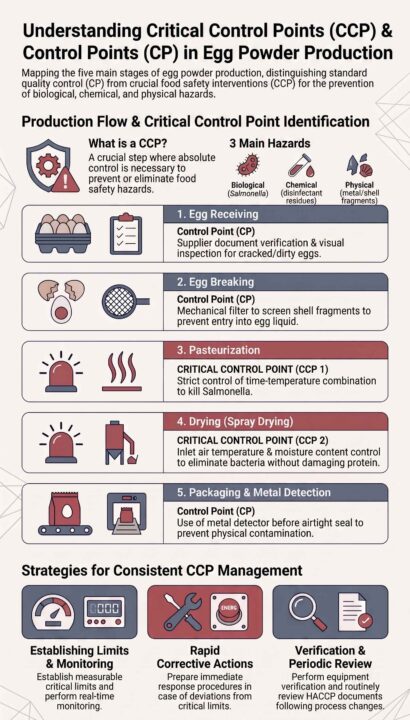
A critical control point, or CCP, is a stage in the production process where control is genuinely necessary to prevent, eliminate, or reduce a food safety hazard to a safe level. In egg powder production, this point usually shows up at stages involving high heat, direct contact with raw material, or the risk of cross-contamination.
Records documenting control at these points make up an important part of the HACCP documents typically requested from a supplier. This article focuses on where those critical control points sit along the production chain, not on the documents themselves.
Why Can Any Production Stage Become a Critical Control Point?
Food safety hazards in egg powder production can show up in three different forms, depending on the stage of the process. Here is a brief look at each hazard type before getting into the specific critical control points.
- Biological hazards, such as Salmonella that can contaminate raw eggs before they go through a heating step
- Chemical hazards, such as cleaning agent residue or contaminants carried over from chicken feed
- Physical hazards, such as shell fragments or metal shavings from production equipment
Critical Control Points Along the Egg Powder Production Chain
Most critical control points in egg powder production sit at stages involving heat or direct contact with raw material. Here is a breakdown of the critical control points along the production chain, from egg receiving through to packaging.
| Production Stage | Potential Hazard | How It’s Controlled |
|---|---|---|
| Egg receiving | Cracked or dirty eggs, or eggs from a supplier without clear documentation | Verifying supplier documents and a visual check before acceptance |
| Egg breaking | Physical contamination from shell fragments | Automated breaking equipment and filtering screens |
| Pasteurization | Biological hazards such as Salmonella | Controlling heating temperature and time against a critical limit |
| Drying (spray drying) | Excessive protein denaturation and any remaining biological hazard | Controlling inlet air temperature and contact time in the spray dryer |
| Packaging | Physical contamination from foreign objects or metal | Using a metal detector and airtight packaging |
The pasteurization and drying stages stand out as the most decisive critical control points, since the high heat at both stages controls biological hazards and the level of protein denaturation at the same time. Failing to control either of these two stages risks letting a hazard through while also lowering the functional quality of the resulting egg powder.
How Is a Stage Identified as a Critical Control Point?
Identifying a critical control point is not done arbitrarily, but through a series of questions known as the CCP decision tree. Here is the simplified flow a HACCP team typically uses to work through it.
- Does this stage have a hazard that needs to be controlled? If not, the stage is not a critical control point.
- Is this stage specifically designed to eliminate or reduce that hazard to a safe level? If yes, the stage is likely a critical control point.
- Could contamination occur again or increase after this stage? If so, check whether a later stage can control it.
- If no later stage can eliminate or reduce the hazard, this stage gets designated as the critical control point.
Tips for Managing Critical Control Points Consistently
Identifying a critical control point is not enough without consistent management on the ground. Four steps below help keep control running every day.
1. Set Measurable, Specific Critical Limits
Every critical control point needs a clear critical limit, such as a specific temperature or time, rather than a general estimate. A measurable limit makes it easier for the production team to catch a deviation early.
2. Monitor on a Routine, Scheduled Basis
Monitor every critical control point according to a set schedule, whether manually or with the help of automated equipment. Consistent monitoring lowers the risk of an undetected deviation.
3. Prepare a Clear Corrective Action Procedure
Decide in advance what steps to take whenever a deviation is found at a critical control point. A clear procedure speeds up the production team’s response without waiting for an on-the-spot decision.
4. Review and Update Critical Control Points Periodically
Reassess critical control points whenever there is a change in raw material, equipment, or the production process. Periodic review makes sure the critical control points in place stay relevant to current production conditions.
Conclusion
Critical control points in the egg powder production chain are spread across five main stages, from egg receiving through to packaging, with the heating stages standing out as the most decisive. Each of these points needs a clear critical limit and routine monitoring to keep food safety hazards genuinely under control.
Understanding where these critical control points sit helps both buyers and manufacturers judge whether a production chain is genuinely safe to rely on. That consistent control across every stage is ultimately what determines the quality of the egg powder that reaches your hands.
For culinary businesses or food manufacturers who want raw material that has gone through critical control point management at every production stage, Egg Powder from Accelist Pangan Nusantara is produced with close monitoring from egg receiving through to final packaging. Contact Us for product information and to discuss your business’s egg raw material needs.
FAQ
A regular control point only helps maintain quality, while a critical control point is genuinely necessary to prevent a food safety hazard that could harm consumers.
The number varies by facility, but pasteurization and drying are generally the most decisive critical control points.
Not always, it depends on whether that stage is specifically designed to control a hazard, such as metal contamination caught by a metal detector.
This is usually decided by a company’s internal HACCP team, made up of people with expertise across production and food safety.
Yes, especially when there is a change in raw material, equipment, or the production process that affects the potential hazard at that stage.