
Saturated fat is a type of fat whose carbon chain has no double bonds, which is why it tends to be solid at room temperature. Butter and the fat on meat are two familiar examples in a home kitchen.
A 2020 Cochrane systematic review of 15 randomized controlled trials with 56,675 adult participants suggested that cutting saturated fat for at least two years lowers the relative risk of combined cardiovascular events by 17%. That figure comes from 12 of the trials, and among people without cardiovascular disease, about 56 would need to cut back for roughly four years to prevent one event.
This article explains how saturated fat differs from other fats, which foods contain it, what the daily limits are, and how it affects the heart. Five simple steps for cutting back come at the end.
How Does Saturated Fat Differ from Unsaturated Fat and Trans Fat?
According to the American Heart Association (AHA), saturated fat is typically solid at room temperature, and a diet high in it raises LDL (bad) cholesterol. Unsaturated fat is typically liquid and can lower LDL when used in place of saturated fat, while trans fat also raises LDL and can lower HDL (good) cholesterol.
| Type of Fat | Example Sources | Effect on Cholesterol |
|---|---|---|
| Saturated fat (typically solid) | Beef, poultry, full-fat dairy such as butter, tropical oils such as coconut and palm | A high intake raises LDL cholesterol |
| Unsaturated fat (typically liquid) | Olive oil, canola oil, nuts, fatty fish | Can lower LDL cholesterol when it replaces saturated fat |
| Trans fat (artificial type is made solid) | Partially hydrogenated oils; small natural amounts in meat and dairy | A high intake raises LDL cholesterol and can lower HDL cholesterol |
The World Health Organization (WHO) recommends no more than 1% of total energy intake from trans fat. That recommendation applies to industrially produced trans fat and to the natural trans fat in meat and dairy from ruminant animals such as cows or sheep.
Which Foods Contain Saturated Fat?
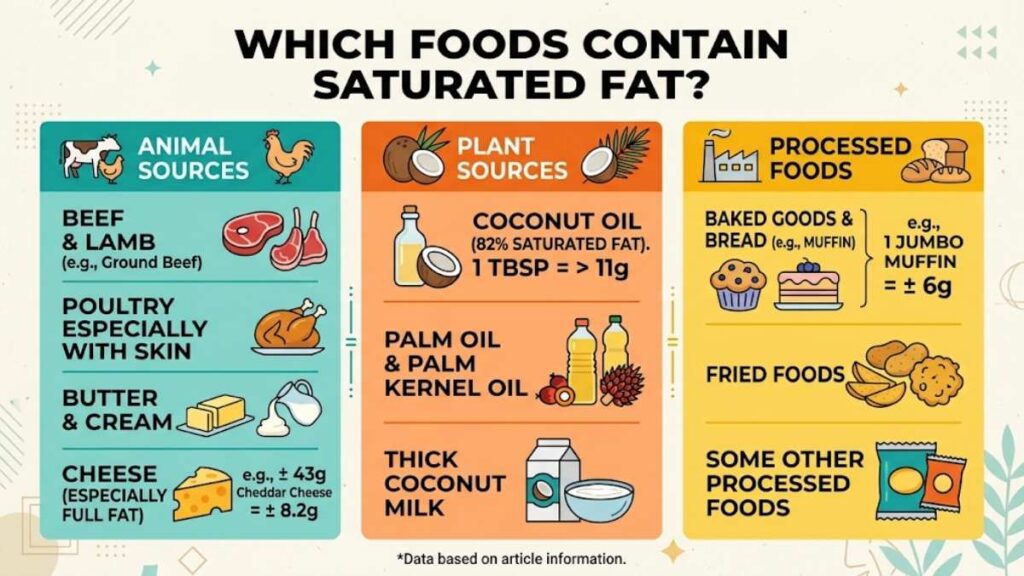
Saturated fat is common in fatty animal products and in coconut and palm oil, according to the AHA list. Some baked and fried foods contain it too.
Animal Sources
The AHA list includes beef and lamb, poultry (especially with the skin on), cream, butter, and cheese. According to Harvard Health, 3 ounces (85 grams) of broiled ground beef (85% lean) contains 5 grams of saturated fat, while 1.5 ounces (about 43 grams) of cheddar cheese contains 8.2 grams.
A large egg has only about 1.5 grams of saturated fat, according to Harvard Health’s article on eggs. The saturated fat in foods eaten with eggs, such as butter, cheese, sausage, and muffins, raises blood cholesterol much more than the cholesterol in the egg itself.
Plant-Based Sources and Processed Foods
Coconut oil is about 82% saturated fat, and a single tablespoon holds more than 11 grams, according to AHA News on coconut oil. Palm oil and palm kernel oil also appear on the AHA list of saturated fat sources.
The UK National Health Service (NHS) also lists cakes, pastries such as pies and croissants, coconut milk, and coconut cream as sources of saturated fat. Baked goods contribute too, for example a jumbo blueberry muffin (5.8 ounces) that contains 6 grams, according to Harvard Health data.
What Is the Daily Limit for Saturated Fat?
The daily limit for saturated fat is no more than 10% of total energy intake according to the WHO, 7% according to nutrition experts quoted by Harvard Health, and less than 6% according to the AHA. The table below converts those percentages into grams for three energy levels.
| Daily Energy Intake | WHO (max. 10%) | Nutrition Experts (7%) | AHA (under 6%) |
|---|---|---|---|
| 1,500 calories | 17 grams | 12 grams | 10 grams |
| 2,000 calories | 22 grams | 16 grams | 13 grams |
| 2,500 calories | 28 grams | 19 grams | 17 grams |
The figures in the table are approximate: they assume 1 gram of fat equals 9 calories and are rounded to the nearest gram. For comparison, the NHS says UK health guidelines recommend no more than 30 grams a day for the average man and 20 grams a day for the average woman.
Is Saturated Fat Bad for the Heart?
A diet high in saturated fat raises LDL cholesterol, which according to the AHA increases the risk of heart disease and stroke. Both the WHO and the AHA recommend a cap on intake rather than a total ban.
The Cochrane review cited at the start also found that cutting saturated fat has little or no effect on mortality, whether from all causes or from cardiovascular disease. Cochrane rated the evidence for both mortality outcomes as moderate quality, but called the effects on total (fatal or non-fatal) heart attacks and strokes unclear because the evidence was of very low quality.
The same review found that replacing saturated fat with polyunsaturated fat or carbohydrate appears to be a useful strategy. Data on replacing it with monounsaturated fat or protein were very limited.
According to the WHO, saturated and trans fats can be replaced with polyunsaturated fat, plant-based monounsaturated fat, or carbohydrates from foods that naturally contain dietary fiber, such as whole grains, vegetables, fruits, and pulses. Because individual needs differ, people with high cholesterol should set their personal limit with a doctor or dietitian.
How Can You Cut Back on Saturated Fat in Daily Meals?
Saturated fat can be reduced in five simple steps, both in the kitchen and at the store. Each step rests on advice from the AHA, Harvard Health, or the FDA.
- If you eat meat, choose skinless poultry and lean cuts.
- Use liquid vegetable oils other than coconut and palm oil, such as canola or olive oil, in place of butter.
- Replace some of the meat with beans, fish, nuts, or tofu.
- Pick low-fat versions of cheese and yogurt.
- Find the saturated fat line on the Nutrition Facts label, then compare it with the daily limits in the table above. According to the US Food and Drug Administration (FDA), the Daily Value for saturated fat is 20 grams on a 2,000 calorie diet, and 5% DV or less per serving counts as low while 20% DV or more counts as high.
Conclusion
On a 2,000 calorie diet, the saturated fat limit ranges from 13 to 22 grams a day, and a single tablespoon of coconut oil already holds more than 11 grams. A large egg, by contrast, contributes only about 1.5 grams.
Saturated fat should be limited, and the food that replaces it can change how much the heart benefits. The Nutrition Facts label shows how much saturated fat a serving adds to the day’s total.

FAQ
Do eggs contain saturated fat?
Yes, a large egg contains about 1.5 grams of saturated fat according to Harvard Health. That is far below the daily limit of 13 to 22 grams on a 2,000 calorie diet.
Does coconut oil contain saturated fat?
Yes, and a lot of it, about 82% according to AHA News. The same article notes that coconut oil raised LDL cholesterol in seven controlled trials.
What is the difference between saturated fat and cholesterol?
Saturated fat is a type of fat in food, while cholesterol is a fat-like substance that the liver mostly makes itself. According to Harvard Health, the liver is stimulated to make it mainly by saturated fat and trans fat in the diet, not by dietary cholesterol.
Does chicken contain saturated fat?
Yes, the AHA lists poultry, especially with skin, among sources of saturated fat. For people who eat meat, it advises choosing lean meat and poultry without skin.
Is the saturated fat limit the same for everyone?
No, because the limit in grams depends on daily calorie needs, which the FDA says vary with age, sex, height, weight, and physical activity level. People with high cholesterol should ask a doctor or dietitian which limit suits them.