
Picture a large food plant that has to process thousands of eggs every day, yet fresh eggs only last two to three weeks at room temperature. Manufacturers need a preservation method that keeps flavor and nutrition intact without breaking down the egg’s structure.
A study by Liu et al. (2015), published in the International Journal of Agricultural and Biological Engineering, found that freeze-dried egg white protein powder scored higher in solubility, emulsion stability, and water holding capacity than its spray-dried counterpart. This finding shows how much the drying method itself shapes the final product. Freeze drying egg powder has become the method of choice for producers who need both nutrition and shelf stability.
The process is not just about removing water from raw egg. It runs through a set sequence of physical steps, and skipping any one of them changes the outcome.
What Is Freeze Drying Egg Powder?
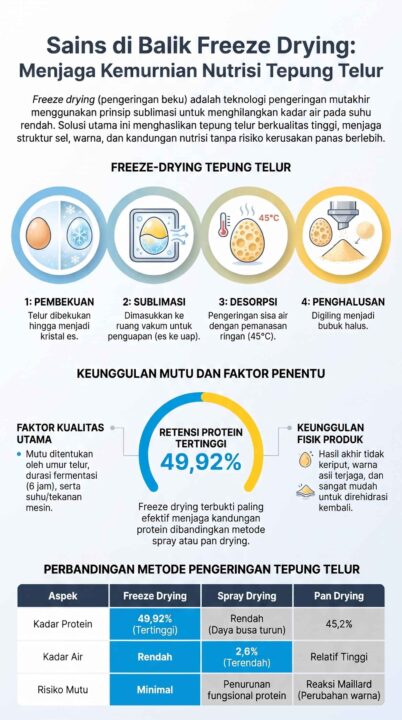
Freeze drying is a method that removes water from a food product after it has already been frozen solid. The ice inside the product turns straight into vapor without passing through a liquid stage, a process known as sublimation (ScienceDirect Topics).
This sets it apart from drying methods that apply direct heat to remove moisture. Below is a comparison of how freeze drying stacks up against spray drying, based on the functional properties reported by Liu et al. (2015).
| Property | Freeze-Dried Egg Powder | Spray-Dried Egg Powder |
|---|---|---|
| Solubility | Higher | Lower |
| Emulsion stability | Higher | Lower |
| Water holding capacity | Higher | Lower |
| Foaming ability and stability | Lower | Higher |
| Heat gel strength | Higher | Lower |
Freeze drying wins on most functional markers except foaming, where spray-dried powder performs better. That single trade-off matters most for producers making meringue or angel food cake, where foam is the deciding factor.
The Stages of Freeze Drying Egg Powder
Freeze drying egg powder runs through 3 main stages before the finished product is ready for packaging. Each stage has its own job, and none of them can be skipped or shortened without affecting quality.
- Freezing: Liquid egg (whole egg, yolk, or white) is frozen solid so that nearly all of its water content turns into ice crystals.
- Primary drying (sublimation): The frozen product sits inside a vacuum chamber, and the ice turns straight into vapor, a stage that removes most of the remaining water, according to ScienceDirect Topics.
- Secondary drying (desorption): Any water still bound to the egg proteins is removed with a mild rise in temperature, bringing final moisture down to a level suited for long-term storage.
These three stages run one after another without long gaps in between. A mistake at the freezing stage, such as ice crystals that grow too large, can damage protein structure before the product even reaches the sublimation stage.
What Affects the Quality of Freeze-Dried Egg Powder?
The freeze dryer itself is not the only variable that decides final quality. There are 3 other factors that shape foaming capacity, color, and rehydration speed.
- Pre-treatment of the egg: Jafari et al. (2022), published in the journal Foods, found that phosphorylation pre-treatment combined with microwave exposure changed particle size, solubility, and foam capacity of freeze-dried egg white powder.
- Processing intensity: In the same study, higher phosphorylation levels paired with specific microwave power settings produced the highest protein solubility and water-holding capacity among the tested combinations.
- Freezing rate: Slower freezing tends to form larger ice crystals, which can tear cell structures and lower the functional quality of the finished powder.
These three factors interact with each other rather than acting alone. An egg batch treated with the right pre-treatment can still underperform if the freezing stage itself is poorly controlled.
Advantages of Freeze Drying Over Other Drying Methods
Food producers pick freeze drying because the finished product beats conventional drying methods on several fronts. Here are 4 advantages worth noting.
- Texture stays intact since the product’s cell structure is preserved throughout sublimation, avoiding the shriveled look common with heat-based drying.
- Original color holds up better than in methods that expose the product to high heat.
- The powder rehydrates back to something close to its original form when water is added later.
- Functional properties such as solubility and water holding capacity outperform spray-dried powder, based on the comparison from Liu et al. cited earlier.
This advantage comes at a cost, since freeze drying takes longer and consumes more energy than spray drying. For high-value applications like infant formula or pharmaceutical-grade egg protein, that extra cost is usually worth the trade-off.
Conclusion
Freeze drying egg powder runs through freezing, sublimation under vacuum, and a final secondary drying stage before packaging. Each stage carries its own risk, and a problem at any single step changes the functional properties of the finished powder.
Factors like pre-treatment, processing intensity, and freezing rate all play a role in the final result. Producers who understand these variables gain more control over the consistency of the egg powder they manufacture.
For food businesses that rely on eggs as a core ingredient, egg powder offers a practical answer to storage and distribution challenges. It is easier to transport, lasts far longer than fresh eggs, and still carries much of the original nutritional value.
If you would like to learn more about egg powder for your production needs, feel free to Contact Us for further consultation.

FAQ
Not by much, since the low temperature used throughout the process helps keep proteins and vitamins intact.
It typically runs from several hours to more than a day, depending on batch size and equipment capacity.
Yes, its very low moisture content makes it last longer than fresh eggs or conventionally dried egg powder.
Yes, whole egg, egg yolk, and egg white can all go through the process, though each type behaves slightly differently.