
Small food businesses face a recurring problem: fresh eggs spoil fast, and their price swings hard. This SME case study on switching to egg powder looks at how that pressure pushes bakeries, catering operations, and packaged food producers toward a dried alternative.
The US egg market shows just how volatile fresh eggs can get. Retail prices hit a record $6.23 per dozen in March 2025 after avian flu wiped out roughly 50 million egg-laying birds, and the market still hadn’t fully settled by early 2026 foodworldnews.com. For a small bakery running on thin margins, a swing like that can wipe out a month’s profit overnight.
That’s the backdrop for this article. We’ll walk through why SMEs make the switch, what the transition looks like in practice, and why the heat used to dry eggs into powder actually improves the product rather than damaging it.
What Is Egg Powder?
Egg powder is fresh egg, whole or separated into whites and yolks, dried into a fine powder. Removing the water changes almost everything about how the product behaves in storage and in the kitchen.
Dried egg products last far longer than fresh eggs and don’t need refrigeration, which cuts food waste and shrinks storage costs at the same time FDCM. A carton of fresh eggs on a shelf is a countdown. A bag of egg powder isn’t.
Why Are SMEs Switching to Egg Powder?
Three problems keep coming up when small food businesses explain why they made the switch. Each one hits the bottom line in a different way.
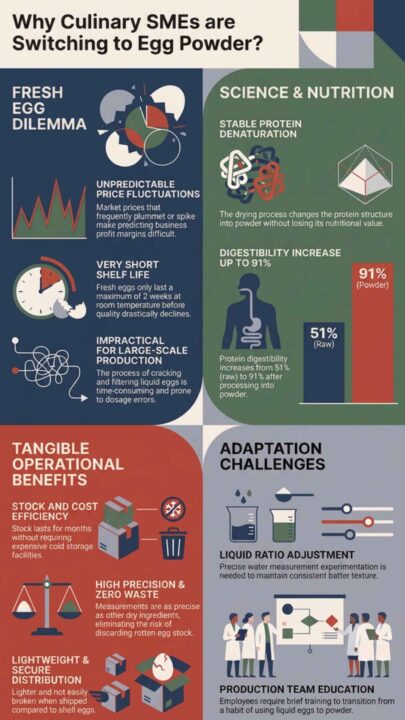
1. Unpredictable Egg Prices
Bird flu, feed costs, and seasonal demand spikes have made fresh egg prices swing wildly over the past few years. US retail prices hit an all-time high of roughly $4.25 a dozen in 2025, while wholesale benchmarks spiked even harder, surging to $8.76 a dozen in early 2025 before prices began to ease IBISWorld.
A bakery can’t easily pass that kind of swing on to customers without losing them. Sticking with the old price just eats into margin instead.
2. Short Shelf Life
Fresh eggs start losing quality within a couple of weeks at room temperature. Without proper cold storage, a lot of small operations end up throwing out stock that’s gone bad before it’s ever used.
That waste comes straight out of the operating budget. Egg powder sidesteps the problem entirely, since it holds its quality at room temperature for months, sometimes years.
3. Easier High-Volume Production
Measuring liquid egg by hand for large batches takes time and invites error. Egg powder can be weighed out with the same precision as flour or sugar, so every batch comes out the same.
That consistency matters more once a business scales past small-batch cooking. Production also moves faster, since there’s no cracking or straining involved.
The Role of Protein Denaturation
Protein denaturation is the process that explains why drying eggs into powder doesn’t ruin their nutritional value, and it’s worth understanding before dismissing the idea as “processed food.” Heat unfolds the tightly coiled protein structure in raw egg during drying, and that change turns out to be a benefit, not a defect.
A widely cited 1998 study in The Journal of Nutrition measured this directly in human subjects. Cooked, denatured egg protein showed true digestibility of about 91%, compared to just 51% for raw egg protein The Journal of Nutrition. Raw egg, in other words, wastes almost half its protein on the way through the body.
Temperature control still matters during drying. Overheating degrades the protein and hurts the powder’s quality, while the right temperature preserves the functional properties that give batter and dough their structure.
Case Study: How SMEs Make the Switch
Small food businesses that move from fresh eggs to egg powder tend to follow a similar path, drawn from patterns seen across egg-based food entrepreneurship initiatives.
- Spot the problem: Repeated losses from spoiled eggs usually trigger the first conversation about alternatives.
- Run a small trial: A portion of the recipe gets swapped for egg powder to check texture and taste.
- Adjust the ratio: Egg powder needs a different water-to-powder ratio than liquid egg, so recipes get reworked.
- Scale to full production: Once results hold steady and customers accept the change, the switch goes company-wide.
- Review the numbers: Ingredient costs before and after get compared to confirm the switch actually paid off.
The trial stage takes patience. Most businesses land on a consistent texture and flavor, but not on the first try. Step five, the cost review, is usually what decides whether egg powder sticks around for good.
Benefits SMEs Report After Switching
Switching ingredients changes daily operations in ways that show up fast. Here’s what businesses mention most often once they’ve made the move.
- Stock lasts longer: Egg powder holds its quality for months without refrigeration, unlike fresh eggs that spoil in about two weeks.
- Storage costs drop: No dedicated fridge or cold chain needed, since powder keeps fine at room temperature.
- Measuring gets more precise: Large batches stay consistent because powder is weighed like any other dry ingredient.
- Less gets thrown away: Spoiled stock stops being a recurring cost once the raw material is shelf-stable.
- Shipping is simpler: Powder is lighter and won’t crack in transit the way shell eggs can.
- Sourcing gets more predictable: Suppliers of egg powder aren’t as exposed to the seasonal shortages that hit fresh egg markets.
Waste reduction and cost stability come up most often as the deciding factors. The ripple effect reaches financial planning too, since ingredient spending becomes something a business can actually forecast month to month.
Challenges to Plan For
The switch isn’t friction-free. A few adjustments usually need to happen before the results really click.
- Texture differs at first: Batters made with egg powder need a different liquid ratio than the original recipe called for.
- Staff need a short learning curve: Employees used to cracking eggs need time to get comfortable with the new measurements.
- Some customers hesitate: A few are skeptical of a dried ingredient at first, so being upfront about the process helps.
None of this tends to be permanent. Once the new recipe and ratios are locked in, production usually runs smoother than it did before.
Conclusion
This SME case study on switching to egg powder shows how a single ingredient change can reshape a small business’s stability. Volatile fresh egg prices and a short shelf life are the two problems that push most operators toward a more predictable alternative.
Protein denaturation during drying turns out to be an advantage rather than a drawback, since it makes the protein easier to digest and far easier to store. Once that’s understood, switching to egg powder looks less like a trend and more like a decision backed by real science.
For any SME weighing the same move, the quality of the egg powder itself matters just as much as the decision to switch. Consistent drying and careful quality control are what keep the final product performing the same way, batch after batch.
Accelist Pangan Nusantara supplies egg powder for food businesses of all sizes, from small kitchens to mid-scale manufacturers. Our team is available to talk through what your operation actually needs, so feel free to Contact Us anytime.
FAQ
Yes. The drying process actually improves protein digestibility compared to raw egg.
Egg powder can be stored for months at room temperature, as long as the packaging stays sealed and dry.
The base flavor stays close to regular egg. The main adjustment is the liquid ratio, to keep the texture from changing.
It works best for operations that need consistent, large-volume ingredients, like bakeries, packaged snack producers, or mid-to-large food manufacturers.