
Before signing on with a new supplier, many food businesses choose to run a food safety audit first. This step helps confirm that the raw material they are about to use is genuinely safe and meets standard before it enters the production line.
In the United States alone, contaminated food sickened 1,392 people in 2024, according to a report tracked by the University of Minnesota’s Center for Infectious Disease Research and Policy (CIDRAP). That number is a reminder of why verifying a supplier, including through a food safety audit, is not a step worth skipping before any raw material gets used.
This article covers what a food safety audit means from a buyer’s perspective, the preparation buyers should handle, and the documents worth requesting from suppliers. You will also find what typically gets checked and tips for making the process more effective.
What Is a Food Safety Audit From a Buyer’s Perspective?
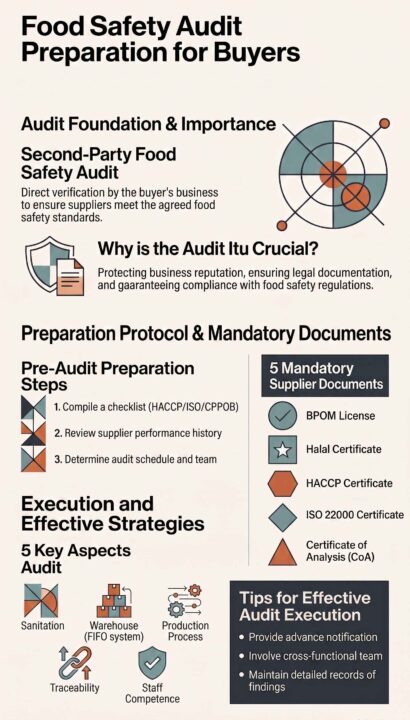
A food safety audit run by a buyer is known as a second-party audit, a verification process a buying business carries out on its own supplier. Unlike a third-party audit, which an independent certification body conducts, this audit exists purely to give the buyer confidence that the supplier meets the food safety standards both sides agreed on.
The process can involve document review, an on-site visit to the production facility, or interviews with the supplier’s staff. The outcome becomes the basis for the buyer to move forward, pause, or end the relationship with that supplier.
Why Should Buyers Audit Their Suppliers?
Auditing a supplier gives a buyer confidence that the raw material they use is safe before it reaches the production line. Here are four reasons this step is worth doing on a regular basis.
- Protects business reputation from the risk of defective or contaminated products originating from a supplier
- Confirms the supplier holds valid legal documents, such as a business registration and Halal certificate where relevant
- Reduces the risk of supply disruptions caused by a supplier who does not consistently maintain production standards
- Supports compliance with the food safety regulations that apply to food manufacturers
Preparation Buyers Should Handle Before an Audit
Solid preparation helps the food safety audit run in a more focused and efficient way. Here are four steps buyers should ideally take before the audit begins.
- Build an audit checklist or criteria that references standards such as HACCP, ISO 22000, or GMP
- Prepare a copy of the contract or agreement that spells out the food safety requirements
- Review the supplier’s past performance, including any complaints or nonconformities on record
- Set the audit schedule and team, including who handles document review and who handles the site visit
Read also: HACCP vs ISO 22000: The Key Differences Every Food Industry Professional Should Know
Documents to Request From Suppliers Before an Audit
Beyond their own preparation, buyers also need to request documents from the supplier as proof of compliance with food safety standards. Here are five documents worth requesting before the audit takes place.
- A business registration or license number confirming the supplier’s product is officially registered
- A Halal certificate from a recognized body, especially for raw materials used in consumer food products
- A HACCP certificate as proof the supplier applies critical control point management in its production process
- An ISO 22000 certificate as proof of a more comprehensive food safety management system than HACCP alone
- Lab test results or a Certificate of Analysis (CoA) to verify raw material quality and safety on an ongoing basis
HACCP centers on identifying critical control points in the production process, while ISO 22000 covers a food safety management system more broadly, including communication and management review. A supplier holding either or both certifications generally already has a well-documented food safety control system in place.
What Gets Checked During a Food Safety Audit
A food safety audit generally covers five areas of a supplier’s operations, from facility cleanliness to documentation systems. Here is a breakdown of what auditors typically focus on.
| Area | What Gets Checked |
|---|---|
| Cleanliness and sanitation | Production facility condition, raw material handling, equipment cleanliness |
| Storage and warehousing | Temperature, humidity, FIFO system, packaging condition |
| Production process | Critical control points, hazard controls following HACCP principles |
| Documentation and traceability | Production records, lab test results, distribution trail |
| Staff competency | Food safety training and staff understanding of SOPs |
Each area above connects to the others and builds a complete picture of a supplier’s readiness. Findings from the audit then become the evaluation basis before the relationship moves into large-scale production.
Tips for an Effective Food Safety Audit
Solid preparation makes the food safety audit run more smoothly for both buyer and supplier. Four steps below can be applied before the audit takes place.
1. Build Audit Criteria Around Relevant Standards
Use standards such as HACCP, ISO 22000, or GMP regulations as the basis for your evaluation criteria. Clear criteria help the audit team assess a supplier objectively and consistently.
2. Notify the Supplier of the Audit Schedule Early
Let the supplier know the timing and scope of the audit two to four weeks in advance. This notice gives the supplier time to prepare documents and the areas that will be inspected.
3. Involve a Cross-Functional Team in the Audit
Bring in representatives from quality control, production, and procurement so the audit is conducted from multiple angles. Cross-functional collaboration helps catch potential issues a single team might miss.
4. Document the Audit Findings in Detail
Record every finding, whether it meets the standard or not, in a structured audit report. This documentation becomes the reference for follow-up evaluations and future audits.
Conclusion
A food safety audit helps buyers confirm that the raw material they use is genuinely safe and meets standard before it enters production. Solid preparation on the buyer’s side, backed by supplier documents such as HACCP or ISO 22000 certificates, determines how effective that audit process turns out to be.
Involving a cross-functional team and documenting audit findings in detail are simple steps with an outsized impact on the sustainability of a supplier relationship. Together, these steps help buyers make better decisions when choosing a raw material partner.
For culinary businesses or food manufacturers who want to partner with a supplier ready for a food safety audit at any time, Egg Powder from Accelist Pangan Nusantara is produced under hygienic standards and is Halal-certified.
Complete documentation and a transparent production process make Egg Powder easier to fit into an audit requested by a prospective business partner. Contact Us for product information and to discuss your business’s egg raw material needs.

FAQ
A second-party audit is carried out directly by the buyer on its supplier, while a third-party audit is carried out by an independent body for certification purposes.
Commonly requested documents include a business registration, Halal certificate, HACCP or ISO 22000 certificate, and lab test results (Certificate of Analysis).
Duration varies with facility scale, ranging from about 2 to 3 hours for a document audit up to a full day for an on-site visit.
It’s strongly recommended, since an initial audit helps confirm a new supplier meets standard before the relationship begins.
Buyers typically give the supplier a set period to make corrections, or end the relationship if the nonconformity is serious enough.