
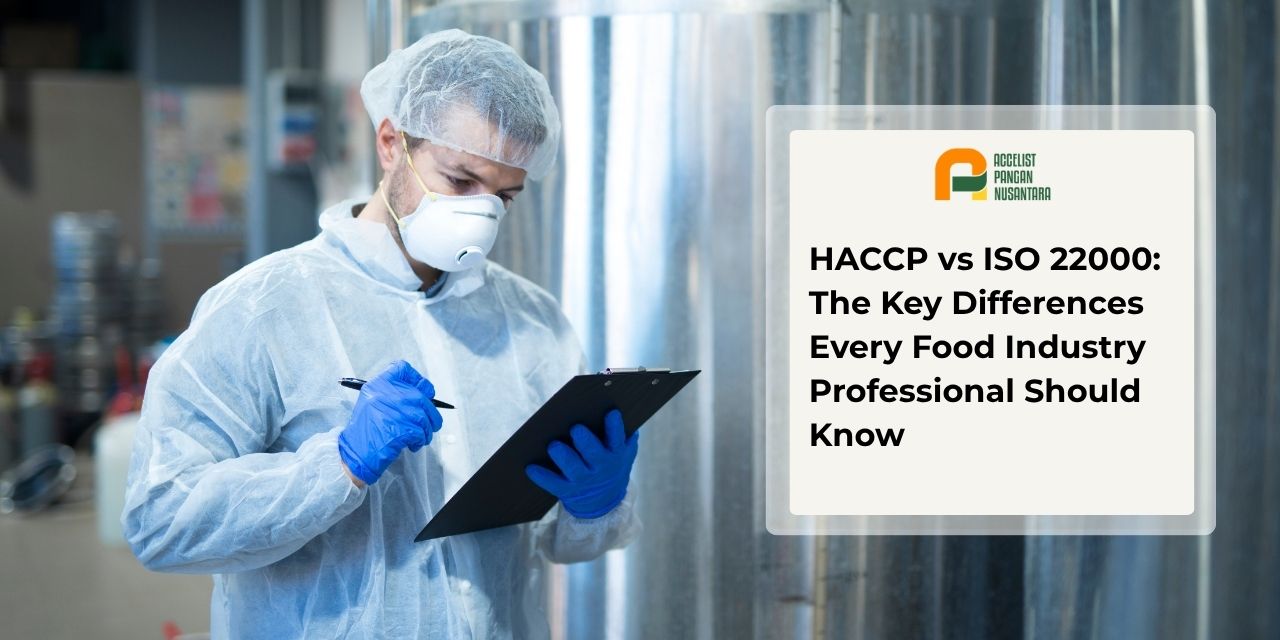
Picture a food processing plant that just received a complaint from its distributor because a batch of frozen products arrived with signs of cross-contamination in the warehouse. The quality control team then traced back the production records, only to find that the temperature monitoring log was incomplete.
According to official guidance from the Food and Agriculture Organization, a properly implemented HACCP system is designed precisely to prevent this kind of recordkeeping failure across the food chain. Unfortunately, many food businesses still treat HACCP and ISO 22000 as if they were the same thing, when in fact each one serves a different purpose.
This article breaks down the difference between HACCP and ISO 22000 in full, covering their definitions, scope, and how to decide which standard fits your business best.
What Is HACCP in the Food Industry?
HACCP (Hazard Analysis and Critical Control Point) is a system for analyzing hazards and controlling critical points, focused on identifying food safety risks at every stage of production. The system was codified by Codex Alimentarius through CAC/RCP 1-1969 and consists of 12 implementation steps, including 7 core principles within it.
Those seven principles cover the following steps.
- Conducting a hazard analysis at every stage of the production process.
- Determining the Critical Control Points (CCPs).
- Establishing critical limits for each CCP, such as cooking temperature or time.
- Setting up a monitoring system to keep each CCP under control.
- Defining corrective actions for when a critical limit is exceeded.
- Establishing verification procedures to confirm the system is working effectively.
- Setting up documentation and recordkeeping for all of the above procedures.
HACCP is essentially a technical method, not a complete management system. In other words, it only governs how hazards in food products are identified and controlled, without addressing an organization’s structure, leadership, or overall performance evaluation.
What Is ISO 22000 in the Food Industry?
ISO 22000 is an international standard for a Food Safety Management System (FSMS), published by the International Organization for Standardization. The latest version, ISO 22000:2018, combines HACCP principles with a management system approach similar to ISO 9001, giving it a much broader scope than HACCP alone.
The standard is organized into 10 clauses that govern the entire organization, not just its production process. Here is a summary of its main clauses.
- Clause 4: defining the organization’s context and the scope of the FSMS.
- Clause 5: leadership commitment to food safety.
- Clause 6: planning for risks and opportunities.
- Clause 7: support in terms of resources, competence, and communication.
- Clause 8: operations, including the application of HACCP within it.
- Clause 9: performance evaluation through internal audits and management review.
- Clause 10: continual improvement and corrective actions.
This structure makes it clear that HACCP is actually a part of ISO 22000, specifically within clause 8. In other words, a company that implements ISO 22000 is automatically applying HACCP principles as well, though the reverse does not hold true.
What Are the Differences Between HACCP and ISO 22000 Across Various Aspects?
The difference between HACCP and ISO 22000 is easiest to understand through five main aspects: system scope, nature of implementation, certification, issuing body, and management orientation. The table below summarizes these five aspects side by side.
| Aspect | HACCP | ISO 22000 |
|---|---|---|
| Issuing body | Codex Alimentarius Commission (FAO/WHO) | International Organization for Standardization |
| Scope | Hazard analysis and critical control points within the production process | A comprehensive food safety management system that includes HACCP |
| Nature | A technical method, can be applied without formal certification | A management system standard that can be certified by accreditation bodies |
| Main focus | Controlling biological, chemical, and physical hazards | Leadership, risk planning, resources, and continual improvement |
| Scale of implementation | Usually applied per production line | Applied across the entire organization and supply chain |
The most fundamental difference lies in HACCP’s position as a technical component, while ISO 22000 acts as the management framework that houses it. For companies seeking a formal, internationally recognized certificate, ISO 22000 is the more relevant choice compared to HACCP alone.
When Should a Food Business Choose HACCP or ISO 22000?
The choice between HACCP and ISO 22000 should be based on business scale, target market, and available resources. Food SMEs that are just starting out usually only need to implement HACCP first, since its focus is narrower and it does not require a full management system certification.
On the other hand, companies targeting export markets or partnering with modern retailers are usually required to hold ISO 22000 certification. The following three considerations can help you determine the right direction.
- If the business is still home-based or an SME with a single production line, HACCP is generally sufficient as an initial foundation.
- If the company plans to export or become a supplier to a multinational corporation, ISO 22000 certification is typically a mandatory requirement from buyers.
- If the organization wants to integrate food safety with other management systems such as ISO 9001, ISO 22000 is easier to align because it uses the same High Level Structure.
Can HACCP and ISO 22000 Be Implemented Together?
Yes, the two standards are not mutually exclusive but rather complementary in practice. HACCP remains the technical core within clause 8 of ISO 22000, so a company that has already implemented HACCP well will find it easier to move toward ISO 22000 certification.
The transition process does not need to start from scratch either. Hazard analysis documentation, CCP determination, and monitoring procedures already established under HACCP can be directly adapted into the operational clause of ISO 22000.
Conclusion
The difference between HACCP and ISO 22000 essentially comes down to scope and position within a food safety system. HACCP is a technical method for controlling hazards at critical points in the production process, while ISO 22000 is a broader food safety management system that already incorporates HACCP principles.
Choosing one does not mean ignoring the other, since both can work side by side depending on a business’s needs and scale. Companies that understand this distinction will find it easier to build a certification roadmap that matches their target market, whether local, modern retail, or export.
Both HACCP and ISO 22000 work best when supported by consistently high-quality raw materials. Egg powder is one example of a raw material whose origin and production process deserve close attention, given how widely it is used across food products.
Accelist Pangan Nusantara produces egg powder under hygienic manufacturing standards to support the needs of the food industry, SMEs, and the Horeca sector. If you would like to learn more about egg powder products suited to your production needs, please contact us for further information.

FAQ
Not as a separate requirement, since HACCP principles are already part of clause 8 of ISO 22000.
Yes, as long as all required clauses can be fulfilled. However, many SMEs choose to start with HACCP first since the process is simpler.
Certificates are generally valid for three years, with a surveillance audit conducted every year.
They apply across product categories, from processed food to raw materials such as flour and spices.