
The quality of egg powder used in noodle production cannot be judged from appearance alone, since many of the parameters that matter only show up through lab testing. Noodle manufacturers who overlook these standards risk getting inconsistent production results over time.
Standard whole egg powder generally contains about 48% protein according to a patent document from Rembrandt Enterprises, with moisture content kept below 5% to stay stable during storage. That figure serves as a baseline for noodle manufacturers to judge whether the egg powder they use genuinely meets industry standards.
This article covers egg powder quality standards for the noodle industry, from the parameters worth checking to how to verify them with a supplier. You will also find out why these standards matter to maintain consistently.
What Are Egg Powder Quality Standards for the Noodle Industry?
Egg powder quality standards for the noodle industry refer to a set of technical parameters, such as protein content, moisture content, and functional properties, that determine whether egg powder is suitable for large-scale production. These standards differ from food safety certifications like HACCP, since they focus on ingredient consistency and performance rather than hazard control alone.
Why Does the Noodle Industry Need Strict Egg Powder Quality Standards?
Large-scale noodle production demands uniform results in every batch, so even a small variation in raw material can have an outsized effect on the final product. Here are four reasons egg powder quality standards need to be strictly maintained.
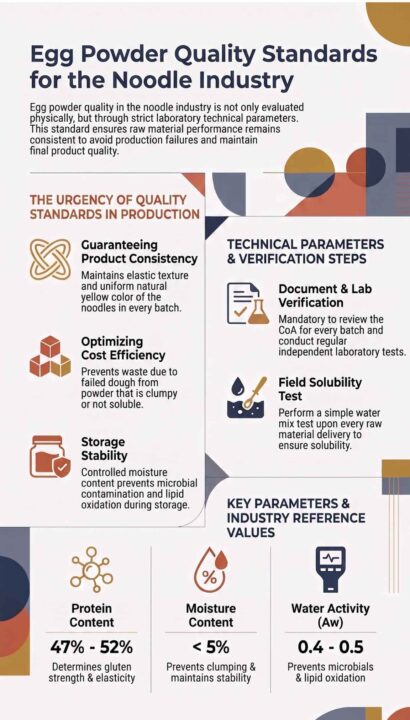
- Keeps the chewy noodle texture consistent across every production batch
- Prevents production failures caused by egg powder that doesn’t dissolve fully or clumps in the dough
- Keeps the yellow color of the noodles uniform even when egg powder comes from different delivery batches
- Reduces the risk of wasted raw material from production runs that fall short of standard
Egg Powder Quality Parameters Worth Checking
Assessing egg powder quality takes more than a visual check, since most of the parameters that matter only show up through lab testing. Here is a breakdown of the parameters commonly used as an industry reference.
| Parameter | Common Reference Value | Function for the Noodle Industry |
|---|---|---|
| Protein content | About 47% to 52% | Determines gluten network strength and chewy noodle texture |
| Moisture content | Below 5% | Maintains stability and prevents clumping |
| Water activity (Aw) | About 0.4 to 0.5 | Prevents microbial growth and fat oxidation |
| Solubility | Dissolves evenly without lumps when mixed with water | Ensures the egg powder blends fully into the dough |
| Microbial contamination | Salmonella negative, within standard microbial limits for egg products | Protects the safety of the final product |
These five parameters are interconnected and need to be met together, not just one at a time. Egg powder with high protein content but excess moisture, for example, is still prone to clumping and unreliable for large-scale production.
How to Verify Egg Powder Quality Standards From a Supplier
Maintaining quality standards doesn’t stop at setting the parameters. It also needs routine verification with the supplier. Four steps below help confirm the egg powder you receive genuinely meets the standard.
1. Request a Certificate of Analysis (CoA) for Every Batch
Ask for a CoA that lists exact figures for protein content, moisture content, and Salmonella test results for each delivery batch, not just a general statement that the product “meets standard.” Compare the figures on the latest CoA against previous batches, and question the supplier if there’s a noticeable difference, especially in protein or moisture content.
2. Run Independent Lab Testing Periodically
Send a sample from the same batch listed on the CoA to an independent food lab, then compare the results, particularly for protein and moisture content. If the independent test results differ significantly from the figures on the supplier’s CoA, consider reevaluating your relationship with that supplier.
3. Run a Water Mix Test on Every Incoming Shipment
Mix a small amount of egg powder with water following the ratio on the packaging, then check whether it dissolves evenly or clumps and settles. Good-quality egg powder forms a smooth mixture with no lumps, while a coarse texture or an unpleasant smell signals that its quality has dropped.
4. Review the Supplier’s Supporting Documents
Check the issue date and validity period on the Halal certificate, and confirm the product registration number can be verified through the relevant food safety authority’s official records. An expired document or a registration number that can’t be verified is a sign that supplier is worth avoiding.
Conclusion
Egg powder quality standards for the noodle industry cover technical parameters such as protein content, moisture content, and functional properties that shape the final production result. Ignoring these standards risks producing noodles with inconsistent texture or color.
Routine verification through a Certificate of Analysis, independent lab testing, and a water mix test helps confirm the egg powder you use genuinely meets the standard you need. Together, these steps help keep your noodle production consistent over time.
For culinary businesses or food manufacturers that need raw material with reliable quality standards for noodle production, Egg Powder from Accelist Pangan Nusantara is produced with consistent quality control across every batch. Contact Us for product information and to discuss your business’s egg raw material needs.

FAQ
Protein content in egg powder generally ranges from 47% to 52%, depending on the type and processing method.
Yes, significantly, since moisture content above 5% raises the risk of clumping and uneven mixing into the dough.
Quality standards focus on ingredient performance and consistency, while HACCP focuses on controlling food safety hazards during production.
Not all of them, so it’s worth confirming a supplier is willing to provide a CoA before entering a long-term partnership.
Frequency can be adjusted to production volume, but it’s generally done every three to six months or when switching suppliers.