
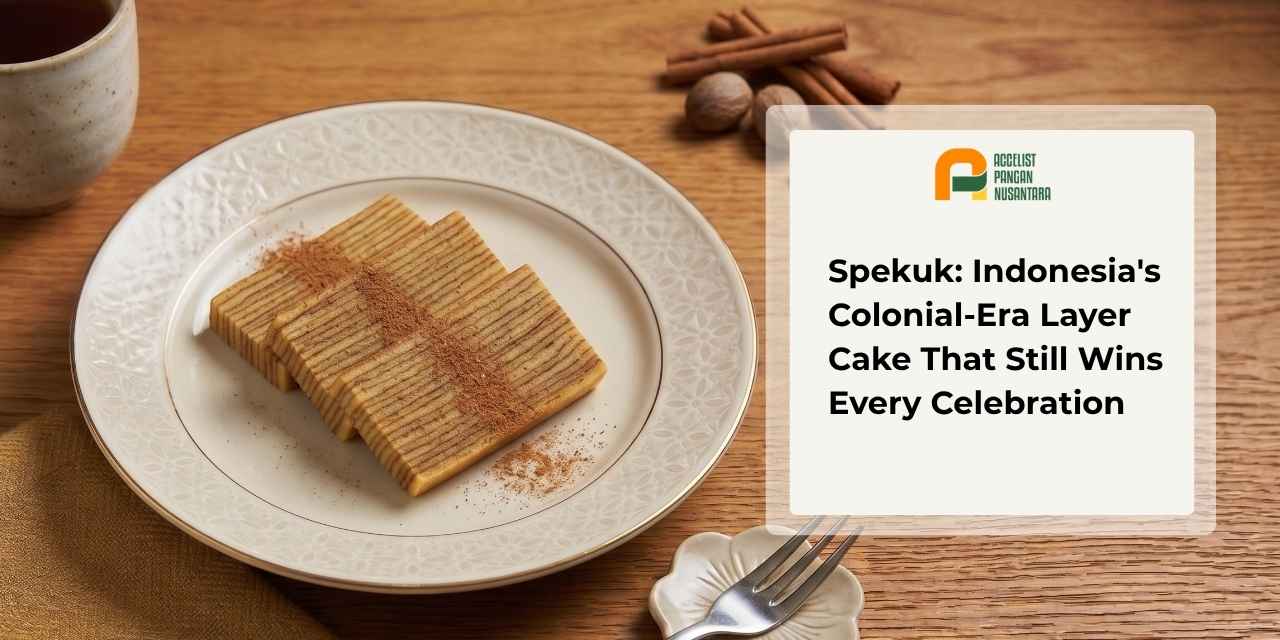
When Eid or Christmas rolls around, there’s almost always one cake that makes an uninvited appearance on the table, a golden-layered cake with a distinctive, mouthwatering aroma of spices. This cake is so iconic that people recognize it instantly just by looking at it.
But many do not know its real name, where it came from, or what makes its flavor so distinctive and difficult to replicate. That cake is spekuk, and there is quite a lot worth knowing about it.
What Is Spekuk?
Spekuk is a traditional Indonesian layer cake known for its thin, dense, golden-colored layers stacked one on top of another. In Dutch, it is called spekkoek, which literally means “layered fat cake,” a name that captures both its texture and appearance quite accurately.
The term “spekuk” also refers to the distinctive spice blend used in making this cake. That spice mixture is the source of its characteristic aroma and flavor, the element that sets spekuk apart from any other layered cake.
Each layer of spekuk is baked individually and alternated until dozens of thin layers are built up and fused together. This process demands time and patience, which is precisely what gives spekuk its special place at significant occasions.
The History of Spekuk
The history of brownies is commonly traced back to Chicago, United States, in 1893. According to the Institute of Culinary Education (ICE), Bertha Palmer requested that the chefs at the Palmer House Hotel create a chocolate dessert that was easy to serve and carry for guests attending the World’s Columbian Exposition. The result was a dense chocolate cake that is widely regarded as one of the earliest forms of the modern brownie, inspiring the many brownie variations enjoyed today.
From that fusion, spekuk took shape, the layer-by-layer baking technique from Dutch kitchens meeting the native spices of Nusantara like cinnamon, nutmeg, and cloves that had already been valuable commodities on this land for centuries.
The tradition of making spekuk did not end with the colonial era. The Dutch brought this recipe home and continued to preserve it, and to this day there is an annual festival called Tong Tong Fair in the Netherlands that features Nusantara cuisine as part of its celebration of Dutch-Indonesian cultural heritage.
The Spice Composition of Spekuk
There is no single definitive formula for spekuk spice. The composition varies from one baker to the next, but several core spices consistently appear and define its aromatic character.
Here are the spices most commonly found in a spekuk blend:
- Cinnamon as the backbone of the aroma, providing a warm, sweet depth
- Nutmeg contributing a complex, slightly peppery warmth
- Cardamom for a fresh, lighter aromatic lift
- Cloves adding a sharp, penetrating note without overpowering the rest
- Ginger bringing a gentle heat and warmth to the blend
Each spice in this mixture has its own role and complements the others. Reducing or removing even one will be immediately noticeable in the final aroma of the cake, because not a single spice here is merely decorative.
Read also: Bread Improver: Don’t Choose the Wrong One to Make Your Bread Rise Perfectly
The Difference Between Spekuk and Speculaas
Many people assume spekuk and speculaas are the same because the names sound alike. Both are products of Dutch-Indonesian culinary exchange, but their differences are quite fundamental.
Speculaas is a crispy spiced biscuit from the Netherlands, typically eaten as a daily snack and closely associated with Christmas celebrations there. Here is a clear comparison between the two:
| Aspect | Spekuk | Speculaas |
| Final form | Layered cake (lapis legit) | Crispy biscuit |
| Number of spices | 4 to 5 varieties | Up to 11 or more |
| Texture | Soft, dense, layered | Dry, crunchy |
| Occasion | Festive cake for holidays and family gatherings | Daily snack, tied to Christmas in the Netherlands |
Speculaas uses a far broader range of spices, including star anise, coriander, black pepper, and bay leaves that have no place in spekuk. So while both carry a rich spiced aroma, their identities are completely distinct.
Tips for Choosing and Storing Spekuk Spices
The quality of the spices used directly determines the final result of the cake. Before buying, there are a few things worth checking to avoid the wrong choice.
- Check the color: Quality spekuk spice tends to be dark and deep in tone, not pale or faded brown. A washed-out color usually indicates the spice has been stored too long or the quality has declined.
- Smell the aroma: Good spice has a strong, sharp, layered aroma when smelled up close. If the fragrance is faint or barely detectable, its intensity has already diminished.
- Check the production date: Spices can lose their potency well before their official expiry date, so always opt for products with a more recent production date.
- Consider ready-to-use blends for convenience: Pre-mixed spekuk blends are now widely available at baking supply stores and supermarkets, offering a practical option with reasonably consistent results.
How to Store Spekuk Spices to Preserve Their Aroma
Good spices can lose their fragrance quickly if they are not stored properly. A few simple steps make a real difference in keeping their quality intact.
- Use an airtight container: Air exposure accelerates the evaporation of aromatic compounds in spices, so avoid leaving them in opened packaging or loosely sealed containers.
- Keep away from direct sunlight: Light and heat speed up the breakdown of aromatic compounds. Store in a cool, dark place such as a cabinet or kitchen drawer.
- Avoid storing near the stovetop: Heat and moisture from cooking can seep into the container and degrade the spice quality faster than expected.
With proper storage, the aroma of spekuk spices can last up to six months after the package has been opened.
Read also: 7 Ways to Store Eggs Properly to Keep Them Fresh and Safe to Eat
The Role of Egg Yolks in Spekuk
Beyond the spices, there is one other ingredient that matters just as much in determining the quality of spekuk: egg yolks. A classic spekuk recipe can call for 20 to 30 egg yolks per standard-sized pan, and that number is not arbitrary.
Egg yolks serve three functions simultaneously: producing the characteristic golden color in each layer, forming the dense yet tender texture that defines spekuk, and delivering a depth of richness that no other ingredient can replicate. All three work together, which is why significantly reducing the yolk count will immediately affect the final result of the cake.
For those making spekuk at a larger scale, or simply looking for a more efficient approach without cracking dozens of eggs individually, egg yolk powder from Accelist Pangan Nusantara offers a reliable solution. Compared to fresh egg yolks, egg yolk powder brings several practical advantages:
- More consistent content levels with each use, resulting in more stable cake outcomes
- Significantly longer shelf life without the risk of spoilage that comes with fresh eggs
- More hygienic because it undergoes a standardized processing procedure.
- Easier to store and handle in both home kitchens and larger production facilities
Read also: Egg Powder: A Versatile Food Ingredient in the Production Process
Conclusion
Spekuk is a culinary legacy shaped by centuries of two cultures meeting, and the fact that this cake still appears on Indonesian tables today proves how deeply its flavor identity has taken root in tradition. It is not simply a layered cake; it is the result of technique, spices, and ingredients that each carry a role that cannot be ignored.
Understanding spekuk means understanding that every detail matters, from the choice of spices to the quality of the egg yolks, and that each element has a direct impact on the final result. There are no shortcuts for a cake that was born from patience and precision.
For those looking to make spekuk at home or seeking a more efficient ingredient solution, egg yolk powder from Accelist Pangan Nusantara is a practical choice that does not compromise on quality. Consistent content, easy storage, and results that remain authentic make it a relevant solution for both home bakers and larger-scale production alike. For more information or to place an order, feel free to Contact Us and our team will be happy to help.
FAQ
Spekuk and lapis legit refer to the same cake. “Spekuk” comes from the Dutch word spekkoek, while “lapis legit” is its Indonesian name.
It depends on the number of layers, but typically between 2 and 4 hours since each layer is baked individually.
Technically yes, but the result would not be called spekuk. The spices are part of the cake’s identity, not just an optional flavoring.
Egg yolks produce the golden color, soft dense texture, and rich flavor characteristic of lapis legit. Without enough yolks, the result will differ significantly from an authentic spekuk.