
Japanese cuisine is celebrated worldwide not only for its flavors, but also for the depth of tradition and philosophy woven into each dish. From sushi to ramen, every serving carries a long story about Japanese culture and way of life.
Among the many donburi dishes, oyakodon is one of the most commonly found on Japanese restaurant menus, particularly in the comfort food and quick-service category. The name may sound unfamiliar at first, but it carries a meaning far more unexpected than most would guess.
What Is Oyakodon?
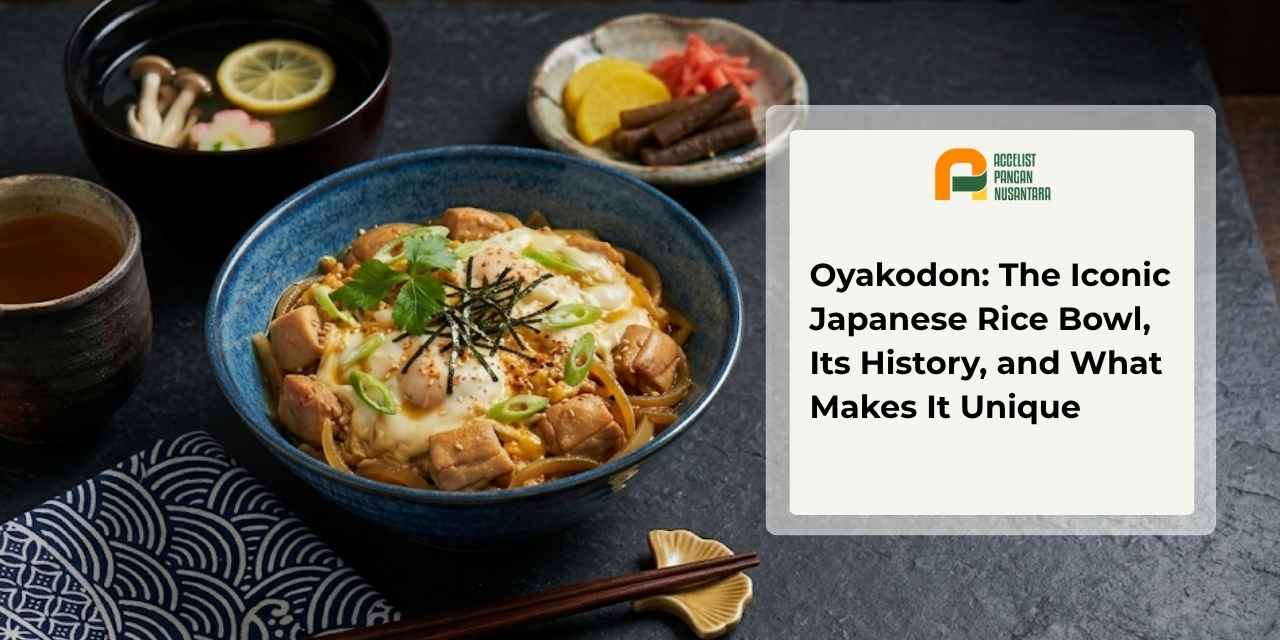
Oyakodon is a Japanese donburi (rice bowl) dish made of chicken and egg cooked together in a sweet-savory broth, then served over steamed white rice. For the Japanese, this dish is more than a convenient lunch option, as the name and combination of its ingredients hold meaning that goes well beyond taste alone.
The word “oyakodon” is built from three Japanese components: “oya” (親) meaning parent, “ko” (子) meaning child, and “don” as a shortened form of “donburi,” referring to a bowl of rice. Together, they literally translate to “parent-and-child rice bowl,” because the dish pairs chicken (the parent) with egg (the offspring) in a single serving.
As a point of comparison: very few dishes from other culinary cultures explicitly immortalize a biological relationship between their ingredients directly in the dish’s name.
Read also: A Delicious and Easy Oyakodon Recipe: Japanese Comfort Food You Can Make at Home
Characteristics of Oyakodon
Oyakodon has several defining features that set it apart from other Japanese rice bowl dishes. Recognizing these characteristics helps explain why it holds a distinct appeal among the many varieties of donburi available.
Here is what makes oyakodon easy to identify:
- Semi-runny egg texture: The egg is not cooked all the way through, but left partially set so it remains silky and tender with every bite.
- Dashi-based broth: A stock made from kombu seaweed and bonito flakes, combined with Japanese soy sauce (shoyu) and mirin, creates a distinctly savory-sweet flavor profile.
- Broth absorbed into the rice: The rice does not simply serve as a base, but absorbs the broth so each spoonful is rich in flavor without needing additional sides.
- Served hot in a bowl: Oyakodon is always plated immediately after cooking to preserve the soft texture of the egg.
Read also: Tamagoyaki: The Japanese Rolled Egg That’s More Complex Than It Looks
The History of Oyakodon in Japan
Oyakodon did not emerge without a clear historical record. Its origins trace back to a historic restaurant in central Tokyo that has been standing for nearly three centuries, the very place where this dish was first created before spreading across Japan.
According to records from the Japanese Ministry of Agriculture, Forestry and Fisheries (MAFF), oyakodon originated from the habit of a customer at Tamahide restaurant in Tokyo who would combine leftover chicken and warishita seasoning with egg over rice. According to Deep Tokyo, Tamahide was established in 1760, though oyakodon itself is believed to have developed and gained recognition as a dish during the Meiji period (around the late 19th century).
What began as a simple, informal habit was later formalized into an official menu item by Tamahide. The dish was initially offered as a delivery service before eventually being served inside the restaurant, as demand from customers steadily grew.
After more than 130 years, Tamahide restaurant continues to operate and remains a popular destination. The long queues outside its doors, even on ordinary days, are proof that the original version of oyakodon has never lost its following.
Tips for a More Authentic Oyakodon
Many first attempts at cooking oyakodon result in overcooked egg or a flat-tasting broth. The three points below target the most commonly overlooked details, including an aspect of equipment that rarely gets discussed.
1. The Key to a Soft Egg Texture
The key to achieving the ideal egg texture in oyakodon is stopping the cooking process before the egg sets completely. Once the edges begin to firm up while the center remains slightly loose, turn off the heat and cover the pan so the residual warmth finishes the process gradually.
If the egg is left over heat until it resembles a fully cooked omelette, the result loses the softness that is central to what makes oyakodon distinctive.
2. How to Get the Most Out of the Broth
Dashi is the flavor foundation that separates authentic oyakodon from a flat, underwhelming version. Instant dashi in powder or sachet form is widely available at Asian grocery stores and many modern supermarkets, so there is no need to make it from scratch.
If dashi is unavailable, a light, unseasoned chicken stock makes a reasonable substitute. Avoid heavily spiced broths, as strong flavors can overpower the characteristic sweet-savory balance of oyakodon.
3. The Oyako Nabe Pan
An oyako nabe is a small, shallow pan with an upward-facing handle, designed specifically to cook a single portion of oyakodon. Its compact shape ensures even heat distribution across all ingredients, making the signature egg texture easier to achieve than with a standard pan.
According to Japanese Station, this pan is available at major supermarkets and 100-yen stores throughout Japan. As an accessible alternative, a small non-stick pan around 18 cm in diameter can produce reasonably comparable results.
Conclusion
Oyakodon is far more than a simple rice bowl. The combination of chicken, egg, and dashi broth, seemingly straightforward, carries a long history and a strong thread of Japanese cultural philosophy, making it a culinary landmark that has outlasted trends since the 19th century.
Understanding oyakodon through its name, history, and cooking process gives the dish a different kind of weight. Every bowl served is not just about flavor, but about a culinary tradition that has been carefully preserved for more than a century.
For food service businesses and culinary producers looking to deliver oyakodon at scale with consistent results, Mix Egg Powder from Accelist Pangan Nusantara offers a practical substitute for whole eggs with reliable texture and flavor in every batch. Contact us for product information and availability.
FAQ
Oyakodon uses chicken and egg, while katsudon uses tonkatsu (breaded and fried pork cutlet) also served with egg over rice.
Mirin can be substituted with a mixture of one tablespoon of sugar and one tablespoon of water.
Oyakodon provides protein from chicken and egg alongside carbohydrates from rice, making it a reasonably balanced everyday meal.
Boneless chicken thigh is recommended over breast meat for its softer texture and lower tendency to dry out during cooking.
Oyakodon is best eaten immediately, but can be kept in a sealed container in the refrigerator for up to one day.