
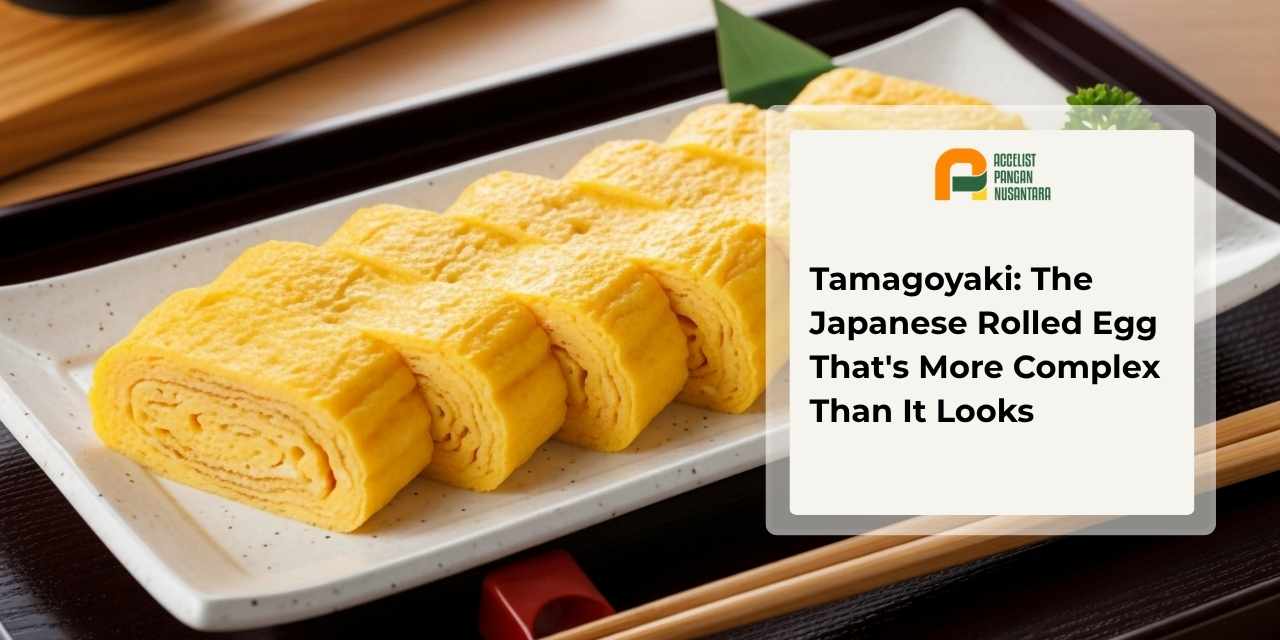
Eating at a Japanese restaurant, whether in Tokyo or your own city, almost always holds a small surprise on the table. There is miso soup, steamed rice, grilled fish, and tucked into the corner of the plate or bento box, a neat golden-yellow rectangular block of egg that most people walk right past.
That block is tamagoyaki. Not a fried egg, and not a regular omelet. Behind its plain appearance is a layered cooking technique, an unexpected flavor, and a history that stretches back centuries.
What is Tamagoyaki?
Tamagoyaki is a layered Japanese rolled omelette made from eggs seasoned with simple ingredients like sugar, salt, mirin, and dashi stock. The batter is poured thin into a hot pan, rolled before it fully sets, and the process is repeated four to six times until the layers build up. The result is a dense, soft rectangular block that balances sweet and savory in the same bite.
The name “tamagoyaki” comes from two Japanese words. “Tamago” means egg, and “yaki” means grilled or pan-fried directly over heat. The word “yaki” also appears in yakitori (grilled chicken skewers) and yakisoba (fried noodles). Literally, tamagoyaki means “grilled egg,” but in Japanese cuisine the term refers specifically to this layered rolled omelet and the technique that defines it.
Read also: A Must-Try Recipe for Soft, Sweet, and Savory Japanese-Style Tamagoyaki
The History of Tamagoyaki in Japanese Cuisine
For centuries, the Japanese did not eat eggs due to prohibitions rooted in Buddhist teachings. Egg consumption only began to spread in the early Edo period (1603 to 1868), when those prohibitions were lifted alongside the influence of the Nanban trade with Portuguese and Spanish merchants.
Around that time, a dish called “tamago fuwafuwa” emerged: eggs poured into hot broth and steamed until light and airy. This is considered the predecessor of modern tamagoyaki, as documented by Japan’s Ministry of Agriculture, Forestry and Fisheries (MAFF).
The layered rolling technique developed afterward, and the tamagoyaki known today is estimated to have gained wide popularity around 100 years ago. Over time it became a home-cooking staple passed down through generations. The ability to roll tamagoyaki neatly is even considered a benchmark of basic culinary skill for Japanese cooks.
Types of Tamagoyaki Worth Knowing
There are several common variations of tamagoyaki. The main differences lie in the seasoning and the liquid ratio in the egg batter.
1. Atsuyaki Tamago
Atsuyaki tamago uses simple seasoning of sugar and salt, with no added stock. Its low liquid ratio produces a firmer, more compact result that holds its shape cleanly when sliced. This is the most common version found in bento boxes and the recognized standard in the Kanto region, including Tokyo.
2. Dashimaki Tamago
Dashimaki tamago uses dashi stock, mirin, and sugar as its main seasonings, with a higher liquid ratio. The result is softer and slightly moist on the inside, which demands more technical skill to roll without tearing. In the Kansai region, including Osaka and Kyoto, this version is more widely made than atsuyaki.
3. Kushi Dama Tamago
Kushi dama tamago is tamagoyaki skewered in small bite-sized portions. It is more a variation in serving format than a distinct recipe. Its popularity grew from the mid-2010s onward as a street food at Japanese-themed food festivals and night markets across Asia.
What Makes Tamagoyaki Different
Tamagoyaki is not simply a rolled-up fried egg. Several things genuinely set it apart from other egg dishes.
1. Layer-by-Layer Cooking
The defining texture of tamagoyaki comes from its step-by-step process. Each thin layer is cooked until just set, rolled to one side, and a fresh layer is poured in and rolled again. That layered structure shows clearly when the roll is cut crosswise, and it cannot be replicated with standard omelet technique.
2. A Balance of Sweet and Savory
Adding sugar to an egg batter feels unfamiliar to many people encountering it for the first time. But that balance of sweet and savory is exactly what defines tamagoyaki’s flavor profile and makes it approachable across all age groups. Some versions also draw umami from dashi stock, giving the final result more depth than the ingredient list suggests.
3. An Even Golden-Yellow Color
The bright, even color of tamagoyaki is not just about appearance. It is also a marker of correct heat. Too high and the surface browns in patches; too low and the layers fail to bond properly. In the context of bento, a consistent yellow color also makes the lunchbox look more visually appealing.
Read also: Cooking Techniques Explore: Five-Star Kitchen Secrets and Ingredients Management
The Role of Tamagoyaki in Japanese Cuisine
Tamagoyaki appears across nearly every level of Japanese food culture, from everyday school lunches to high-end sushi restaurants.
1. A Core Component of the Bento Box
In Japanese bento tradition, tamagoyaki is almost always present as a staple side. Its rectangular shape fits neatly into compartmentalized boxes, its mild flavor pairs well with other sides, and its ability to hold up for several hours at room temperature makes it a reliable daily choice.
2. Tamago Nigiri in Sushi
In the world of sushi, tamagoyaki is served as tamago nigiri, a piece of tamagoyaki placed over an oval mound of seasoned rice. At many Japanese sushi restaurants, the ability to produce a neat, tender tamago nigiri is used as a measure of an itamae’s (sushi chef’s) overall skill. What is in that single piece says a great deal about the kitchen as a whole.
3. An Everyday Home Side Dish
In Japanese households, tamagoyaki is a practical side for both breakfast and dinner. The ingredients are easy to source, cooking time is short, and the result consistently works for all ages.
Tamagoyaki Nutrition Facts
Tamagoyaki is a good source of protein given that eggs are its primary ingredient. Its sodium content can run fairly high if the recipe uses significant amounts of soy sauce or salt, so portion size should be adjusted to individual daily needs.
Here is the nutritional content of tamagoyaki per 100 grams:
| Nutrient | Amount per 100 g |
| Calories | 154 kcal |
| Protein | 9.8 g |
| Fat | 10.3 g |
| Carbohydrates | 3.1 g |
| Sodium | ±300 mg |
| Calcium | 40 mg |
| Iron | 1.2 mg |
| Vitamin D | 40 IU |
Source: SnapCalorie (based on USDA data)
The Difference Between Tamagoyaki and a Regular Omelet
On the surface, tamagoyaki and an omelet look similar because both are egg-based. But the way each is made differs considerably, and that difference produces an entirely distinct texture, shape, and eating experience.
Tamagoyaki
Tamagoyaki is built through a stepwise rolling process, layer by layer, with no additional fillings mixed into the base batter. Each layer is cooked separately and rolled over the previous one until a firm, distinctive block takes shape.
- Batter is poured thin and rolled in stages, repeated 4 to 6 times
- No fillings inside the batter
- Final shape is firm, rectangular, and layered
- Cross-section reveals rings similar to tree growth rings
Omelet
An omelet is cooked in a single step, and fillings can be mixed directly into the batter from the start. There is no layered rolling technique, and its final shape is more free-form.
- Batter cooked all at once with no repeated steps
- Can include cheese, meat, vegetables, or other ingredients
- Final shape is free-form, usually folded or flipped
- No structured layering inside
Read also: Egg Yolk: Nutritional Facts About Egg Yolks That Are Much Healthier
Conclusion
Tamagoyaki is proof that simple ingredients, handled with the right technique, can produce something far more meaningful than they first appear. The dish grew out of the everyday kitchens of Edo-period Japan and now appears on sushi menus around the world.
Understanding tamagoyaki is not only about knowing how it is made. Each layer reflects precision and care, and each slice carries a culinary history longer than most people realize.
For a more practical way to make tamagoyaki at home, Tepung Telur Mix by Accelist Pangan Nusantara is an egg powder alternative that still produces the soft, layered texture tamagoyaki is known for, with its protein content preserved. Contact us for more information, and the Accelist Pangan Nusantara team will be ready to assist you.
FAQ
Not necessarily. A rectangular tamagoyaki pan does make rolling easier, but a standard round pan can still produce results that are not far off.
Cooked tamagoyaki can be stored in a sealed container in the refrigerator for 2 to 3 days.
Yes, particularly atsuyaki tamago, which is sweeter and has a firmer texture. It can be cut into small pieces as needed.
Yes. Egg powder is a practical substitute, especially for large-volume production or when fresh eggs are not available in optimal condition.