
Food manufacturers rely on egg yolk powder for more than just flavor and color. Its real value lies in its ability to bring together ingredients that naturally resist mixing, such as oil and water. That function makes it a go-to ingredient in mayonnaise, sauces, and cake batter.
Egg yolk contains about 29% phospholipids of its total fat content, the compound behind most of its emulsifying power. That content works alongside low-density lipoprotein (LDL), which further reinforces the stability of the emulsion that forms.
This article covers how egg yolk powder functions as a natural emulsifier, from the underlying mechanism to its applications across different food products. You will also find tips for getting the most out of this emulsifying function in your own production.
What Is an Emulsifier, and How Does Egg Yolk Fit In?
An emulsifier is an ingredient that helps bring together two liquids that don’t naturally mix, such as oil and water, by reducing the surface tension between them. Egg yolk counts as a natural emulsifier that has been used in cooking and food manufacturing long before synthetic emulsifiers became widespread.
Egg yolk is naturally structured as an emulsion itself, made up of oil droplets dispersed through a water-based phase, so that property carries over when it’s used to bind other ingredients together. That characteristic is what keeps egg yolk, whether fresh or in powder form, effective as a natural emulsifier.
How Does Lecithin in Egg Yolk Work as an Emulsifier?
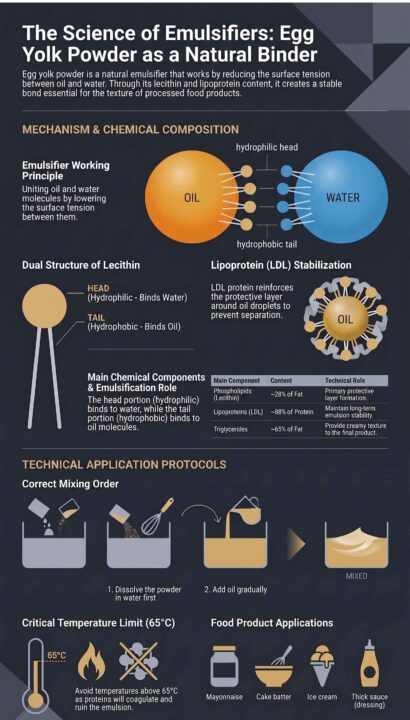
Lecithin is the main component responsible for egg yolk’s emulsifying ability. Here is a breakdown of the mechanism across four key steps.
- Lecithin has a dual structure, with a head that’s attracted to water (hydrophilic) and a tail that’s attracted to oil (hydrophobic)
- The hydrophobic end of lecithin attaches itself to oil droplets, while the hydrophilic end faces the surrounding water phase
- This arrangement forms a protective layer around each oil droplet, keeping them from merging back together and separating
- Low-density lipoprotein (LDL) in egg yolk further reinforces the stability of that protective layer
What in Egg Yolk Powder Supports Its Emulsifying Function?
Egg yolk powder’s emulsifying ability comes down to a chemical makeup dominated by specific fats and proteins. Here is a breakdown of the components behind that function.
| Component | Percentage | Role in Emulsification |
|---|---|---|
| Phospholipids (including lecithin) | About 29% of total fat | Forms a protective layer between oil and water |
| Triglycerides | About 65% of total fat | Contributes a creamy texture to the emulsion |
| Low-density lipoprotein (LDL) | About 68% of total protein | Reinforces long-term emulsion stability |
| High-density lipoprotein (HDL) and livetin | About 26% of total protein | Supports the overall protein structure |
That combination of phospholipids and lipoproteins is what keeps egg yolk, whether fresh or dried, effective as an emulsifier even after going through the drying process. Food industry research has found no meaningful difference in emulsifying properties between dried egg yolk powder and fresh liquid egg yolk.
Where Is Egg Yolk Powder Used as an Emulsifier in Food Products?
Egg yolk powder’s emulsifying function gets put to use across a wide range of processed food categories. Here are four of the most common applications.
- Mayonnaise and salad dressing, which rely on egg yolk to bind oil and vinegar into a stable mixture
- Cake batter, where egg yolk helps distribute fat evenly throughout the mix
- Ice cream, which needs an emulsifier to keep ice crystals from growing too large
- Cream sauces and other thick dressings that need a smooth, stable texture
Tips for Getting the Most Out of Egg Yolk Powder’s Emulsifying Function
Egg yolk powder’s emulsifying function only performs at its best when used the right way. Four tips below help you get the most out of it.
1. Dissolve the Egg Yolk Powder Before Adding Oil
Mix egg yolk powder with water first until fully dissolved before adding oil gradually. This helps lecithin work at its best in forming a protective layer around each oil droplet.
2. Add the Oil Gradually
Pour the oil in small amounts while continuously stirring, rather than adding it all at once. Gradual addition gives lecithin time to coat each oil droplet before the next one is added.
3. Watch the Temperature During Mixing
Avoid overly high temperatures when mixing egg yolk powder with other ingredients, since its protein can start clumping at around 65°C (149°F). Room temperature or slightly warm conditions are generally safer for keeping the emulsion stable.
4. Store the Finished Emulsion Somewhere Cool
Keep finished products like mayonnaise or sauce refrigerated to maintain emulsion stability for longer. Exposure to high heat after the emulsion has formed risks letting the oil and water separate again.
Conclusion
Egg yolk powder functions as a natural emulsifier thanks to its lecithin and lipoprotein content, which can bind oil and water into a stable mixture. That function stays intact even after egg yolk goes through the drying process into powder form.
Understanding the mechanism and how to get the most out of this emulsifying function helps food manufacturers produce a more stable, consistent texture. The right approach, from dissolving the powder properly to controlling temperature, determines how well the resulting emulsion holds up.
For culinary businesses or food manufacturers that need raw material with a reliable emulsifying function, Egg Powder from Accelist Pangan Nusantara offers quality egg yolk content to support your product’s stability. Contact Us for product information and to discuss your business’s egg raw material needs.

FAQ
Yes, research shows no meaningful difference in emulsifying properties between egg yolk powder and fresh egg yolk.
Because the lecithin and lipoproteins responsible for emulsification are found mostly in the yolk, not the egg white.
It can for many applications, especially products aiming for a natural-ingredient label, though performance can vary depending on the final product.
Ideally below 65°C (149°F), since the protein in egg yolk risks clumping and disrupting emulsion stability above that point.
Most do, though there are also low-cholesterol or vegan mayonnaise variants that use alternative emulsifiers instead of egg yolk.